
What Is a TIE Card? Apply Within 30 Days or Face Fines
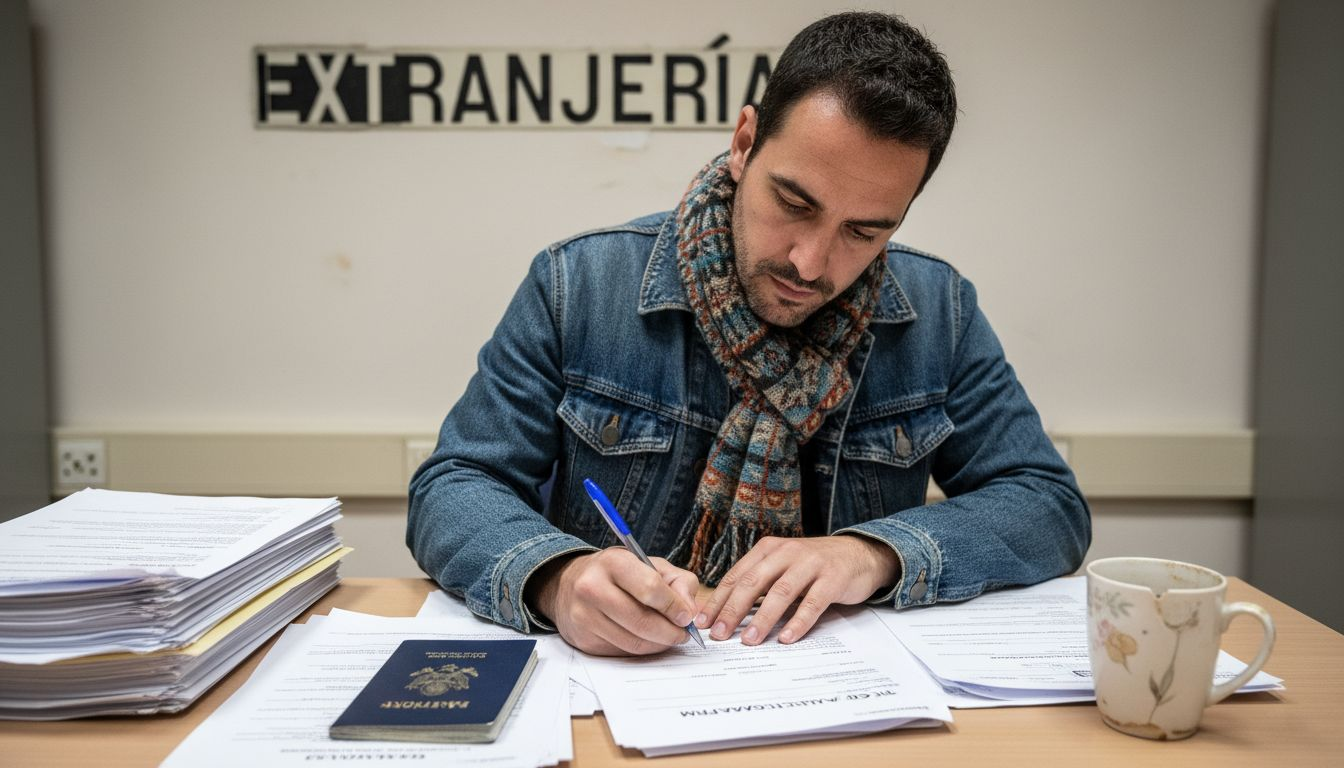
Many expatriates believe that obtaining an NIE number is enough to establish legal residency in Spain. This misconception can lead to serious compliance issues and legal penalties. The TIE card is actually the mandatory physical residency identification required for all non-EU nationals planning to stay longer than six months. This guide will clarify exactly what a TIE card is, walk you through the application process step by step, and help you avoid the most common pitfalls that delay or derail applications.
Table of Contents
- Introduction To The TIE Card In Spain
- Why Is The TIE Card Essential For Expatriates?
- Step-By-Step TIE Card Application Process
- Common Misconceptions And Pitfalls In TIE Card Applications
- Renewal And Replacement Of The TIE Card
- Tips For A Smooth TIE Card Application With Legal Assistance
- Simplify Your TIE Card Journey With Vive Legal
- Frequently Asked Questions About The TIE Card
Key Takeaways
| Point | Details |
|---|---|
| Mandatory ID | TIE card is the required physical residency ID for non-EU nationals staying over 6 months in Spain |
| 30-Day Deadline | You must apply within 30 days of arrival to avoid legal penalties and fines |
| Essential Access | The card enables healthcare, employment rights, and tax system integration |
| Renewal Required | Card must be renewed before expiration to maintain continuous legal residency |
| Professional Help | Legal services reduce application errors and speed processing times significantly |
Introduction to the TIE Card in Spain
The TIE card (Tarjeta de Identidad de Extranjero) is a physical plastic residency card issued to non-EU nationals who plan to reside in Spain for more than six months. Unlike the NIE number, which is simply an identification number used for various administrative procedures, the TIE card is legally required under Spanish immigration law as proof of your residency status.
Living legally in Spain shouldn't be difficult.
View services and pricesNot sure which procedure you need? Find out in 2 min
Questions? Message us on WhatsApp
The card contains biometric data including your photograph and fingerprints. It displays your NIE number prominently, but the two documents serve different purposes and are not interchangeable. Understanding the distinction between NIE and TIE is crucial for maintaining legal compliance.
Local police stations (Oficina de Extranjería) issue TIE cards after verifying your residency authorization. The card proves your legal status when accessing services, opening bank accounts, or during routine identity checks. Without this physical card, you cannot fully exercise your residency rights even if you hold a valid visa or NIE number.
Key characteristics of the TIE card include:
- Biometric security features including fingerprints and facial recognition data
- Your unique NIE number printed on the front
- Validity period matching your residency authorization type
- Machine-readable chip containing encrypted personal information
- Official government watermarks and security holograms
Why is the TIE Card Essential for Expatriates?
The TIE card unlocks your ability to function legally as a resident in Spain. Without it, you face significant barriers to everyday life and risk serious legal consequences. The card is essential for accessing healthcare through the Spanish public system, registering with social security, and exercising your right to work legally.
Employers cannot legally hire you without a valid TIE card, regardless of your visa status. Banks require the card to open resident accounts with favorable terms. Tax authorities need it to process your declarations correctly and assign you to the appropriate tax regime.
Failure to obtain your TIE card within the required timeframe results in fines ranging from €500 to €10,000 depending on the severity. Repeated violations can lead to residency revocation and deportation proceedings. Even minor delays create complications when renewing visas or applying for permanent residency later.

The card links your physical identity to your legal residency status in government databases. This connection ensures that your rights and obligations are properly tracked across healthcare, taxation, and legal systems. Without this linkage, you exist in a gray area that creates problems at every official touchpoint.
Critical uses of your TIE card:
- Proving legal employment eligibility to Spanish employers
- Accessing public healthcare services and obtaining your health card
- Opening bank accounts with resident status and better terms
- Registering vehicles and obtaining a Spanish driver’s license
- Filing annual tax returns and claiming resident tax benefits
Pro Tip: Always carry your TIE card with you as Spanish law requires residents to present identification when requested by authorities. Failure to produce the card can result in temporary detention until your status is verified.
Step-by-Step TIE Card Application Process
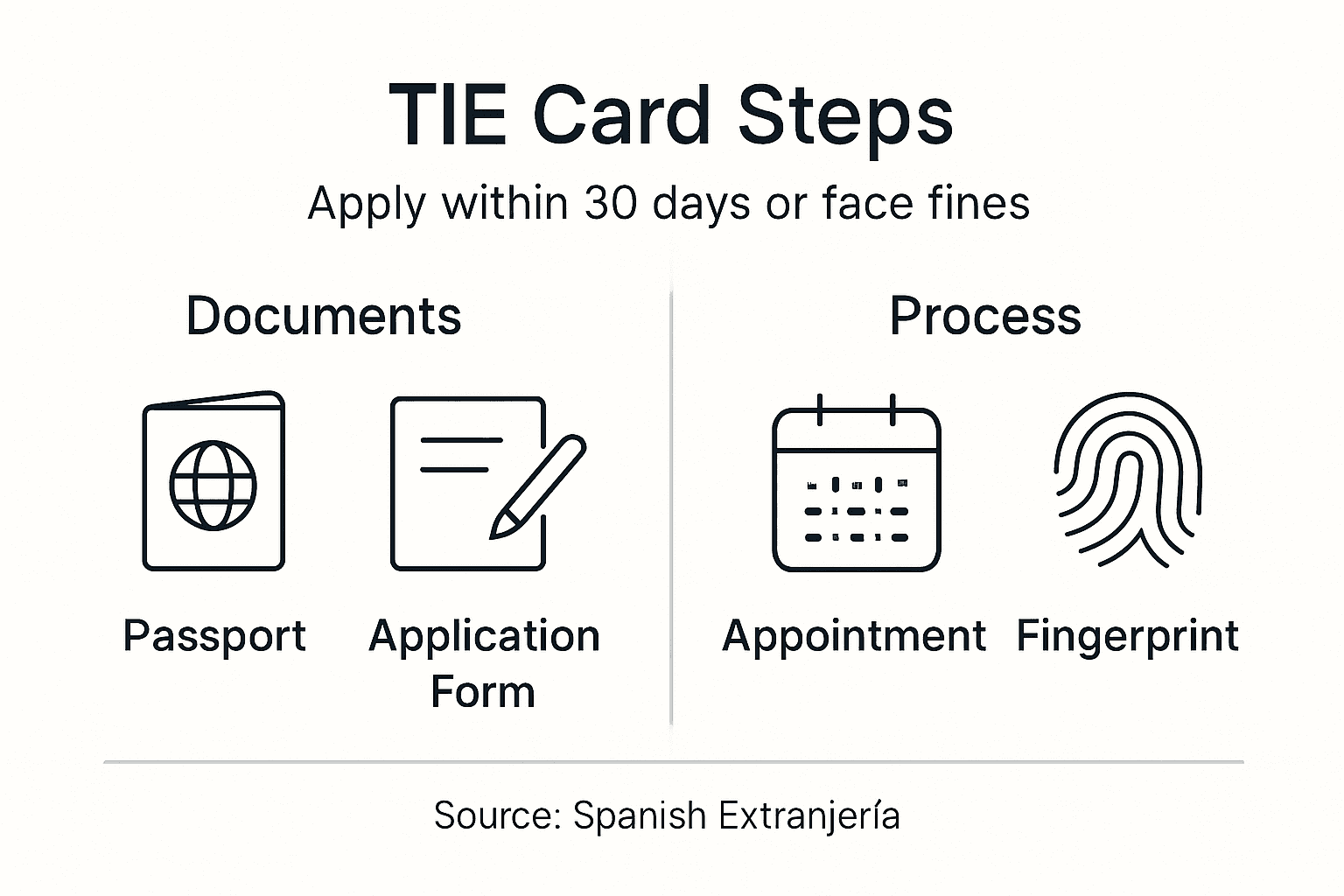
Securing your TIE card requires careful attention to deadlines and documentation. You must apply within 30 calendar days of your arrival in Spain to remain compliant with immigration law. Missing this deadline triggers penalties and complicates your residency status.
The process begins with scheduling a biometric appointment at your local police station. Appointments fill quickly in major cities, so book as soon as you arrive. Some regions allow online scheduling while others require phone calls or in-person requests.
Follow these steps for a successful application:
- Schedule your appointment at the Oficina de Extranjería within one week of arrival
- Gather all required documents and make certified copies as needed
- Complete the EX-17 form accurately with no errors or omissions
- Pay the application fee at a designated bank and obtain the receipt
- Attend your appointment with all original documents and copies
- Submit to biometric data collection including fingerprints and photograph
- Receive your collection receipt with tracking number and estimated date
- Check application status online using your reference number
- Collect your TIE card in person with your passport and collection receipt
Required documents include:
- Valid passport with entry stamp showing arrival date within 30 days
- Original Spanish visa or residency authorization document
- Completed EX-17 application form with original signature
- Recent proof of address (empadronamiento certificate or rental contract)
- Payment receipt for the processing fee (approximately €12-€16)
- One recent passport photo meeting official specifications
- NIE assignment document if previously obtained
Processing typically takes 20 to 30 business days from submission. Detailed guidance on document preparation can prevent common errors. If you need help with related procedures, explore NIE applications or arraigo processes that may affect your timeline.
Pro Tip: Double-check that your empadronamiento certificate is dated within the last three months before your appointment. Outdated certificates are the most common reason for application rejection.
Common Misconceptions and Pitfalls in TIE Card Applications
Many expatriates confuse the NIE number with the TIE card, assuming that obtaining one eliminates the need for the other. The NIE is simply an identification number used for tax and administrative purposes, while the TIE card is the physical proof of your residency authorization. You need both, and they serve completely different functions.
| Aspect | NIE Number | TIE Card |
|---|---|---|
| Purpose | Tax and administrative ID | Physical residency proof |
| Format | Number only on paper | Plastic card with biometrics |
| Who needs it | Anyone doing business in Spain | Non-EU residents over 6 months |
| Validity | Permanent number | Expires with residency period |
| Where issued | Police or consulate | Police station in Spain only |
The 30-day application deadline is strictly enforced. Applying for your TIE card after this window closes requires explaining the delay and may result in fines. Some applicants mistakenly believe the 30 days starts from visa approval rather than physical arrival in Spain. The clock begins ticking the moment you enter the country, as evidenced by your passport stamp.
Document mistakes account for over 40% of rejected applications. Common errors include:
- Submitting expired empadronamiento certificates older than three months
- Using incorrect photo specifications (wrong size, background, or pose)
- Incomplete or unsigned EX-17 forms with missing fields
- Providing uncertified copies when originals are required
- Mismatched names between passport and supporting documents
Another frequent pitfall involves appointment scheduling. Some regions have appointment backlogs extending weeks or months. If you cannot secure an appointment within 30 days despite reasonable efforts, document your attempts with screenshots and confirmation numbers. This evidence can protect you from penalties.
Language barriers cause confusion during the appointment itself. Bring a translator if your Spanish is limited, as officials may not speak English. Misunderstanding instructions can lead to rejected applications or missed follow-up requirements.
Pro Tip: Use official government checklists from the police website for your specific province, as requirements vary slightly by region. Better yet, engage legal assistance to verify completeness before submission and avoid costly delays.
Renewal and Replacement of the TIE Card
Your TIE card is not permanent. It expires when your current residency authorization ends, typically after one, two, or five years depending on your visa type. You must renew approximately 60 days before expiration to maintain continuous legal status and avoid gaps in your residency rights.
The renewal process mirrors the initial application with updated documentation. You need proof that your circumstances still qualify you for residency, such as continued employment, ongoing studies, or sufficient financial means. Gather new evidence of address, updated financial statements, and any changed personal circumstances.
Replacement becomes necessary if your card is lost, stolen, damaged, or contains errors. Report lost or stolen cards immediately to local police and obtain an official report (denuncia). This document is required when applying for a replacement card to prevent fraud.
Renewal requirements include:
- Application submitted 60 days before current card expires
- Updated empadronamiento certificate proving current address
- Proof of continued eligibility (employment contract, enrollment certificate, financial statements)
- Recent passport photos meeting current specifications
- Payment of renewal fees
Failure to renew on time has serious consequences. Your residency status becomes irregular the moment your card expires. This triggers automatic fines and prevents you from working legally or accessing certain services. Extended lapses can result in deportation proceedings and bans on future residency applications.
Tracking your expiration date is your responsibility. Spanish authorities do not send renewal reminders. Set calendar alerts at 90, 60, and 30 days before expiration to ensure you initiate the process with adequate buffer time. Processing delays are common, so early submission protects your status.
Tips for a Smooth TIE Card Application With Legal Assistance
Navigating Spanish immigration bureaucracy alone increases your risk of errors and delays. Professional digital legal platforms reduce application mistakes by up to 30% through systematic document review and expert guidance. Processing times improve by approximately 40% when specialists manage your case from start to finish.
Legal experts keep you aware of changing requirements and deadlines specific to your situation. They review your documents before submission, catching errors that would otherwise result in rejection. Appointment scheduling assistance ensures you secure slots quickly, even in high-demand regions.
Digital platforms like Vive Legal combine technology with human expertise. Automated checklists ensure nothing is overlooked, while experienced immigration lawyers review each case personally. This dual approach minimizes human error while maintaining the judgment and flexibility only professionals provide.
Benefits of professional assistance:
- Complete document review preventing common errors
- Form preparation ensuring accuracy and completeness
- Appointment scheduling and reminder systems
- Real-time case tracking through secure client portals
- Expert consultation for complex situations
- Increased approval rates and faster processing
One Vive Legal client shared:
“I was completely lost trying to figure out the TIE card requirements on my own. The conflicting information online was overwhelming. Using professional help simplified everything. My case was ready in 24 hours, and I got my card without any complications or delays.”
Case tracking systems provide transparency throughout the process. You receive notifications at each stage, from document submission through final card collection. This visibility reduces anxiety and allows you to plan accordingly.
Pro Tip: Choose platforms offering guaranteed support and clear pricing. Digital solutions should include unlimited consultations, document revisions, and appointment rescheduling assistance without hidden fees.
Simplify Your TIE Card Journey With Vive Legal
Securing your TIE card doesn’t have to be stressful or complicated. Vive Legal offers expert, end-to-end TIE card processing with complete digital convenience. Our platform combines AI-powered document review with professional legal oversight, ensuring your application is error-free and submitted correctly the first time.
Avoid the common pitfalls that delay applications and trigger penalties. Our team handles appointment scheduling, form preparation, and document verification while keeping you informed at every step. Most cases are ready for submission within 24 hours of starting the process.
Explore our comprehensive immigration services designed specifically for expatriates in Spain. From NIE applications to permanent residency, we provide guaranteed support throughout your legal residency journey. Let us handle the bureaucracy while you focus on enjoying your new life in Spain.
Frequently Asked Questions about the TIE Card
What happens if I miss the 30-day deadline to apply for my TIE card?
Missing the deadline results in fines ranging from €500 to €10,000 depending on how long you delayed. You’ll still need to apply for the card, but must provide explanation for the delay. Repeated violations can lead to residency revocation and future visa denials.
Can I travel within the EU while waiting for my TIE card?
Yes, you can travel using your passport and visa during the processing period. However, carry your appointment confirmation and collection receipt as proof you’ve initiated the application. Some border officials may request these documents to verify your legal status.
How long does a TIE card remain valid?
Validity depends on your residency authorization type. Initial cards typically last one or two years for work or student visas. Long-term residence cards are valid for five years. The expiration date is printed clearly on the card itself.
Do I need to notify authorities if I change addresses after getting my TIE card?
Yes, you must update your empadronamiento within 30 days of moving. While the TIE card itself doesn’t change, your address must remain current in municipal records. Failure to update can complicate renewals and cause issues with healthcare or banking services.
Can my family members get TIE cards through my residency?
Dependent family members (spouse, children under 18, dependent parents) can apply for their own TIE cards based on your residency authorization. They need separate appointments and documentation proving the family relationship and your ability to support them financially.
Recommended
Living legally in Spain shouldn't be difficult.
View services and pricesNot sure which procedure you need? Find out in 2 min
Questions? Message us on WhatsApp