
What Is TIE and Why It Matters in Spain

Moving to Spain as an expatriate or international student brings a wave of excitement, but the challenge of securing the right residency documentation quickly becomes a top concern. For non-EU citizens, the TIE is not just another piece of paperwork—it’s mandatory legal proof of residence if you plan to stay over six months, linking your identity to your immigration status and access to essential services. This guide highlights what the TIE means, why it matters, and how you can simplify the process through accurate information and reliable online legal support.
Table of Contents
- Defining TIE: Foreigner Identity Card Essentials
- TIE Versus NIE and Residency Certificates
- Who Needs a TIE and When
- Required Documents and Application Steps
- Rights, Obligations, and Common Mistakes
- Renewal, Replacement, and Legal Consequences
Key Takeaways
| Point | Details |
|---|---|
| TIE Essentiality | The TIE is mandatory for foreign residents in Spain planning to stay over six months, serving as legal proof of residency. |
| Document Requirements | Gather necessary documents such as passport, visa, and proof of address before scheduling your appointment to avoid delays. |
| Rights and Obligations | TIE holders can access public services, but must carry their TIE at all times and update any personal information promptly. |
| Renewal and Replacement | TIEs expire after five years; initiation of renewal must occur three to six months prior to avoid legal issues. |
Defining TIE: Foreigner Identity Card Essentials
The TIE, or Tarjeta de Identidad de Extranjero, is Spain’s official identification document for foreign residents. If you’re an expat planning to stay in Spain for more than six months, this card becomes your legal proof of residence and your key to accessing services across the country. Unlike a tourist visa or temporary permit, the TIE is a physical card that travels with you, containing your biometric data and immigration status. Think of it as Spain’s way of saying “you’re officially here and registered with us.”
Living legally in Spain shouldn't be difficult.
View services and pricesNot sure which procedure you need? Find out in 2 min
Questions? Message us on WhatsApp
What makes the TIE essential is what it represents. Physical identity credentials like the TIE contain your photograph, fingerprints, and personal details, allowing Spanish authorities to verify your legal status instantly. For non-EU citizens, the TIE is not optional—it’s mandatory if you’re staying longer than six months. EU citizens can operate under different residency rules, but many still obtain a TIE for practical reasons. Banks want to see it when opening accounts. Employers need it for payroll documentation. Healthcare providers request it for medical records. Landlords demand it for rental agreements. Without this card, you’re essentially invisible in Spain’s official systems, and that invisibility creates real problems.
The document itself is a laminated plastic card about the size of a credit card, issued by the National Police (Policía Nacional) after you submit your application at a local police station. The process involves several steps: initial registration, biometric collection, background checks, and finally card issuance. Getting it right the first time matters because errors or missing documents can delay your approval by weeks or even months. Many expats struggle with the application process because they’re unfamiliar with Spanish administrative requirements and documentation standards. The forms must be filled correctly, photos must meet specific specifications, and supporting documents need proper apostille certification if they’re from outside Spain.
Pro tip: Organize your documents before your appointment and create copies of everything—Spanish authorities often request multiple versions of the same document, and having extras on hand prevents frustrating return trips to the police station.
TIE Versus NIE and Residency Certificates
One of the most confusing aspects of Spanish residency for expats is understanding the difference between the TIE, NIE, and residency certificates. These three documents sound similar, but they serve distinctly different purposes in Spain’s immigration system. Many people mistakenly believe they’re interchangeable, when in reality they complement each other. Getting clarity on what each document does will save you time, money, and frustration as you navigate the Spanish bureaucracy.
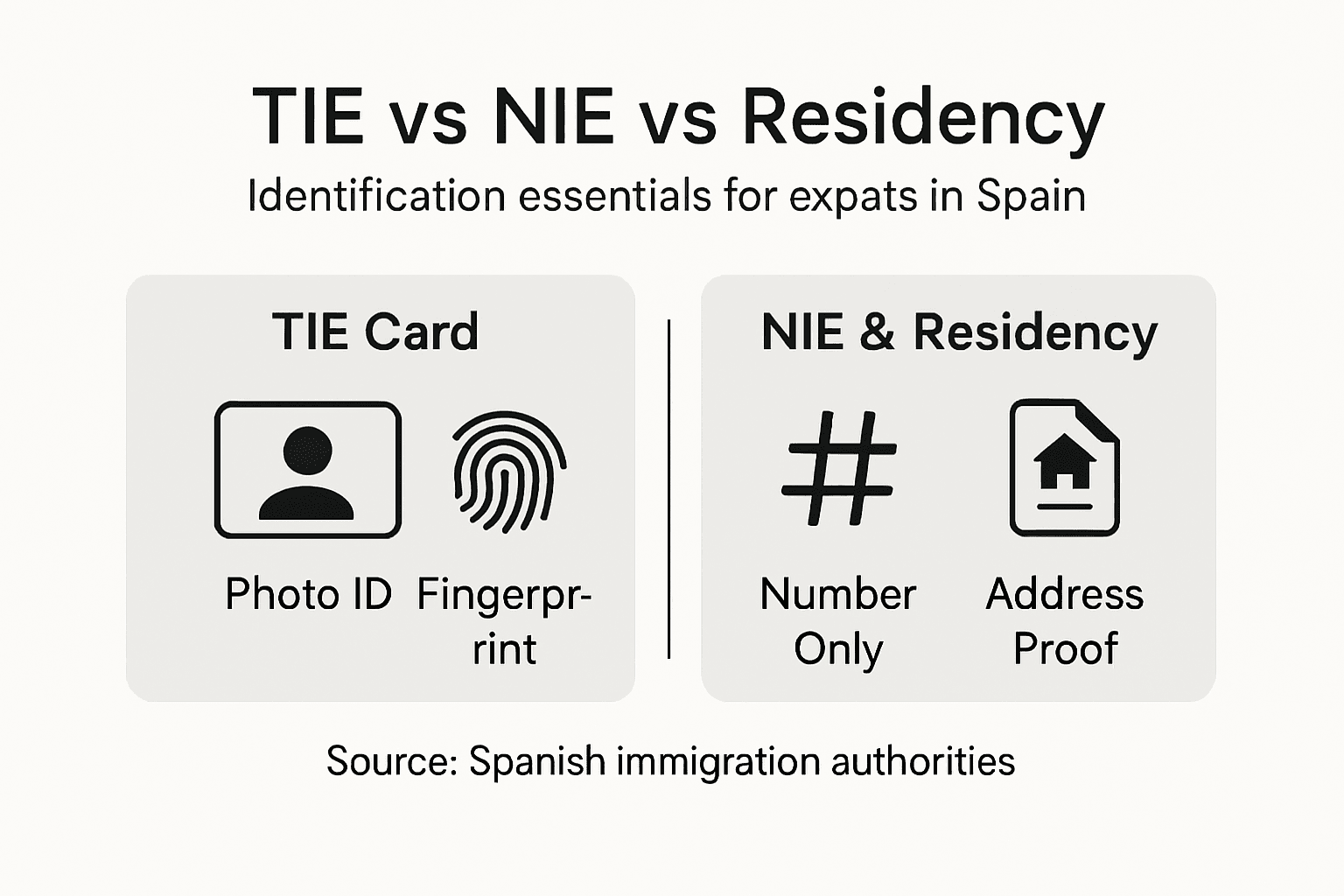
The NIE (Número de Identidad de Extranjero) is fundamentally a number, not a physical card. The NIE serves as an identification number for tax and legal purposes, issued to any foreigner who engages in economic activity in Spain, opens a bank account, or needs to register with Spanish authorities. Think of it as your tax ID in Spain. You might receive a simple paper document with your NIE number, but it’s not an official identification card. Banks use it for financial records. The taxing authority uses it to track your income. Employers need it for payroll. But the NIE alone doesn’t prove you’re legally residing in Spain. You could theoretically have a NIE and still be on a tourist visa.
A residency certificate is different again. This document, officially called a “certificado de empadronamiento,” proves where you actually live in Spain. It’s issued by your local municipal office (ayuntamiento) and simply states that you’re registered at a specific address. It’s useful for practical purposes like enrolling children in school, accessing healthcare, or proving habitual residence for administrative matters. But like the NIE, it doesn’t confer legal status. You could live in Spain illegally and still obtain a residency certificate if you’re registered at an address.
The TIE brings everything together. The TIE card physically certifies identity and legal residency status in Spain, encompassing more information than a NIE or residency certificate alone. It combines your biometric information, your photograph, your NIE number, and your visa or permit status into one official identification card. For non-EU citizens staying longer than six months, the TIE is the document that actually proves you have the legal right to be in Spain. It’s the comprehensive proof that connects your identity to your legal status.
Here’s the practical breakdown:
- NIE: Just a number for tax and administrative identification
- Residency certificate: Proof of where you live locally
- TIE: Complete identification card proving legal residency status
Most expats need all three at different times. You’ll get a NIE early in the process. You’ll obtain a residency certificate when you register with your municipal government. And you’ll receive the TIE once your residency application is approved. Don’t confuse obtaining one with having completed your residency requirements. They work together to create the full picture of your legal status in Spain.
Here’s how the TIE, NIE, and Residency Certificate compare for foreign residents in Spain:
| Document Type | Physical Form | Main Purpose | When Required |
|---|---|---|---|
| TIE (Foreigner ID Card) | Laminated card with biometrics | Legal proof of residency | Stays over 6 months |
| NIE (Foreigner ID Number) | Number on a paper certificate | Tax and administrative identification | Any economic activity |
| Residency Certificate | Municipal paper certificate | Verifies local address | Enrolling in services |
Pro tip: Request your NIE and residency certificate immediately upon arrival, as these documents are often required to apply for the TIE and will speed up the entire process.
Who Needs a TIE and When
The TIE isn’t a document you decide to get someday if you feel like it. There are specific categories of people who legally must obtain one, and specific timelines you need to follow. Missing the deadline can result in fines, deportation threats, or complications when renewing your residency. Understanding whether you fall into the mandatory category and when you need to apply is critical to staying compliant with Spanish immigration law.
The primary rule is straightforward: Foreigners who plan to stay in Spain for more than six months must apply for a TIE card. This applies to non-EU nationals who have obtained a visa or residence permit allowing extended stay. If you’re a third-country national (meaning not from the European Union, Iceland, Norway, or Liechtenstein) and you’re staying longer than six months, you legally cannot avoid getting a TIE. This includes workers, students, family members of Spanish citizens, investors, freelancers, and anyone else with a long-term permit. EU citizens have different rules and can often register instead, but even they sometimes choose to obtain a TIE for practical purposes.
The timing requirement is equally strict. You must acquire your TIE within 30 days of arriving in Spain. This doesn’t mean 30 days from when your visa is approved. It means 30 days from when you physically enter the country. Many expats arrive with the intention to apply later, thinking they have time to settle in. That’s a mistake. The clock starts ticking immediately. If you miss this deadline, Spanish authorities can impose fines, cancel your residency permit, or initiate deportation proceedings. The 30-day window exists so you can register with local police, provide biometric data, and officially enter Spain’s immigration database. Travelers to Spain staying over 90 days or planning to work or study must obtain a TIE card once their visa is approved to legally live and access services.
Who Must Apply
You need a TIE if you fall into any of these categories:
- Non-EU citizens with a residence permit of any kind
- Non-EU workers with a work visa or authorization
- Non-EU students with a student visa
- Non-EU family members of Spanish citizens or EU residents
- Non-EU investors or entrepreneurs with business permits
- Non-EU individuals seeking asylum or protection
You do not need a TIE if you are staying under six months as a tourist, but the moment you apply for any residence or work permit, the mandatory TIE requirement activates.
Pro tip: Book your appointment at the National Police station during your first week in Spain, not your fourth week, to ensure you don’t accidentally miss the 30-day deadline and face administrative penalties.
Required Documents and Application Steps
The paperwork involved in getting a TIE can feel overwhelming at first glance. Documents need originals, copies, certifications, apostilles, and sometimes translations. Forms must be filled in specific ways. Photos need to meet exact specifications. But breaking this down into manageable steps makes the process far less intimidating than it seems. The key is understanding exactly what you need and in what order to gather it.
Start with the foundational documents. You’ll need a valid passport that covers the entire period of your intended stay in Spain. Your visa or residence permit approval is non-negotiable. This is what triggers your TIE requirement in the first place. Next comes proof of address, officially called an empadronamiento, which you obtain from your local municipal office after registering with them. You’ll also need a completed TIE application form (available from the National Police or online), and you must provide biometric data including fingerprints and a photograph that meets Spanish specifications (white background, specific dimensions, recent photo). Applying for a TIE involves submitting required documents such as a valid passport, visa or residence permit, proof of address, biometric data, and completed application forms.
Beyond the basics, you’ll typically need additional supporting documents depending on your situation. If you’re coming from outside the EU, you’ll need a police clearance certificate (antecedentes penales) from your home country, with an apostille certification proving it’s authentic. You may need proof of income or financial stability, though this varies by residency type. Students require acceptance letters from their institutions. Workers need employment contracts or authorization letters. Family members of Spanish citizens need documentation proving the relationship. The frustrating part is that requirements can differ slightly depending on which regional police office you’re applying through, so checking your specific location’s requirements beforehand saves time.
Step-by-Step Application Process
-
Gather and organize all required documents
- Collect originals and make copies
- Obtain apostille certifications where needed
- Arrange any necessary translations into Spanish
-
Register with your local municipal office (ayuntamiento)
- Complete empadronamiento form
- Receive your proof of address document
-
Schedule an appointment at the National Police station
- Use the online appointment system or visit in person
- Bring all required documents
-
Attend your appointment
- Submit all documentation
- Provide fingerprints and biometric data
- Have your photo taken
- Pay the corresponding application fee
-
Wait for processing
- Processing typically takes 4-6 weeks
- You’ll receive notification when your TIE is ready for collection
-
Collect your TIE card
- Return to the police station with your appointment notification
- Verify all information on the card is accurate
- Your TIE is now your primary identification document
Following step-by-step procedures including submitting application forms and biometric data capture ensures your application meets all regulatory requirements and avoids costly delays. The documentation process can feel tedious, but accuracy matters more than speed. A single missing document or illegible form can send your application back to the beginning.
Pro tip: Create a checklist of all required documents specific to your police station before gathering anything, then organize them in the exact order requested rather than relying on memory during your appointment.
Rights, Obligations, and Common Mistakes
Having a TIE opens doors, but it also comes with responsibilities. Many expats get their card and assume they’re done with the bureaucratic side of Spanish residency. That’s where problems start. Your TIE isn’t a one-time document you obtain and then forget about. It’s an active part of your legal status that requires ongoing attention and compliance. Understanding what you can and cannot do with your TIE, and what you must do to keep it valid, prevents costly mistakes down the road.
What Your TIE Allows You to Do
Holders of the TIE have the right to live, work, and access public services in Spain according to their visa or residency status. This is significant. Your TIE grants you legitimacy in Spain’s system. You can open a bank account without a tourist explanation. You can sign employment contracts. You can rent an apartment without landlords questioning your legal status. You can access healthcare through the Spanish system. You can enroll children in schools. These might sound like basic rights, but without your TIE, you’re locked out of all of them. Your specific rights depend on your residency type though. A student TIE limits you to studying, not full-time work. A work visa TIE ties you to specific employment. A family reunification TIE has its own limitations. Read your card carefully. The conditions printed on it define your actual freedoms.
What You’re Legally Obligated to Do
Your obligations are straightforward but critical. First, carry your TIE with you at all times. Spanish law requires you to have it on your person. Police can stop you and request identification, and not having your TIE can result in fines or worse. Second, update your information when it changes. If you move addresses, you must register your new address with the municipal office and notify the police within ten days. If you change your last name, marital status, or other personal details, update these immediately. Third, renew your card before expiration. Your TIE doesn’t last forever. Most cards are valid for five years. Missing your renewal deadline is a serious violation that can result in loss of residency status.
Beyond these basics, you must also comply with tax obligations. Foreign residents in Spain must comply with both local obligations such as tax filings and federal obligations like reporting income for tax purposes if applicable. If you work in Spain, you must file Spanish tax returns. If you earn passive income from outside Spain, you must declare it. These aren’t optional extras. Spanish tax authorities take this seriously, and violations can lead to fines, asset seizure, or even deportation.
The Mistakes That Cost You
Experience has shown several patterns of mistakes that repeatedly derail expats. The first is missing the 30-day application deadline. People arrive in Spain thinking they have months to apply. They don’t. Miss this, and you face fines starting around 300 euros, potentially reaching several thousand. The second is failing to update address information. You move apartments but forget to register the change. Months later, your mail goes to your old address. Important notifications arrive too late. Your residency application renewal gets lost because the authorities can’t reach you. The third mistake is losing or misplacing your TIE. You have to report it immediately, pay a replacement fee, and wait for a new card. During this time, you technically don’t have valid identification. The fourth is not renewing in time. Your card expires, and you assume you can renew whenever convenient. You can’t. Expired TIE means expired legal status. You become technically undocumented.
The fifth and most costly mistake is confusing your rights with actual permissions. Your TIE gives you certain rights, but those rights are conditional on your visa type. A student can’t work full-time. A family member on a dependent visa can’t establish a business. An investor can’t switch to full-time employment. Using your TIE for something your residency type doesn’t permit can result in revocation.
Pro tip: Set calendar reminders for your renewal date six months before expiration, and immediately photograph and upload your TIE details to a secure cloud service so you have digital proof if your physical card is ever lost or stolen.
Below is a quick reference for TIE application issues and their consequences:
| Mistake | Typical Consequence | How to Prevent It |
|---|---|---|
| Missed 30-day deadline | Fines, possible deportation | Book early appointment |
| Not updating address | Lost notices, renewal delays | Register change promptly |
| Card expired | Loss of status, account suspension | Set renewal reminders |
| Lost card | Replacement fees, risk in checks | Digitize card for backup |
| Incorrect use of TIE | Risk of revocation | Follow visa restrictions |
Renewal, Replacement, and Legal Consequences
Your TIE isn’t permanent. Most cards expire after five years, and when they do, you can’t just keep using the old one and hope nobody notices. Renewal is mandatory. Beyond expiration, there are other situations where you’ll need a replacement card. Lost it? Stolen? Damaged from water or wear? You need to act quickly. The longer you wait without a valid TIE, the more serious your legal situation becomes. Understanding the renewal and replacement process, and what happens if you don’t complete it, keeps you on the right side of Spanish law.
Renewal Process
Renewal typically begins three to six months before your card expires. You apply through the same National Police office where you originally obtained your TIE, using the same process and documentation you provided initially. You’ll complete renewal application forms, provide updated biometric data if required, and pay the renewal fee. The entire process usually takes four to eight weeks. The good news is that if you apply before your card expires, you can often continue using your old TIE while the new one is being processed. The bad news is that if you wait until after it expires, you’re in violation.
Replacement for Lost, Stolen, or Damaged Cards
If your TIE is lost, stolen, or damaged, you must report it immediately to the police. You’ll file a report and then apply for replacement through the National Police. Renewal or replacement of the TIE card is required if the card expires, is lost, stolen, or damaged. Provide the police report, fill out replacement forms, and pay the replacement fee, which is typically higher than a renewal fee. Processing takes similar timeframes, but you’re without official identification during this period. If you’re stopped by police and can’t produce your TIE or a police report proving you’ve applied for a replacement, you face fines and potential legal complications.
What Happens If You Don’t Renew
This is where consequences get serious. An expired TIE means you’re technically out of status. The legal consequences of not maintaining valid identity documents like the TIE include being considered out of status, which may lead to removal or deportation proceedings under Spanish immigration law. You can’t get this undone quickly. If police stop you with an expired card, you face fines starting at several hundred euros. Banks may freeze your account if they detect an expired TIE during routine verification. Your employer could terminate you for employing someone without valid documentation. Your health insurance may be suspended. You cannot renew your lease or sign new employment contracts.
Worse still, if you allow your TIE to remain expired for an extended period, you can lose your residency status entirely. Spanish immigration law treats expired cards seriously because it indicates you’re no longer maintaining compliance with residency requirements. The path back from this point involves significant administrative hassle, potential fines, and possibly reapplication from scratch.
Avoiding the Crisis
Don’t wait until the last minute. Most expats who face serious consequences waited too long. Create a system that tracks your expiration date. Set phone reminders six months before expiration. Contact your police station at the four-month mark to understand local processing times and any special requirements. Some regions have slight variations in their procedures. In Madrid, renewal might work slightly differently than in Barcelona. Getting ahead of the deadline by three months gives you breathing room.
If you’re worried about your current status because your card is expired or you missed a deadline, don’t ignore it. Address it immediately. Apply for renewal today, even if it’s overdue. Document your application. Keep receipts and proof of payment. The longer you delay, the worse your legal position becomes.
Pro tip: Submit your TIE renewal application exactly four months before expiration to allow processing time with buffer, and request a certified letter from the police confirming your renewal application in case you’re stopped before receiving your new card.
Simplify Your TIE Application and Stay Compliant in Spain
Navigating the complexities of the TIE card application and renewal process can be overwhelming. Missing deadlines, incorrect documentation, or not understanding your rights and obligations can lead to costly fines and legal setbacks. If you want to avoid the stress and confusion highlighted in “What Is TIE and Why It Matters in Spain,” you need straightforward, reliable support tailored to your situation.

At Vive Legal, we specialize in streamlining immigration and residency procedures like TIE, NIE, and residency certificate applications. With personalized diagnostics, document review, and appointment scheduling, our platform ensures your application is accurate and complete from start to finish. Don’t risk missing the 30-day deadline or losing your legal status. Take control now and experience peace of mind by trusting a digital solution that combines professional oversight with cutting-edge automation to maximize your chances of approval. Visit Vive Legal to get started today and secure your legal residency in Spain with confidence.
Frequently Asked Questions
What is a TIE and why is it important?
The TIE, or Tarjeta de Identidad de Extranjero, is Spain’s official identification document for foreign residents, proving legal residency and enabling access to various services in the country.
Who needs to apply for a TIE?
Non-EU citizens planning to stay in Spain for more than six months are required to apply for a TIE, while EU citizens may choose to obtain one for practical reasons.
What documents are needed to obtain a TIE?
To get a TIE, you need a valid passport, visa or residence permit approval, proof of address (empadronamiento), a completed application form, biometric data, and possibly additional documents like a police clearance certificate, depending on your situation.
How does a TIE differ from an NIE and a residency certificate?
The TIE is a physical identification card proving legal residency, the NIE is a tax identification number without physical form, and the residency certificate verifies your local address. All three serve different but complementary purposes in proving legal status in Spain.
Recommended
Living legally in Spain shouldn't be difficult.
View services and pricesNot sure which procedure you need? Find out in 2 min
Questions? Message us on WhatsApp