
Why Apply for EU Residency in Spain: 40% Fewer Rejections

Approximately 40% of EU residency applications in Spain are initially rejected due to simple documentation errors. Understanding the benefits and navigating the application process with expert guidance makes the difference between approval and costly delays. This guide explains why applying properly matters and how professional legal platforms can dramatically improve your chances of success.
Table of Contents
- Understanding The Legal And Economic Benefits Of EU Residency In Spain
- Overview Of The Spanish EU Residency Application Process
- Different Types Of Residency Permits In Spain And Their Eligibility Criteria
- Common Misconceptions And Pitfalls In Applying For EU Residency
- Benefits Of Using Legal Consultancy Platforms For Residency Applications
- Practical Steps To Streamline Your EU Residency Application In Spain
- Get Expert Legal Help To Secure Your EU Residency In Spain
- Frequently Asked Questions About EU Residency In Spain
Key Takeaways
| Point | Details |
|---|---|
| Legal Rights | EU residency grants you the right to live, work, and access public services including healthcare and education in Spain. |
| Application Timeline | The process typically takes 2 to 6 months but can extend up to a year without proper documentation and expert guidance. |
| Expert Advantage | Professional legal consultancy platforms reduce errors by 20% and boost approval rates from 65% to approximately 88%. |
| Permit Types | NIE, TIE, UE registration, and Arraigo permits serve different purposes and require specific eligibility criteria to qualify. |
| Common Pitfalls | Misconceptions about residency versus citizenship and incomplete paperwork account for most application rejections. |
Understanding the Legal and Economic Benefits of EU Residency in Spain
EU residency grants the right to live, work, and access public services in Spain legally, which proves essential for expatriate integration. This status transforms your life in tangible ways that extend far beyond simple permission to stay.
Living legally in Spain shouldn't be difficult.
View services and pricesNot sure which procedure you need? Find out in 2 min
Questions? Message us on WhatsApp
Once you obtain residency, you unlock access to Spain’s comprehensive healthcare system, public education for your children, and social security benefits. These rights ensure you receive the same protections as Spanish citizens in daily life. You can open bank accounts without restrictions, start businesses, and sign employment contracts with full legal protection.
The economic opportunities multiply significantly. Employers prefer candidates with proper residency status because it eliminates visa sponsorship complications. Your ability to rent apartments, purchase property, and establish credit becomes straightforward rather than nearly impossible.
Key benefits include:
- Legal work authorization across all sectors and industries
- Full access to Spain’s national healthcare system and subsidized medical services
- Educational rights for dependents in public schools and universities
- Social security coverage including unemployment benefits and retirement pensions
- Protection from deportation and legal penalties associated with undocumented status
Family reunification becomes possible once you establish residency. You can bring spouse, children, and sometimes parents to live with you legally. This creates stability for long term planning rather than constant uncertainty about your status.
For detailed guidance on starting your residency journey, explore our immigration guides covering every permit type. The official Spanish residency guidelines outline all requirements clearly.
Overview of the Spanish EU Residency Application Process
The typical application process takes about 2 to 6 months, though delays extending up to a year occur frequently without proper preparation. Understanding each step helps you avoid the common mistakes that derail applications.
The process demands meticulous attention to documentation. You need original documents, certified translations, and specific forms completed without errors. A single missing page or incorrectly filled field can trigger rejection or requests for resubmission that add months to your timeline.
Standard Application Steps:
- Determine your eligibility and identify the correct permit type for your situation
- Gather all required documents including passport, proof of income, health insurance, and background checks
- Obtain your NIE (foreigner identification number) if you don’t already have one
- Schedule an appointment with immigration authorities, which can take weeks or months depending on location
- Submit your complete application package at your scheduled appointment
- Wait for processing and respond promptly to any requests for additional information
- Collect your residency card once approved
Essential Documents by Permit Type:
| Document | NIE | TIE | UE Registration | Arraigo Social |
|---|---|---|---|---|
| Valid Passport | Yes | Yes | Yes | Yes |
| Proof of Income | No | Yes | Yes | Yes |
| Health Insurance | No | Yes | Yes | Optional |
| Background Check | No | Yes | No | Yes |
| Social Integration Proof | No | No | No | Yes |
| Registration Certificate | No | No | Yes | No |
Incomplete or incorrect paperwork causes the majority of delays and rejections. Immigration officers have little flexibility to overlook missing documents or errors. They simply return your application, forcing you to start over.
Pro Tip: Schedule your appointment as early as possible in the process. Appointment availability in major cities like Madrid and Barcelona can be limited for weeks, and you cannot submit your application without one.
Our detailed guide on residency applications walks through each document requirement. For EU citizens specifically, the EU registration process in Spain offers a streamlined path. Check current residency application processing times before starting.
Different Types of Residency Permits in Spain and Their Eligibility Criteria
Spain offers several residency permits, each designed for specific situations. Selecting the wrong type guarantees rejection, so understanding distinctions matters critically.
The NIE (Número de Identidad de Extranjero) confuses many applicants because it’s not actually a residency permit. It’s simply a tax identification number required for official transactions like buying property or opening bank accounts. You need an NIE before applying for actual residency, but having one doesn’t grant you the right to live in Spain long term.
The TIE (Tarjeta de Identidad de Extranjero) represents the physical residency card for non-EU nationals. This card proves your legal right to live and work in Spain. Eligibility requires demonstrating financial means, health insurance, and a valid reason for residency such as employment, family ties, or investment.
UE registration applies exclusively to EU citizens and their family members. The process is simpler than TIE applications because EU law guarantees freedom of movement. You register your presence with local authorities and receive a certificate confirming your residency status.
Arraigo permits serve people who have lived in Spain without proper documentation but can prove social integration. Three types exist: Arraigo social (requires three years of residence and a job offer), Arraigo laboral (requires two years and proof of employment relationship), and Arraigo familiar (for family members of Spanish citizens or legal residents).
Permit Comparison:
| Permit Type | Purpose | Who Qualifies | Processing Time |
|---|---|---|---|
| NIE | Tax ID number | Anyone needing to conduct legal transactions | 1 to 2 weeks |
| TIE | Residency card for non-EU nationals | Workers, students, investors, family members | 2 to 6 months |
| UE Registration | Certificate for EU citizens | EU nationals living in Spain | 1 to 3 weeks |
| Arraigo Social | Regularization for undocumented residents | 3+ years residence with integration proof | 4 to 12 months |
Key eligibility factors:
- Financial stability demonstrated through employment contracts, bank statements, or investment
- Valid health insurance coverage meeting Spanish requirements
- Clean criminal record in Spain and countries of previous residence
- Proof of housing through rental contracts or property ownership
- Integration evidence such as language skills, family ties, or employment history for Arraigo
Pro Tip: Many applicants waste months applying for the wrong permit type. Consult with immigration experts before starting your application to confirm which permit matches your specific circumstances and documentation.
For detailed information, visit our pages on TIE residency card details, Arraigo social residency program, and UE registration for EU citizens.
Common Misconceptions and Pitfalls in Applying for EU Residency
Myths about residency rights cause expensive mistakes. Clearing up these misunderstandings saves you time and money.
The biggest misconception equates residency with citizenship. Spanish residency allows you to live and work in Spain but doesn’t automatically grant citizenship or EU-wide work rights. You can travel freely within the Schengen zone for short stays, but working in other EU countries requires separate permits unless you eventually obtain Spanish citizenship.
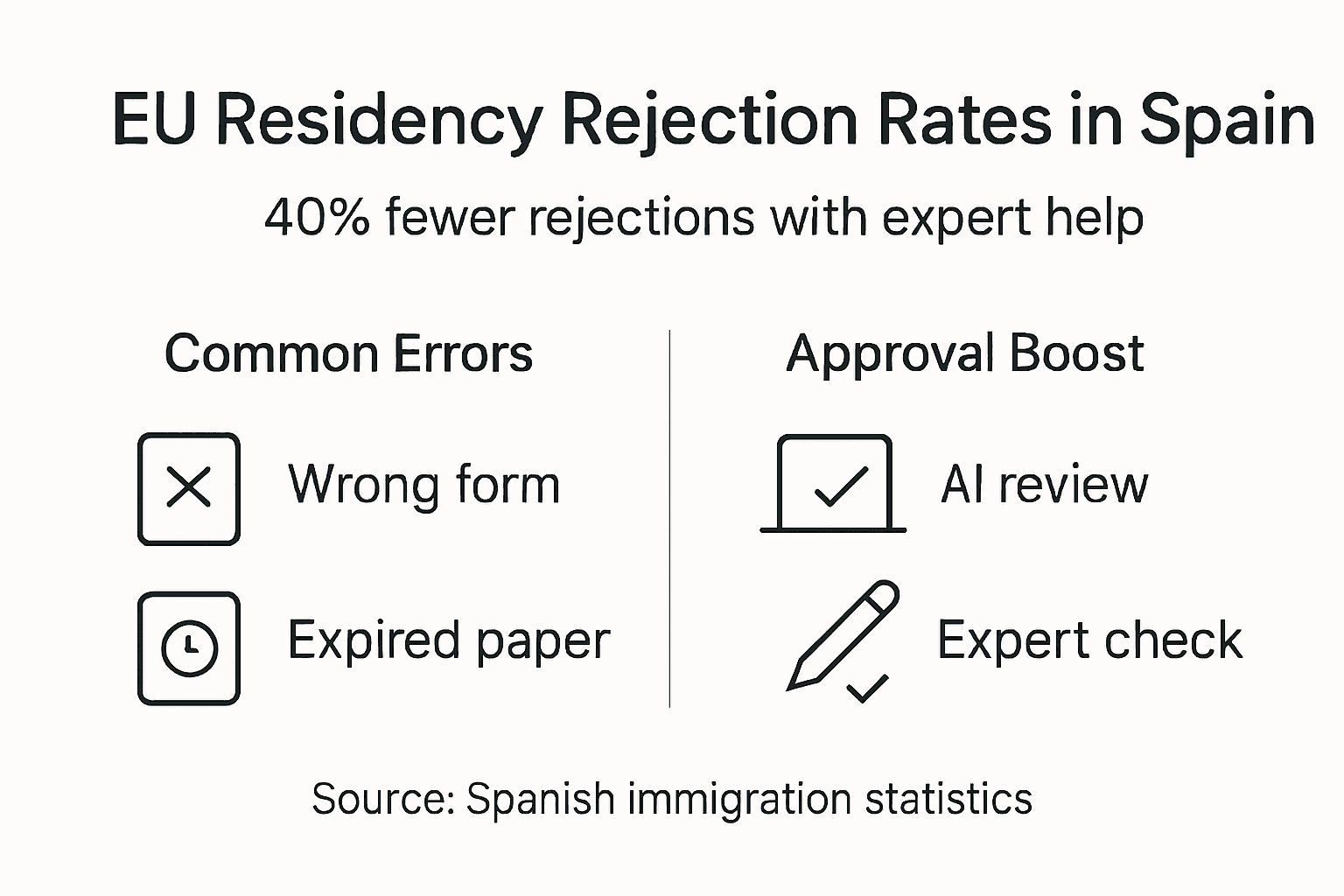
Documentation errors drive approximately 40% of application rejections. These aren’t complex legal issues but simple mistakes: expired documents, missing translations, unsigned forms, or insufficient proof of income. Immigration officers follow strict guidelines and cannot approve incomplete applications regardless of your circumstances.

Self-application without expert help reduces approval chances significantly. While legally you can handle your own application, the complexity of requirements and frequent regulation changes make professional assistance valuable. Approval rates jump from roughly 65% for self-filed applications to about 88% with professional help.
Common mistakes include:
- Assuming NIE grants residency rights when it’s only an identification number
- Submitting documents without certified translations even when originals are in English
- Missing appointment deadlines, which often require rescheduling months later
- Providing insufficient financial documentation or using incorrect formats
- Misunderstanding specific requirements for different permit types
- Failing to maintain valid health insurance throughout the entire process
Another frequent error involves timing. Some applicants start gathering documents too early, leading to expired paperwork by appointment time. Others wait until the last minute and cannot obtain required documents like background checks quickly enough.
Pro Tip: Immigration regulations change frequently. Information you found online six months ago may be outdated. Always verify current requirements through official channels or updated legal consultancy services before submitting your application.
The consequences of rejection extend beyond delay. You may need to leave Spain while reapplying, lose job opportunities, or face complications with housing contracts. Review our guide on common residency misconceptions to avoid these pitfalls.
Benefits of Using Legal Consultancy Platforms for Residency Applications
Digital legal platforms combine artificial intelligence with human expertise to dramatically improve application outcomes. The results speak clearly: error rates drop and approval rates climb.
Professional platforms reduce submission errors by approximately 20% compared to self-filed applications. AI-powered document review catches missing signatures, incorrect formats, and incomplete sections before submission. Human lawyers then verify accuracy and compliance with current regulations.
Speed and convenience improve substantially. Rather than spending weeks researching requirements and navigating government websites, you receive personalized guidance tailored to your situation. The platform handles appointment scheduling, document preparation, and submission tracking through a single dashboard.
Approval rates tell the story. Self-filed applications succeed roughly 65% of the time on first submission. With professional legal consultancy, this jumps to approximately 88%. That 23-percentage-point difference represents thousands of applicants who avoid rejection, reapplication fees, and months of additional waiting.
Key advantages:
- Automated document checks that identify errors before submission
- Expert legal review by licensed immigration lawyers
- Appointment scheduling assistance in high-demand locations
- Real-time application tracking and status notifications
- Direct communication channels for questions and updates
- Guaranteed resubmission support if initial application faces issues
Success Rate Comparison:
Approval rates with professional help reach 88% compared to 65% without expert assistance, representing a 35% improvement in success probability.
Time savings add up quickly. Applicants using legal platforms typically complete the process 30% faster than those navigating it alone. You avoid costly reapplications that can cost €500 to €1,000 in fees plus additional months of uncertainty about your legal status.
The investment in professional services pays for itself through faster approval, reduced error rates, and peace of mind. You focus on your work and life in Spain rather than wrestling with bureaucratic procedures.
Explore expert legal consultancy services designed specifically for Spanish immigration procedures. Learn more about digital legal platform benefits in our comprehensive resource library.
Practical Steps to Streamline Your EU Residency Application in Spain
Success requires following a clear sequence of actions. This roadmap guides you from initial assessment through final approval.
Step-by-Step Process:
-
Assess Your Eligibility: Determine which permit type matches your situation based on nationality, purpose of stay, and documentation you can provide. EU citizens typically need UE registration, while non-EU nationals require TIE permits. Those with existing ties but lacking documentation should explore Arraigo options.
-
Gather Required Documents: Collect all necessary paperwork including valid passport, proof of financial means, health insurance certificates, background checks, and any specific documents for your permit type. Obtain certified translations for documents not in Spanish.
-
Obtain Your NIE: If you don’t already have a foreigner identification number, apply for one first. Most residency applications require an NIE before proceeding.
-
Submit Through Professional Platform: Use a legal consultancy service to review your documentation, prepare required forms, and submit your application. This dramatically reduces error rates and speeds processing.
-
Schedule Official Appointments: Book appointments with immigration authorities as soon as possible. Availability can be limited, especially in major cities. Professional services often have better access to appointment slots.
-
Attend Your Appointment: Arrive on time with all original documents and copies. Immigration officers will verify your paperwork and may ask questions about your situation.
-
Track Application Progress: Monitor your application status through the legal platform’s dashboard or official government systems. Respond immediately to any requests for additional information.
-
Collect Your Residency Permit: Once approved, you’ll receive notification to collect your physical card or certificate. This typically happens at the same office where you submitted your application.
Pro Tip: Start the process at least six months before you need residency status. This buffer absorbs unexpected delays and prevents gaps in your legal status that could complicate employment or housing situations.
Maintaining organized records throughout proves essential. Create digital and physical copies of every document, submission receipt, and communication. These records become invaluable if questions arise or you later apply for permit renewal or citizenship.
Our step-by-step residency application guide provides detailed checklists for each permit type. For those qualifying based on social integration, the social integration residency application page explains specific requirements.
Get Expert Legal Help to Secure Your EU Residency in Spain
Navigating Spanish immigration procedures demands expertise that most applicants simply don’t possess. Professional legal assistance transforms a confusing, error-prone process into a streamlined path toward approval.
Avoid the documentation mistakes that cause 40% of rejections. Vive Legal’s platform combines AI-powered document review with licensed immigration lawyers who understand current regulations. You receive personalized guidance tailored to your specific situation, whether you need a TIE card, UE registration, or Arraigo permit.
The platform handles everything: eligibility assessment, document preparation, form completion, appointment scheduling, and application tracking. You submit with confidence knowing experts have reviewed every detail. Real-time notifications keep you informed at each stage, and secure client portal access lets you monitor progress anytime.
Explore specialized services at Vive Legal immigration management services designed for efficiency and high approval rates. Learn about the EU long-term residence application process or discover how Arraigo social residency services help those with existing Spanish ties regularize their status. Professional support maximizes your chances while minimizing stress and delays.
Frequently Asked Questions about EU Residency in Spain
What rights does EU residency grant in Spain?
EU residency provides legal authorization to live and work in Spain indefinitely, access to public healthcare and education systems, and social security benefits including unemployment and retirement coverage. You gain protection from deportation and the ability to conduct all legal transactions such as signing employment contracts, opening bank accounts, and purchasing property without restrictions.
How long does the residency application process usually take?
Typical processing times range from 2 to 6 months for most permit types when applications are complete and correct. Delays can extend the timeline to 12 months if documentation is incomplete or errors require resubmission. Using professional legal services generally reduces processing time by about 30% through proper preparation and expert guidance.
Can I work anywhere in the EU with Spanish residency?
No, Spanish residency only grants work rights within Spain, not across the entire European Union. You can travel freely within the Schengen zone for tourism or short stays up to 90 days, but employment in other EU countries requires separate work permits unless you eventually obtain Spanish citizenship, which does provide EU-wide work rights.
Do I need legal help to apply for residency?
While not legally required, professional legal assistance increases approval rates from approximately 65% to 88% by eliminating common documentation errors. Legal platforms provide document review, form preparation, appointment scheduling, and expert guidance through complex requirements. The investment typically pays for itself through faster processing and avoiding costly reapplication fees.
What documents are essential for a smooth application?
Core documents include a valid passport, proof of financial means such as employment contracts or bank statements, comprehensive health insurance meeting Spanish requirements, background checks from countries of previous residence, and certified translations of all non-Spanish documents. Specific permit types require additional documentation like proof of housing, integration evidence for Arraigo, or registration certificates for UE applications.
How does Arraigo social differ from other residency permits?
Arraigo social specifically serves individuals who have lived in Spain without documentation for at least three years and can demonstrate social integration through family ties, employment relationships, or community involvement. Unlike standard permits requiring legal entry and status, Arraigo provides a regularization pathway for those already established in Spain but lacking proper documentation.
Recommended
Living legally in Spain shouldn't be difficult.
View services and pricesNot sure which procedure you need? Find out in 2 min
Questions? Message us on WhatsApp