
Why automate residency in Spain for faster approvals

Navigating Spain’s residency process can be overwhelming, especially when 40% of applications face delays or rejections due to preventable errors. The fragmented system across provinces creates confusion, missed deadlines, and frustration for expatriates and international students. Automation offers a transformative solution, combining AI-powered accuracy with expert oversight to streamline applications, reduce processing times, and significantly boost approval rates in 2026.
Table of Contents
- Understanding The Challenges Of Spain’s Traditional Residency Process
- Introducing Spain’s 2026 National Digital Residency Platform
- Benefits Of Automating The Residency Process
- Dispelling Common Misconceptions About Automation In Residency
- Real-World Impact: Automation Benefits For International Students And Expatriates
- Ensuring Data Security And User Trust In Automated Residency Services
- How To Get Started: Practical Steps To Automate Your Residency Process With Vive Legal
- Streamline Your Residency Application With Vive Legal
- Frequently Asked Questions About Automating Residency In Spain
Key takeaways
| Point | Details |
|---|---|
| Automation cuts errors | AI-powered review and auto-filled forms eliminate common mistakes that cause rejections. |
| 2026 platform unifies procedures | Spain’s new national digital system standardizes residency steps across all provinces. |
| Hybrid AI-human model ensures accuracy | Professional legal oversight complements automation for contextual compliance. |
| Real-time tracking improves transparency | Applicants monitor progress online, reducing uncertainty and missed appointments. |
| Substantial time savings | Students and expats cut preparation time by up to 40% with automated workflows. |
Understanding the challenges of Spain’s traditional residency process
Spain’s residency system is fragmented across provinces, creating a maze of inconsistent requirements that confuse applicants. Each region interprets documentation standards differently, forcing you to navigate unique bureaucratic quirks depending on where you apply. This disjointed approach creates bottlenecks that slow everything down.
Living legally in Spain shouldn't be difficult.
View services and pricesNot sure which procedure you need? Find out in 2 min
Questions? Message us on WhatsApp
Manual paperwork compounds the problem. Traditional applications require in-person appointments at crowded government offices, where wait times stretch for weeks. Missing a single document or making a small formatting error sends you back to square one, restarting the entire process.
Processing times vary wildly by location. An EU family card in Spain might take three weeks in Barcelona but six weeks in Valencia, with no clear explanation for the difference. These inconsistencies make planning nearly impossible for students with enrollment deadlines or professionals starting new jobs.
Key challenges include:
- Provincial offices using different document checklists for identical permit types
- Handwritten forms prone to illegibility and transcription errors
- Limited appointment availability forcing multi-month delays
- No centralized tracking system to monitor application status
- Language barriers complicating communication with local officials
The cumulative effect? Applicants waste countless hours researching requirements, traveling to offices, and correcting preventable mistakes. This fragmentation creates an error-prone environment where even careful preparation can lead to rejection, forcing you to restart the expensive and time-consuming process from scratch.
Introducing Spain’s 2026 national digital residency platform
Spain is revolutionizing its immigration system with a unified national digital platform launching in 2026 that consolidates all visa and residency procedures into one centralized portal. This groundbreaking initiative eliminates the provincial patchwork that has frustrated applicants for decades. You’ll access standardized procedures regardless of location, ensuring consistent requirements nationwide.
The platform digitizes every step. Upload documents directly through secure online forms instead of making multiple in-person trips. Standardized checklists eliminate surprises about missing paperwork, while automated validation catches formatting errors before submission. This front-end quality control dramatically reduces rejection rates.

Real-time tracking transforms the applicant experience. Log into your dashboard to monitor progress through each processing stage, receiving automated notifications when officials review your case or request additional information. This transparency replaces the current black box system where applications disappear for weeks without updates.
Core features include:
- Single portal for initial applications, renewals, and permit modifications
- Automated document verification to flag issues before official submission
- Integrated appointment scheduling with real-time availability across all offices
- Multilingual interface supporting English, Spanish, and other common languages
- Secure digital signatures eliminating the need for notarized physical copies
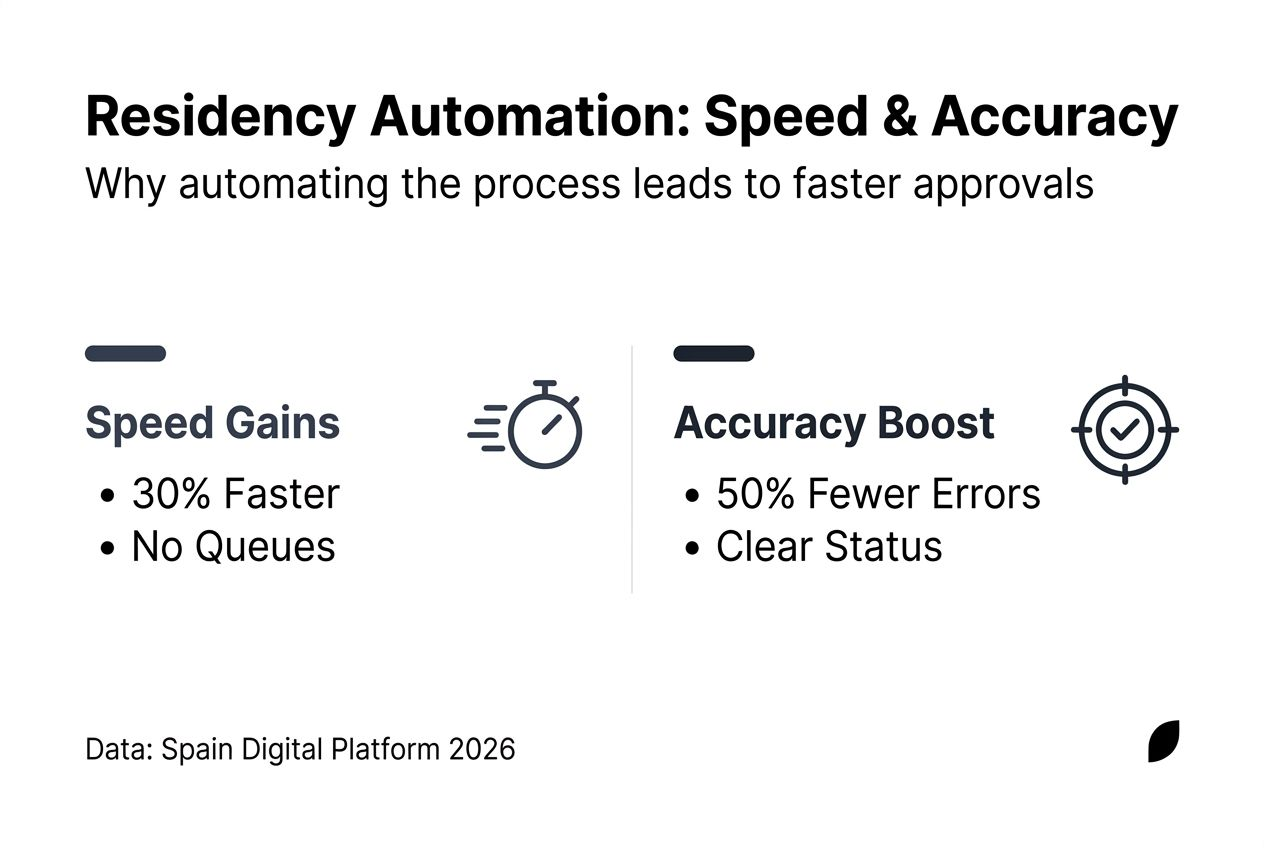
The platform aims to cut average processing times by 30% while reducing administrative errors by over 50%. By standardizing procedures nationwide, Spain joins other European countries offering efficient, user-friendly immigration systems that respect applicants’ time and reduce bureaucratic friction.
Benefits of automating the residency process
Automating document review and form preparation eliminates the human errors that sink countless applications. AI algorithms cross-reference your documents against official requirements, flagging inconsistencies like mismatched dates or incomplete fields before submission. This pre-flight check catches mistakes that would otherwise trigger rejections weeks later.
Digital appointment scheduling removes a major bottleneck. Instead of calling offices during limited hours or waiting in line for available slots, you book appointments online at your convenience. The system displays real-time availability across multiple locations, letting you choose times that fit your schedule. Automated reminders ensure you never miss critical dates.
Hybrid human review provides the best of both worlds. While AI handles repetitive verification tasks with perfect consistency, experienced immigration lawyers review your complete application for contextual accuracy. They catch nuanced issues that algorithms might miss, like whether your employment contract satisfies specific permit requirements or if your academic credentials need additional apostille certification.
Key advantages include:
- Form auto-population from uploaded documents reducing data entry errors
- Instant eligibility assessments based on your specific circumstances
- Automated deadline tracking with proactive alerts for renewals or status changes
- Digital case history accessible anytime for reference or future applications
- Reduced processing times through optimized workflows and parallel task handling
For complex cases involving EU long-term residence applications or permit modifications, automation provides structured guidance through multi-step procedures. You receive clear instructions for each phase, with the system orchestrating document collection, official submissions, and follow-up communications seamlessly.
Pro Tip: Start your automated application at least 60 days before your current permit expires. This buffer allows time for any unexpected requests from immigration officials while automated tracking keeps you informed throughout the process. Visit the Vive Legal immigration guides for detailed preparation checklists tailored to your specific permit type.
Dispelling common misconceptions about automation in residency
Automation doesn’t replace human expertise. Many applicants worry that AI-driven systems operate without professional oversight, but effective platforms combine algorithmic efficiency with experienced legal review. Immigration lawyers supervise automated workflows, intervening when cases require judgment calls that algorithms can’t make. You get speed without sacrificing personalized attention.
Automation improves accuracy but doesn’t guarantee approval. Your eligibility determines outcomes, not the application method. If you don’t meet income thresholds for a work permit or lack required documentation, no amount of automation will change that. What automation does is ensure your qualifying application is presented flawlessly, maximizing approval chances when you do meet criteria.
Some in-person steps remain mandatory. While digitization eliminates many office visits, certain procedures still require physical presence. Biometric data collection for initial permits, for example, must happen at designated centers. Automation streamlines everything else, but legal frameworks dictate which steps can move online.
Common myths debunked:
- “Automated systems are impersonal”: Platforms include chat support, video consultations, and assigned case managers providing human touchpoints throughout your application.
- “AI makes decisions about my case”: Algorithms assist preparation and review, but immigration officials and legal professionals make all final determinations about your residency status.
- “Full automation happens overnight”: Digital transformation is gradual. Spain’s 2026 platform represents years of development, with ongoing refinements based on user feedback and changing regulations.
- “Automation works identically for all permit types”: Different visas have unique requirements. Effective systems customize workflows for student permits, work authorizations, family reunification, and other categories.
- “Technology eliminates the need for legal knowledge”: Automation tools encode legal expertise into user-friendly interfaces, but understanding your rights and obligations remains essential for successful outcomes.
Hybrid models currently represent best practice. Pure automation lacks contextual understanding, while purely manual processes waste time on routine tasks. The sweet spot combines AI efficiency for repetitive work with human judgment for complex situations, delivering faster processing without compromising quality or personalized service.
Real-world impact: automation benefits for international students and expatriates
International students experience dramatic time savings with automated residency workflows. Traditional applications consumed 15-20 hours across document gathering, form completion, office visits, and follow-up communications. Automated platforms cut this to 8-12 hours by pre-filling forms from uploaded documents and eliminating redundant trips. Students reclaim valuable time for studies and settling into their new environment.
Expat processing times drop by nearly half. Manual work permit applications averaged 45-60 days from submission to approval, with applicants left guessing about status. Digital tracking and automated case progression reduce this to 25-35 days, with real-time updates eliminating anxiety about where applications stand.
| User Group | Traditional Timeline | Automated Timeline | Time Saved |
|---|---|---|---|
| International Students | 15-20 hours prep | 8-12 hours prep | 40% reduction |
| Working Professionals | 45-60 days processing | 25-35 days processing | 35% reduction |
| EU Family Members | 12-18 office visits | 3-5 office visits | 70% reduction |
| Permit Renewals | 8-10 weeks total | 4-6 weeks total | 45% reduction |
Transitions between permit types become seamless. Students completing degrees and moving into employment previously navigated confusing student to worker permit modifications with minimal guidance. Automated systems recognize these common transitions, providing step-by-step instructions and flagging when you’re eligible to begin the conversion process. The platform pre-populates shared information from your student visa application, eliminating redundant data entry.
Internship residence applications showcase automation’s clarity advantages. These permits have specific requirements about company registration, compensation minimums, and academic program coordination. Automated eligibility checks verify all criteria are met before submission, preventing rejections from overlooked technicalities. Students receive clear pass/fail assessments on each requirement with guidance for resolving any gaps.
Real-time updates minimize uncertainty. Instead of wondering whether officials received your documents or if your case is under review, automated platforms send notifications at each milestone. You know exactly when to expect next steps, allowing better planning for travel, housing commitments, and other life decisions that depend on residency status.
Pro Tip: Upload high-resolution scans of all documents when using automated platforms. Clear images enable accurate AI extraction of data for form completion, reducing errors and speeding processing. Blurry photos of passports or certificates force manual review, negating automation’s speed advantages.
Ensuring data security and user trust in automated residency services
Automated residency platforms handle extremely sensitive personal information, from passport details to financial records. Data security protocols ensure this information remains protected through every step of the application process. Robust encryption standards safeguard data during transmission between your device and platform servers, preventing interception by unauthorized parties.
GDPR compliance is mandatory for any service operating in Spain. These regulations give you explicit control over your personal data, including rights to access, correct, or delete information held by platforms. Automated systems must document exactly how they use your data, with whom it’s shared, and for what purposes. Transparent privacy policies explain these practices in plain language.
Encryption protects stored data on platform servers. Even if systems were compromised, encrypted files remain unreadable without proper decryption keys. Industry-standard AES-256 encryption provides military-grade security, ensuring your documents are safer digitally than in physical filing cabinets vulnerable to theft or loss.
Security measures include:
- Multi-factor authentication requiring password plus mobile verification for account access
- Automatic session timeouts logging you out after periods of inactivity
- Regular security audits by independent cybersecurity firms identifying vulnerabilities
- Segregated data storage keeping personal information separate from operational systems
- Encrypted backups ensuring data recovery without exposing sensitive information
User trust depends on transparency. Reputable platforms clearly explain their security architecture, certification compliance, and incident response procedures. They outline what happens if breaches occur, including immediate notification protocols and steps to protect affected users. This openness builds confidence that your information receives appropriate protection.
Security practices evolve alongside threats. Platforms regularly update encryption standards, authentication methods, and access controls to address emerging risks. Continuous monitoring detects suspicious activity patterns that might indicate unauthorized access attempts, triggering immediate protective measures.
Legal accountability reinforces security commitments. Platforms face significant penalties for data breaches under GDPR, creating strong financial incentives to maintain robust protections. This regulatory framework ensures your privacy isn’t just a marketing promise but a legally enforceable obligation backed by substantial consequences for violations.
How to get started: practical steps to automate your residency process with Vive Legal
Beginning your automated residency application requires just a few straightforward steps that set you up for efficient processing. The streamlined approach eliminates guesswork while ensuring nothing gets overlooked. Here’s exactly how to launch your application with confidence.
Follow these steps to get started:
-
Create your secure user profile: Visit the Vive Legal official site and register with your email and basic contact information. The platform encrypts your credentials immediately, establishing your protected workspace for the entire application process.
-
Complete the personalized diagnostics: Answer questions about your current status, intended permit type, and specific circumstances. The AI analyzes your responses to determine eligibility, identify potential complications, and recommend the optimal application pathway for your situation.
-
Upload your supporting documents: Submit digital copies of your passport, proof of income, academic certificates, employment contracts, and other required materials. The system automatically extracts data from these files to pre-fill your application forms, dramatically reducing manual entry errors.
-
Review AI-assisted application preparation: The platform generates your complete application package with forms properly completed and documents organized according to official requirements. Review everything carefully, making any necessary adjustments before the system finalizes your submission.
-
Schedule required appointments digitally: Book any mandatory in-person steps like biometric collection through the integrated calendar showing real-time availability at convenient locations. The system sends automatic reminders before each appointment so you never miss critical dates.
-
Monitor progress with real-time tracking: Log into your dashboard anytime to check your application status. Automated notifications alert you immediately when officials request additional information, complete review stages, or issue decisions. You stay informed without constant manual checking.
-
Access expert consultation if needed: Complex cases involving unusual circumstances can request video consultations with immigration lawyers through the platform. These professionals review your specific situation and provide personalized guidance beyond automated assistance.
Pro Tip: Gather all documents before starting your application. Having everything ready lets you complete the entire process in one session, maintaining momentum and ensuring consistency across all forms. Incomplete applications save as drafts, but finishing quickly reduces the risk of changing regulations affecting your case.
The automated system guides you through each step with clear instructions and progress indicators. You’ll always know what’s completed, what remains, and exactly what to do next. This structured approach transforms residency applications from overwhelming to manageable.
Streamline your residency application with Vive Legal
Navigating Spain’s residency requirements no longer needs to be a frustrating ordeal filled with uncertainty and delays. Vive Legal delivers a comprehensive automated platform designed specifically for expatriates and international students seeking efficient, accurate residency management. The service combines cutting-edge AI document review with experienced legal oversight, ensuring your application meets every official requirement while progressing as quickly as possible.
The platform handles everything from initial eligibility assessments through final permit issuance. You’ll benefit from automated form completion that eliminates data entry errors, intelligent document verification that catches issues before submission, and real-time case tracking that keeps you informed at every stage. Professional immigration lawyers supervise the entire process, providing personalized attention when your situation requires human expertise.
Whether you’re applying for standard work permits, navigating the Extraordinary Regularization 2026 program, or managing applications through immigration services for study centers, Vive Legal’s automated workflows deliver faster processing and higher approval rates. The secure platform protects your sensitive information with bank-level encryption and full GDPR compliance, giving you peace of mind throughout the application journey.
Take control of your residency process today. Visit Vive Legal residency services to start your personalized application and experience how automation transforms immigration procedures from complicated obstacles into straightforward steps toward your new life in Spain.
Frequently asked questions about automating residency in Spain
Does automation increase my chances of residency approval?
Automation significantly improves approval odds by eliminating the preventable errors that cause most rejections. AI-powered review catches missing signatures, incorrect dates, and incomplete forms before submission. However, approval ultimately depends on meeting eligibility criteria like income requirements, clean criminal records, and valid documentation. Automation ensures your qualifying application is presented perfectly, but it can’t compensate for failing to meet substantive legal requirements.
Are in-person appointments still required with automated systems?
Some in-person steps remain mandatory regardless of automation. Biometric data collection for initial residence cards requires visiting designated centers equipped with fingerprint and photo capture technology. Final permit pickup may also require physical presence depending on your location and permit type. Automation eliminates unnecessary office visits for document submission, form filing, and status inquiries, but legal requirements dictate which steps must occur in person.
Who benefits most from automated residency platforms?
International students and working professionals gain the greatest advantages from automation. Students juggling academic schedules appreciate time savings and clear guidance through complex procedures like student-to-work permit transitions. Professionals relocating for employment value faster processing that aligns with job start dates and reduced disruption from office visits during work hours. Families and retirees also benefit, though their typically less time-sensitive applications see somewhat smaller relative improvements.
How is my personal data protected in automated residency applications?
Platforms use AES-256 encryption for data transmission and storage, the same standard banks employ for financial transactions. Multi-factor authentication prevents unauthorized account access, while GDPR compliance gives you legal rights to control how your information is used. Regular security audits by independent firms identify and address vulnerabilities before they can be exploited. Your documents are significantly more secure digitally than physical copies vulnerable to loss, theft, or damage.
Can automated systems handle complicated residency cases?
Automation excels at straightforward applications but includes escalation pathways for complex situations. Cases involving criminal record explanations, unusual documentation, or special circumstances trigger review by immigration lawyers who provide personalized guidance. The platform identifies when your situation requires human expertise and connects you with appropriate professionals. This hybrid approach combines automation’s efficiency for routine elements with expert judgment for challenging aspects of your case.
Recommended
Living legally in Spain shouldn't be difficult.
View services and pricesNot sure which procedure you need? Find out in 2 min
Questions? Message us on WhatsApp