
Why automated legal services are smarter for immigration

TL;DR:
- Automated legal services streamline Spain immigration tasks like form filling, appointment booking, and status tracking.
- Human expertise remains essential for complex cases, appeals, or legal interpretations beyond automation.
- Choose platforms with clear professional oversight, strong data security, and transparent, integrated legal review processes.
Moving to Spain means navigating a maze of bureaucratic requirements, from NIE applications to residency renewals, all in a second language under tight deadlines. Many people assume that “automated legal services” means handing everything over to a computer with no professional involvement. That assumption is wrong, and it costs people time and money. AI tools are designed to remove administrative friction and support legal professionals, not replace them. This guide explains how automation actually works in Spain’s immigration system, where it helps most, where human expertise is still essential, and how to choose a provider that gives you both.
Living legally in Spain shouldn't be difficult.
View services and pricesNot sure which procedure you need? Find out in 2 min
Questions? Message us on WhatsApp
Table of Contents
- What are automated legal services?
- Key benefits for immigrants and expatriates in Spain
- Balancing automation with expert legal review
- How to choose and maximize automated legal services
- The real promise and limits of legal automation for immigration
- Get expert-backed automation with Vive Legal
- Frequently asked questions
Key Takeaways
| Point | Details |
|---|---|
| Automation streamlines tasks | Automated legal services handle routine immigration steps like forms and appointments quickly and reliably. |
| Legal review is essential | Even with automation, a qualified lawyer should check complex or important filings for accuracy and compliance. |
| Choose reputable providers | Select platforms that clearly involve expert lawyers and outline privacy and security measures for your data. |
| Best for standard cases | Automation works especially well for straightforward, high-volume applications but not for unique legal situations. |
What are automated legal services?
With the myth addressed, let’s break down exactly what automated legal services cover.
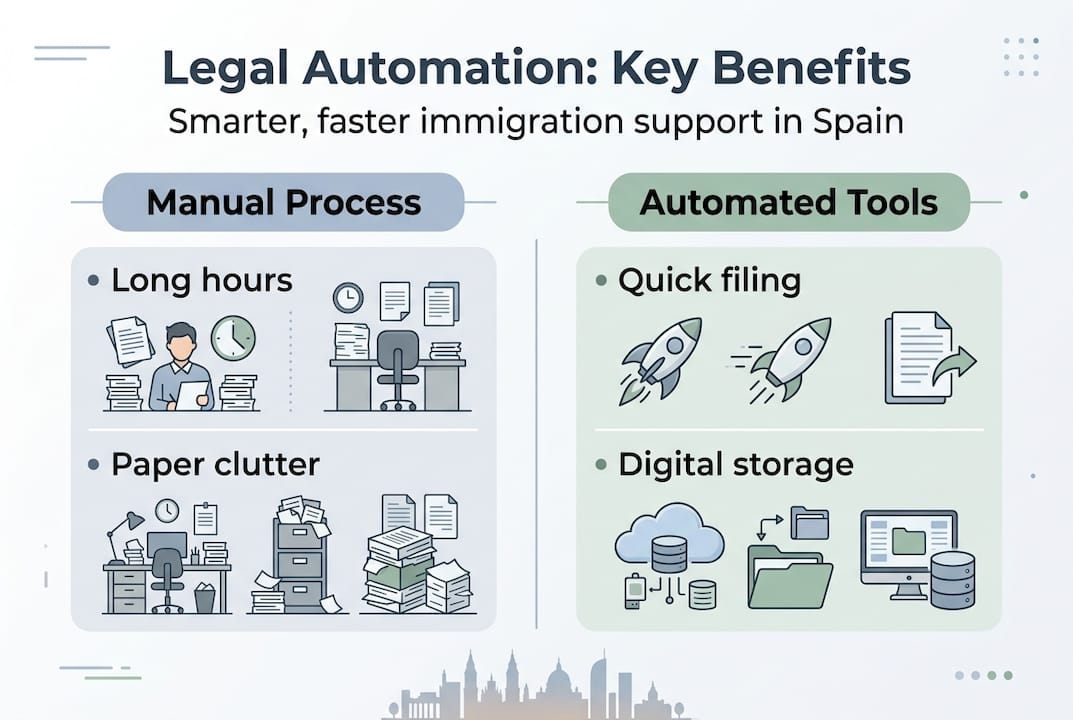
Automated legal services use software and artificial intelligence to handle repetitive, rule-based tasks that previously required hours of manual work. Think of it less like a “robot lawyer” and more like a very organized assistant who never forgets a deadline, never misfiles a document, and flags inconsistencies before they become problems. The technology itself is straightforward: it collects your information once, applies it across multiple official forms, and tracks every step of your case through a central platform.
In the context of Spain’s immigration system, automated legal services typically cover these core functions:
- Form pre-filling: Your personal data, passport details, and residency history are entered once and populated automatically across documents like the EX-15, EX-17, or the model 790 fee form.
- Document management: The platform organizes your uploaded files, checks for expiration dates, and reminds you when a document needs renewal before it invalidates your application.
- Appointment scheduling: Automated systems monitor availability at immigration offices and notify you the moment a slot opens, eliminating the need to refresh the Sede Electrónica page for hours.
- Status tracking: You receive real-time notifications at each stage of your case rather than waiting on hold with an administrative office.
- Deadline alerts: The system flags critical dates so you never miss a renewal window.
What automation does not do is interpret nuanced legal situations, advocate for you in an appeal, or make judgment calls about which permit type fits your specific circumstances. AI tools remove administrative friction while professional review remains essential for accuracy, security, and jurisdiction-specific decisions. A good platform always pairs the software with qualified immigration professionals who review outputs before anything is submitted.
For example, if you are applying for a TIE (Tarjeta de Identidad de Extranjero) after obtaining a long-term visa, automation can pre-fill your application forms, generate your appointment confirmation letter, and track whether your biometric appointment has been confirmed. But if your employment situation has changed since your original visa was granted, a human professional needs to assess whether that change affects your eligibility before the documents go in.
Pro Tip: When evaluating any automated legal platform, ask specifically whether their team includes licensed immigration lawyers or registered gestores. Automation saves time, but professional oversight is what protects your legal status. For students in particular, look for platforms offering study center immigration tools tailored to academic visa requirements.
The most important thing to understand is that automation and legal expertise are not opposites. They work best when combined. Technology handles the volume and repetition; professionals handle the judgment and accountability.
Key benefits for immigrants and expatriates in Spain
Now that we’ve defined the concept, here’s why automation matters for people navigating Spain’s immigration system.
Spain’s immigration bureaucracy is notoriously complex. Forms change, appointment availability fluctuates by province, and missing a single document can push your case back by months. Automated legal services directly address these pain points in ways that traditional gestorías simply cannot match for speed or consistency.
Manual vs. automated: a side-by-side comparison
| Factor | Manual process | Automated process |
|---|---|---|
| Form preparation time | 3 to 8 hours per application | 20 to 45 minutes |
| Risk of data entry errors | High (repeated manual entry) | Low (single data entry, auto-populated) |
| Appointment tracking | Manual refreshing of government portals | Real-time automated monitoring |
| Document expiration alerts | Relies on applicant memory | Automatic notifications |
| Cost | Variable, often high | Transparent flat-fee pricing |
| Case status visibility | Phone calls or in-person visits | 24/7 online dashboard |
The efficiency gains are not trivial. A manual NIE application can take a full workday once you account for gathering documents, completing forms, traveling to the office, and following up. An automated platform compresses that to under an hour of your direct input, with the system handling the rest.
Here are the key steps that automated services simplify for applicants in Spain:
- Initial eligibility check: Answer a short questionnaire and receive a personalized diagnostic showing which permit type applies to your situation.
- Document collection: The platform provides a precise checklist based on your case type, so you never show up missing a required form.
- Form completion: Your data is entered once and distributed across all required documents automatically.
- Fee payment guidance: Step-by-step instructions for completing the model 790 tax form and payment without errors.
- Appointment booking: Automated monitoring of the official booking system with instant alerts.
- Submission review: A legal professional confirms everything is correct before you attend your appointment.
- Post-submission tracking: Status updates delivered directly to your inbox or client portal.
The immigration experts who review your case at key checkpoints add a layer of assurance that software alone cannot provide. This is especially relevant for EU citizens registering in the census (Registro de Ciudadanos de la Unión) or for non-EU workers applying for initial work permits, where local administrative practices vary by province.

Outputs still need human review especially for accuracy, security, and jurisdiction-specific nuance. A platform’s service terms should clearly explain the scope of that human review.
Pro Tip: Even with excellent automation, always keep physical or cloud-stored copies of every document you submit. Offices occasionally lose records, and having your own organized archive gives you a strong backup if any dispute arises.
Balancing automation with expert legal review
While the benefits are impressive, it’s critical to know where human expertise is essential.
Automation is a powerful tool, but it operates on rules and patterns. Immigration law, particularly in Spain, involves a level of interpretive judgment that software cannot fully replicate. Knowing when to rely on automation and when to escalate to a professional is the key to a smooth residency process.
“AI tools are meant to remove administrative friction and support professionals, while outputs still need human review especially for accuracy, security, and jurisdiction-specific nuance.”
Here are the situations where automation alone carries real risk:
- Appeals and denials: If your application is rejected, the appeal process requires legal argumentation tailored to the specific grounds of the denial. No automated system can draft that effectively.
- Complex employment situations: Applicants with multiple employers, freelance contracts, or irregular income streams may not fit neatly into the categories immigration forms recognize.
- Unusual nationality or document combinations: Some applicants have documents issued across multiple countries or hold dual citizenship, which creates interpretation questions that require a professional’s judgment.
- Family reunification cases: These involve overlapping residency timelines, proof of economic means calculations, and dependent documentation that require careful coordination.
- Arraigo applications: The arraigo social and arraigo laboral permits require evidence of social integration and often involve subjective assessments. Human lawyers build the narrative; software fills the forms.
The Vive Legal attorney team is integrated into the platform’s workflow precisely because these moments arise even in seemingly routine cases. A professional review at the right stage can be the difference between approval and a multi-month setback.
How do you verify that a platform offers real lawyer oversight? Check whether their website names licensed professionals with registration numbers, read user reviews that mention specific human interactions, and confirm that the privacy and data security practices meet Spanish law requirements, including GDPR compliance.
Good legal-tech platforms are transparent about what the software handles and what the professionals handle. If a company’s marketing implies that no human involvement is needed at any point, treat that as a serious warning sign.
How to choose and maximize automated legal services
Understanding the balance, here’s how you can select and get the most from automated legal services in Spain.
Choosing the right platform requires looking beyond slick interfaces and low introductory prices. The evaluation criteria that matter most relate to legal accountability, data protection, and the quality of human oversight built into the process.
Evaluation criteria for legal automation providers
| Criteria | What to look for | Red flags |
|---|---|---|
| Legal credentials | Named lawyers or gestores with license numbers | Anonymous “legal team” with no verifiable credentials |
| Scope of automation | Clear description of what is automated vs. reviewed | Vague promises of “full automation” |
| Data security | GDPR-compliant, encrypted storage | No privacy policy or unclear data sharing |
| Pricing transparency | Flat fees per service, no hidden charges | Unclear fee structures or mandatory upsells |
| Case tracking | Real-time dashboard with professional notes | Email-only updates with no portal access |
| Jurisdiction coverage | Specific to Spain’s immigration law | Generic “international” tools not localized |
Follow these steps to use automated legal services safely:
- Run the eligibility check first. Every credible platform starts with a diagnostic to confirm you are applying for the right permit type. Skipping this step is the most common and costly mistake.
- Upload complete documents before proceeding. Partial uploads lead to incomplete reviews. Use the platform’s checklist and complete it fully before moving to the next stage.
- Read the Spanish legal notices for any platform you use. These documents define the scope of service, limitations of liability, and what happens if your case is denied.
- Confirm human review checkpoints. Ask customer support exactly which stages involve a qualified professional reviewing your documents and forms. Get it in writing.
- Download your completed documents immediately. Do not rely on the platform’s storage as your only copy. Maintain your own organized folder with dated versions of everything submitted.
- Check data handling policies before uploading sensitive documents. Your passport, financial records, and biometric data are highly sensitive. Verify how the platform stores, processes, and potentially shares this information.
Outputs still need human review at the most critical stages, and a good platform will build that in by default rather than offering it as an expensive add-on.
One practical best practice that many applicants overlook: set your own independent reminders for residency expiration dates, even if the platform sends alerts. System failures happen. Your legal status should never depend on a single notification channel.
The real promise and limits of legal automation for immigration
Most articles about legal technology focus on efficiency and cost savings. Those benefits are real. But what typically goes unexamined is the mindset shift that automation actually requires from you as the applicant.
The biggest risk is not that automation gets something wrong. The biggest risk is that you stop paying attention because the software feels reliable. The “set it and forget it” approach to immigration is genuinely dangerous. Residency permits expire. Employment situations change. Address updates affect official correspondence. None of these nuances are fully captured by any automated system without your active input.
Our view is that automated legal services work best for people who stay engaged with their own case. Use the platform to eliminate tedious manual work, absolutely. But treat every automated notification as a prompt to verify your situation, not as a guarantee that everything is in order. The most successful applicants we see are those who combine the efficiency of technology with their own informed awareness.
Immigration law in Spain continues to evolve, particularly around extraordinary regularization pathways and new categories for digital workers. Automation tools are updated to reflect regulatory changes, but interpreting how those changes affect your individual case will always require a human perspective.
Get expert-backed automation with Vive Legal
To put these insights into practice, here’s how you can get help today.
Vive Legal combines automated document preparation, appointment tracking, and case management with professional legal oversight built into every stage. Whether you are pursuing extraordinary regularization applications, navigating residency requirements through study center support, or managing internship residence help, the platform gives you a structured, transparent process from your first eligibility check to your final approval confirmation.
Every service includes GDPR-compliant data handling, named legal professionals who review your documents, and a secure client portal where you can track progress in real time. Transparent flat-fee pricing means no surprises. If you want immigration support that actually works in Spain’s current regulatory environment, Vive Legal is built specifically for that.
Frequently asked questions
Is it safe to use automated legal services for immigration in Spain?
Yes, reputable platforms include strong GDPR-compliant data protection and build in mandatory human lawyer review at critical steps, ensuring that outputs meet accuracy and jurisdiction-specific compliance standards.
Can automated legal services fully replace an immigration lawyer?
No. AI tools remove friction for routine tasks, but appeals, complex employment situations, and final document reviews still require a qualified immigration lawyer or gestor.
What common tasks can be automated for Spain’s immigration process?
AI tools support professionals by automating form filling, document organization, appointment scheduling, fee payment guidance, and real-time status notifications throughout your application.
How do I know if a platform uses real legal experts?
Look for named lawyers or gestores with verifiable registration numbers on the platform’s website, read the service agreement to confirm the scope of professional review, and check independent reviews that mention direct interactions with legal staff.
Recommended
Living legally in Spain shouldn't be difficult.
View services and pricesNot sure which procedure you need? Find out in 2 min
Questions? Message us on WhatsApp