
Why document review matters for immigration success in Spain
TL;DR:
- A single missing apostille or an uncertified translation can cause months of delays or application rejection in Spain’s immigration process. Proper document review involves verifying authenticity, legalization, sworn translation, and internal consistency, which are critical for success. Expert assistance ensures all paperwork meets strict standards, safeguarding your legal status and access to services in Spain.
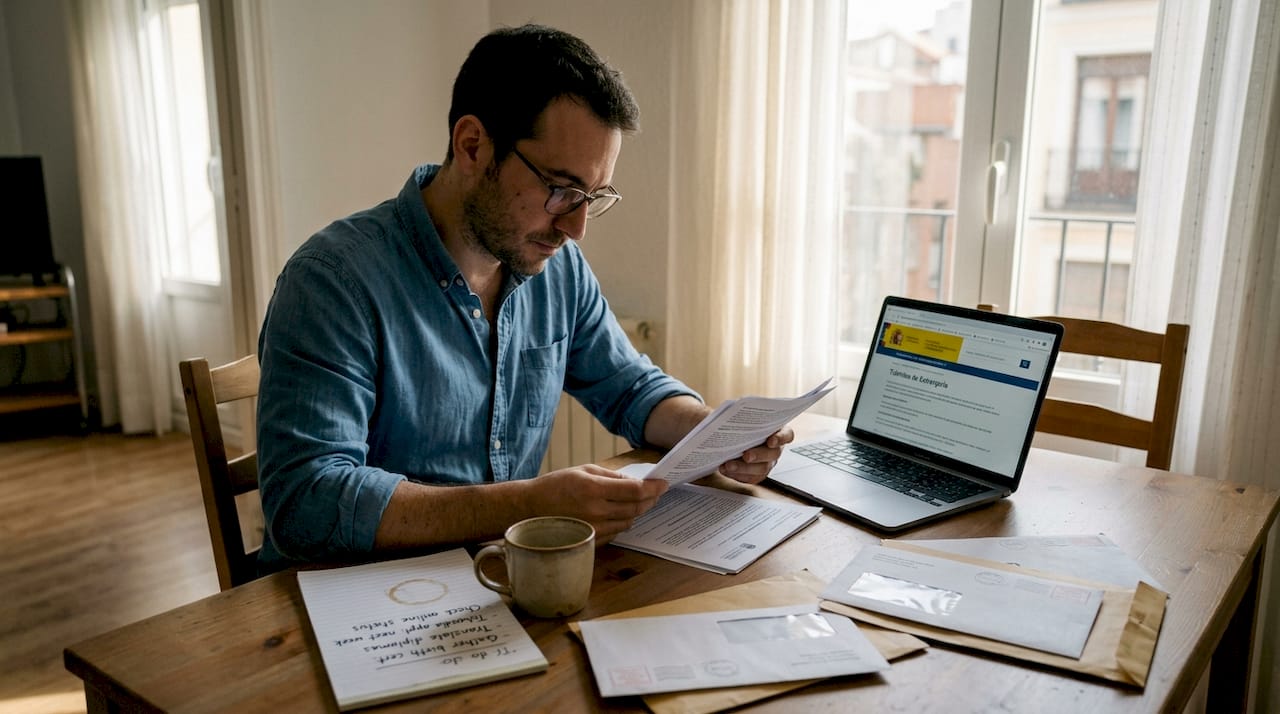
A single missing apostille on a birth certificate, or a translation done by an uncertified translator, can get your entire residency application rejected in Spain. This is not a minor inconvenience. It can mean months of delays, loss of healthcare access, or even being turned away at a border crossing. Many people treat paperwork as a formality, assuming that filling out forms correctly is the hard part. In reality, the authenticity and completeness of your supporting documents is where most applications fail, and understanding document review is the single most important step you can take toward a successful outcome.
Living legally in Spain shouldn't be difficult.
View services and pricesNot sure which procedure you need? Find out in 2 min
Questions? Message us on WhatsApp
Table of Contents
- What is document review and who needs it?
- Legalization and sworn translation: Why they matter
- Ensuring completeness and consistency: Avoiding pitfalls
- Document review for residency: Impact on legal status and access
- What most applicants miss about document review in Spain
- Get expert help for your document review and immigration case
- Frequently asked questions
Key Takeaways
| Point | Details |
|---|---|
| Document review is essential | Proper document review ensures your immigration application meets Spanish legal requirements and avoids costly mistakes. |
| Legalization and translation | Most documents must be legalized (apostilled) and officially translated to be accepted in Spain. |
| Completeness avoids delays | Submitting complete and consistent documentation is crucial to prevent application rejections and administrative issues. |
| Residency status impact | Correct document review is necessary to prove legal residency and access services like healthcare and education in Spain. |
| Professional help available | Expert assistance streamlines document review, making your immigration process faster and safer. |
What is document review and who needs it?
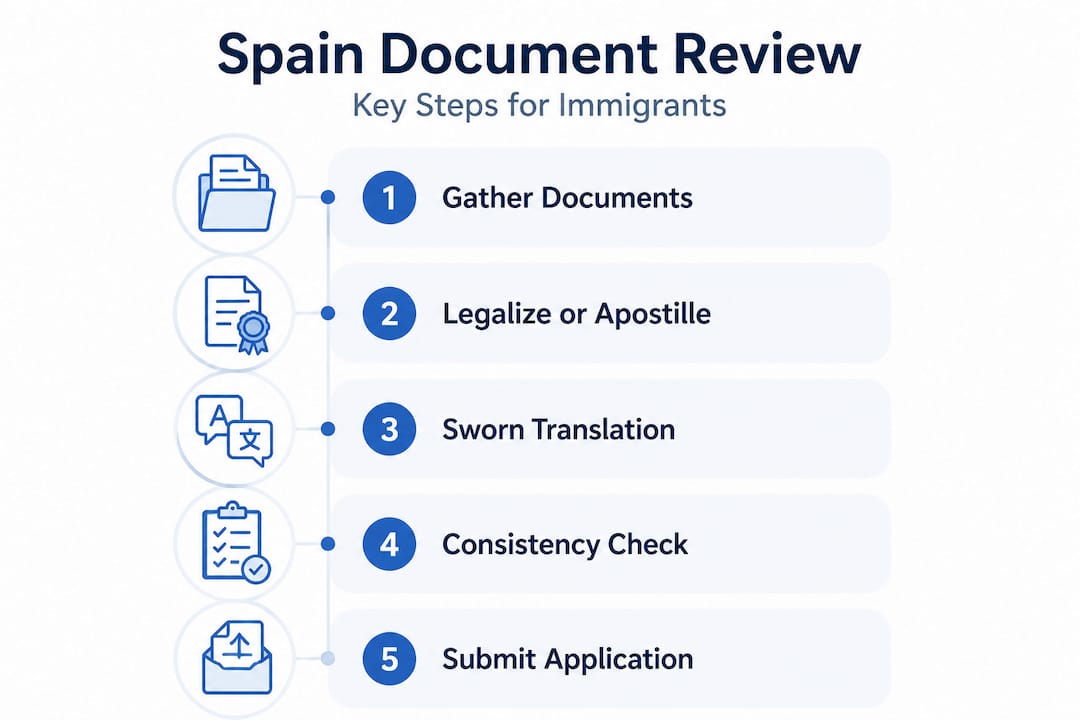
Document review, in the immigration context, is the process of verifying that every document you submit to Spanish authorities is authentic, properly legalized, officially translated, and internally consistent. It is not just proofreading. It is a structured legal check that confirms your paperwork meets the specific standards required by Spanish administrative offices, immigration bureaus, and consulates.
Spain’s immigration system accepts foreign public documents only under strict conditions. According to Spain’s Ministry of Foreign Affairs guidance, foreign public documents generally must be legalized or apostilled and documents in another language need an official sworn translation to be accepted. These are not optional steps. They are legal requirements.
Who needs document review?
Virtually anyone navigating Spain’s immigration system will encounter this process at some point. The key groups include:
- Expatriates relocating to Spain who need to register as residents or obtain a NIE (Número de Identificación de Extranjero, your foreign identification number in Spain)
- Foreign workers applying for work permits, renewing authorizations, or proving employment history
- International students enrolling at Spanish universities or transitioning from student to worker status
- EU citizens applying for the EU registration process or seeking EU long-term residency
- Family members of Spanish or EU nationals applying for dependent residency cards
The documents most commonly requiring review include birth certificates, marriage certificates, police clearance records, academic diplomas, proof of income, and proof of residency. Each of these must pass through a defined chain: authentication or legalization, sworn translation if not in Spanish, and a consistency check against your other submitted materials.
Legalization and sworn translation: Why they matter
Once you know which documents you need, the next question is what must be done to them before they are accepted. This is where legalization and sworn translation come in, and this is also where the most common and costly mistakes happen.
Legalization and apostille explained
An apostille is a specific type of certification used between countries that have signed the Hague Convention. It confirms that a document issued in one country is authentic and can be recognized in another. For countries that are not part of the Hague Convention, full diplomatic legalization through the Spanish consulate in the issuing country is required. Either way, the goal is the same: Spanish authorities need to know that your birth certificate, diploma, or police record is genuine and was issued by a competent authority.
The sworn translation requirement
Even after legalization, if your document is not in Spanish, it must be translated by a sworn translator. Spain’s Ministry of Foreign Affairs certifies these translators, and only their translations carry legal weight in Spanish administrative proceedings. A translation done by a bilingual friend, a language school, or even an uncertified professional translator will be rejected. The distinction matters enormously.
Here is the correct sequence to follow for any foreign public document:
- Obtain the original document from the issuing authority in your home country
- Have the document apostilled or diplomatically legalized, depending on your country’s treaty status with Spain
- Commission a sworn translation from a translator certified by Spain’s Ministry of Foreign Affairs
- Review the translation for consistency: names, dates, and identifying information must match exactly across all documents
“Correct document authentication and sworn translation are central parts of document review for Spain. Foreign public documents generally must be legalized or apostilled, and documents in another language need an official translation to be accepted.” Spain’s Ministry of Foreign Affairs
Pro Tip: Always check that the name spelling in your sworn translation matches exactly what appears on your passport. Even a minor difference, like a missing accent or a transposed letter, can cause authorities to treat them as two different people and reject your application on the spot.
For applicants seeking an EU family card or going through the Spanish family card process, this consistency check is especially critical. Family relationship documents like marriage or birth certificates are frequently the point where small discrepancies between translations create serious administrative problems.
Ensuring completeness and consistency: Avoiding pitfalls
Legalization and translation handle the authenticity side of the equation. But there is a second, equally important dimension: completeness and internal consistency across your entire document package. This is where applications that looked strong on paper fall apart at the last stage.

Common mistakes that derail applications
| Common error | Best practice |
|---|---|
| Missing document pages or stamps | Always verify the full document is included and all pages are present |
| Outdated documents (expired certificates) | Check issue dates against application requirements before submitting |
| Inconsistent personal information | Cross-check every document for matching names, birthdates, and addresses |
| Translation not matching the original | Compare names, numbers, and dates line by line in both versions |
| Incorrect or incomplete residency history | Gather continuous proof covering the required years without gaps |
| Police record from wrong jurisdiction | Some applications require records from every country of residence in recent years |
The Spain’s Ministry of Foreign Affairs guidance outlines a methodologically sound approach: treat document review as a chain-of-custody check across identity, residency history, financial evidence, and criminal record documentation before submission. This is the mindset shift that separates successful applicants from those stuck in a cycle of resubmissions.
How to approach a completeness check
Before submitting any immigration application in Spain, work through these four categories systematically:
- Identity documents: Passport, national ID, NIE or TIE if applicable. Confirm all are valid and not expiring within the next six months.
- Residency history: Empadronamiento (municipal registration certificate), rental contracts, utility bills. Cover the full required period with no unexplained gaps.
- Financial evidence: Bank statements, employment contracts, payslips, or tax declarations. Ensure amounts and dates are consistent and support your claimed income level.
- Criminal record: Certificates from every country where you have lived for six months or more in the past five years, properly apostilled and translated.
Pro Tip: Build a physical or digital checklist for every application type. Group documents by category, note the issue date and expiration of each, and check off legalization and translation status separately. It takes 20 minutes and can save you months of delays.
For complex cases like arraigo social documentation or student-to-worker documentation, completeness checks are even more critical because these applications depend on proving a specific continuous period of residency or employment, and any gap in the evidence chain will trigger a rejection.
Document review for residency: Impact on legal status and access
Getting your documents right is not just about passing an administrative hurdle. The quality of your document review directly determines your legal status in Spain and your ability to access the services and rights that come with it.
What is at stake
Once you have a valid TIE (Tarjeta de Identidad de Extranjero, the physical residency card issued to non-EU nationals) or an EU citizen registration certificate, you gain the right to work, access public healthcare, enroll children in schools, open bank accounts, and cross borders without complications. Incomplete or unreviewed documents can block every one of these outcomes.
| Document review status | Impact on legal outcomes |
|---|---|
| Complete and verified | Residency card issued on schedule; full service access |
| Missing apostille | Application suspended; resubmission required; timeline extended by weeks or months |
| No sworn translation | Document rejected as inadmissible; application stalled |
| Inconsistent personal data | Application flagged; possible fraud investigation triggered |
| Outdated criminal record | Application delayed pending new certificate; potential entry denial |
According to GOV.UK guidance for UK citizens in Spain, having the TIE and correct residency documents is directly linked to legal status evidence and the ability to avoid administrative problems at borders. This applies far beyond UK nationals. Any non-EU citizen or newly arrived EU citizen who lacks properly reviewed documents faces real risks at border crossings and service offices.
The numbers tell a clear story
Estimates from immigration practitioners consistently point to documentation errors as the leading cause of first-time application rejections. Whether you are applying for padrón registration, a TIE, or a long-stay visa, the pattern is the same: the form is usually fine, the documents are the problem.
Key risks of skipping document review include:
- Denial of entry at Spanish borders or ports if your residency card is invalid or your supporting documents are inconsistent
- Suspension of healthcare access if your empadronamiento is challenged because your residency documents do not match
- University enrollment problems if your academic records are not properly legalized and translated
- Loss of job offers if your work authorization is delayed due to a preventable documentation error
Explore the full TIE process or browse our immigration guides to get a clearer picture of what each application type requires.
What most applicants miss about document review in Spain
Here is the uncomfortable truth that most guides will not tell you. People obsess over filling out the correct form. They research which box to tick, which office to go to, and what fee to pay. But the form is almost never the reason an application gets rejected. The documents behind the form are.
We see this pattern consistently. An applicant spends hours on a form, submits everything in a rush, and weeks later receives a notification that the application has been suspended because a birth certificate lacks an apostille or a police record was translated by someone not certified by Spain’s Ministry of Foreign Affairs.
The conventional wisdom in immigration circles is that the legal framework is the hard part. Learn the rules, follow the procedure, get the right visa. That is necessary but not sufficient. The authentication and sworn translation steps are where real applications live or die, and they require specific technical knowledge that most applicants simply do not have going in.
The smarter approach is to treat document review as the foundation, not the finishing touch. Before you think about forms, check your documents. Before you book an appointment, verify legalization. Before you submit, run a consistency check across every piece of paper in your package. This is the chain-of-custody mindset, and it is what experienced practitioners recommend without exception.
For long-term cases like EU long-term residency, this approach pays off in reduced back-and-forth with authorities and a significantly cleaner application record, which matters if you ever need to appeal a decision or apply for citizenship.
Document review is not bureaucracy for its own sake. It is a legal safeguard designed to protect the integrity of Spain’s immigration system and, by extension, protect your rights within it.
Get expert help for your document review and immigration case
Navigating legalization, sworn translation, and consistency checks across multiple document types is genuinely complex. One missed step can set your timeline back by months.
At Vive Legal, we offer professional document review as part of a fully digital immigration management process. Our platform combines AI-assisted checking with expert legal oversight to catch errors before they reach the authorities. Whether you need support with regularization services, help managing internship residency documentation, or want to understand the broader legal residency impact of your application, our team is ready. You get a personalized diagnostic, document review, form preparation, and real-time case tracking, all in one secure online portal. Start your process today and stop guessing whether your paperwork is right.
Frequently asked questions
What documents require legalization for Spanish immigration?
Foreign public documents like birth certificates, academic degrees, and police records must typically be legalized or apostilled for Spanish immigration, depending on the issuing country’s treaty status with Spain.
Is sworn translation always required for documents in another language?
Yes, Spain requires an official sworn translation for any documents not in Spanish, performed by translators certified by the Ministry of Foreign Affairs, and no other translation type is legally valid.
What happens if my documents are incomplete or inconsistent?
Incomplete or inconsistent documents can cause delays and rejections, and in serious cases may result in denial of entry or suspension of your legal residency status in Spain.
How does document review affect access to essential services in Spain?
Document review proves your legal residency, which Spanish authorities require for access to healthcare and services, as well as smooth passage at border crossings without administrative complications.
Can professional legal services help with document review?
Yes, professionals with expertise in Spanish immigration law can ensure your documents are correctly legalized, translated, and consistent, giving your application the strongest possible foundation for a fast and successful outcome.
Recommended
Living legally in Spain shouldn't be difficult.
View services and pricesNot sure which procedure you need? Find out in 2 min
Questions? Message us on WhatsApp