
Why legal accreditation matters for immigration in Spain

TL;DR:
- Legal accreditation in Spain’s immigration system authorizes official representatives to submit applications through government-recognized channels, ensuring legitimacy and traceability. This accreditation protects applicants by reducing errors, managing deadlines, and increasing success rates, especially during the 2026 regularization process with strict deadlines. While accreditation improves process integrity, it does not guarantee approval, as eligibility depends on meeting substantive legal criteria.
Plenty of people assume that Spain’s immigration process is mostly a form-filling exercise. You gather some documents, submit online, and wait. That assumption has cost thousands of applicants their opportunity, especially now that Spain has introduced its 2026 extraordinary regularization with strict deadlines and defined eligibility conditions. What most people miss entirely is the role of legal accreditation — the official status that allows a representative to act on your behalf through legitimate, government-recognized channels. This article walks you through exactly what accreditation means, how it protects you, what accredited support looks like in practice, and the hard limits that every applicant needs to understand before filing anything.
Living legally in Spain shouldn't be difficult.
View services and pricesNot sure which procedure you need? Find out in 2 min
Questions? Message us on WhatsApp
Table of Contents
- What legal accreditation means in Spain’s immigration processes
- How accreditation protects applicants: Compliance, risk reduction, and success rates
- What an accredited legal representative actually does
- Nuances and limits: Accreditation is critical, but not a guarantee
- Why trusting the process alone is not enough: Hard truths for 2026
- Next steps: Secure your path with accredited support
- Frequently asked questions
Key Takeaways
| Point | Details |
|---|---|
| Accreditation equals legitimacy | Using a registered legal representative ensures access to Spain’s official immigration channels. |
| Reduces process risk | Accredited support helps avoid missed deadlines or paperwork errors that can jeopardize your record. |
| No guarantee of approval | Legal support increases your chances but does not override Spain’s eligibility requirements. |
| Best for complex or vulnerable cases | Accreditation is especially valuable when your financial means, time limits, or legal status are uncertain. |
What legal accreditation means in Spain’s immigration processes
Legal accreditation in the immigration context is not a loose term. It refers to the formal recognition by Spanish authorities that a person or organization is authorized to represent third-party applicants in official immigration procedures. This is not something any adviser, translation service, or self-described “immigration consultant” automatically qualifies for.
Spain’s Ministry of Inclusion, Social Security and Migration created the Electronic Registry of Immigration Collaborators, regulated by Order ISM/164/2026 (March 2, 2026). This registry establishes a specific, vetted category of professionals and organizations permitted to submit applications electronically on behalf of applicants. Getting onto that registry is not automatic. It requires official application, compliance with eligibility criteria, and ongoing adherence to procedural rules.
So who qualifies?
- Registered immigration lawyers with bar association membership and relevant experience
- Authorized non-governmental organizations (NGOs) working within the migrant support framework
- Registered collaborating entities, meaning specific organizations that have successfully applied and been accepted under the new Order ISM/164/2026
- Certified gestorías (administrative agencies) that meet the new requirements
People who do not qualify include informal advisers, unlicensed consultants, and anyone not listed in the official registry, regardless of their claimed experience.
The reason Spain restricts who can submit and represent is straightforward: electronic submissions made through the new centralized systems carry legal weight. When a submission is made by an accredited collaborator, it creates a traceable, legitimate record of representation. This matters enormously for process integrity. You can explore more about how these procedures connect in the immigration guides blog, which breaks down specific routes including the arraigo formativo process and its documentation requirements.

| Type of representative | Accredited status | Can submit electronically |
|---|---|---|
| Immigration lawyer (bar-registered) | Yes | Yes |
| Registered NGO collaborator | Yes | Yes |
| Informal consultant | No | No |
| Self-representation | N/A | Limited, case-by-case |
| Unlicensed adviser | No | No |
The table makes it clear: accreditation is the difference between having a legitimate channel and potentially having your submission rejected at the source.
“The Electronic Registry of Immigration Collaborators formalizes who can act on your behalf in Spain’s electronic immigration system. Without accreditation, there is no recognized representation.”
How accreditation protects applicants: Compliance, risk reduction, and success rates
Understanding who can represent you legally is just the foundation. The next consideration is how this status impacts your odds of success and how it shields applicants from avoidable setbacks.
Spain’s 2026 extraordinary regularization is a time-limited pathway for undocumented migrants already living in Spain. Applications are not accepted after June 30, 2026. That is a hard cutoff. Miss it, and the pathway closes entirely, regardless of how strong your case might be.
Accredited support protects applicants in several direct ways:
- Deadline management: Accredited professionals track filing windows, ensure submissions are made before cutoffs, and follow up on acknowledgments and administrative responses.
- Document verification: They catch missing documents, inconsistencies in evidence, and formatting issues that would otherwise trigger rejection.
- Route selection: Spain has multiple regularization and residence permit pathways. Choosing the wrong one wastes time and can reset the clock on your case.
- Error prevention: Even minor formality errors, like a mismatch between names on documents or an unsigned declaration, can get an application rejected or suspended.
- Administrative follow-up: Spanish immigration authorities often issue requirements (requerimientos) asking for additional information. Accredited representatives know how to respond promptly and correctly.
Pro Tip: Spain’s immigration system does not issue warnings for small errors. If your application has a problem, it gets rejected or put on hold. An accredited representative catches these issues before the submission even leaves the office.
Here is a direct comparison of what filing alone looks like versus filing with accredited support:
| Scenario | Filing alone | Filing with accredited support |
|---|---|---|
| Correct form selection | High risk of error | Professionally verified |
| Document completeness | Often incomplete | Reviewed for consistency |
| Deadline adherence | Frequently missed | Tracked and managed |
| Response to requerimientos | Often delayed or incorrect | Handled promptly |
| Submission channel | May lack access | Official electronic registry |
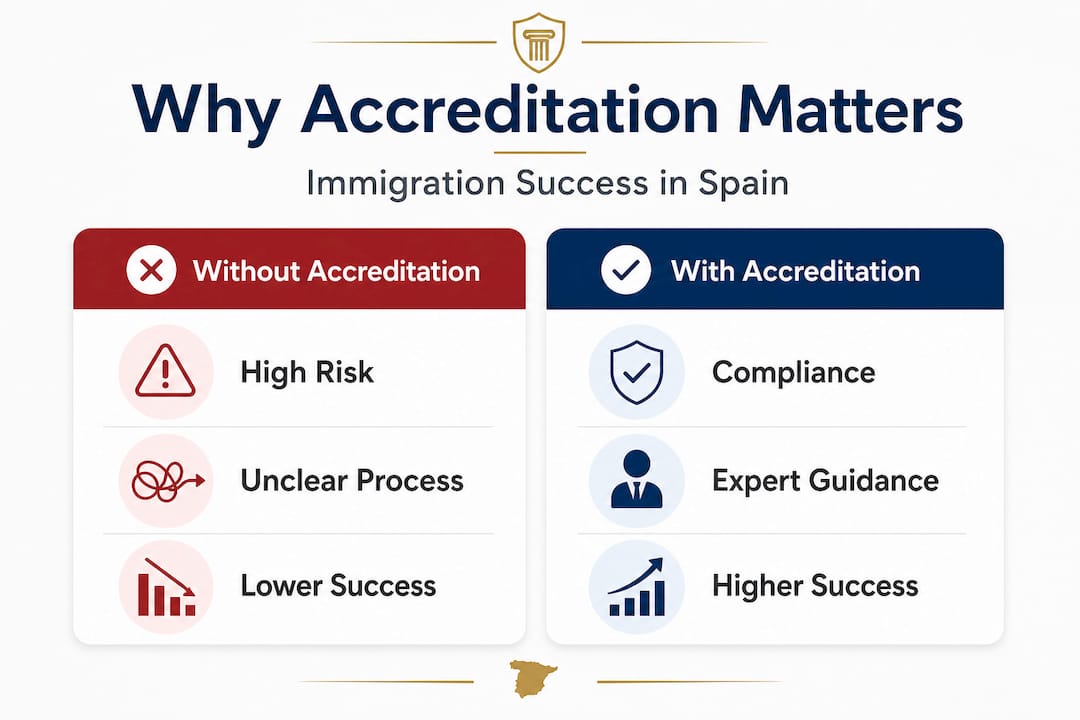
The data is not subtle. For high-stakes applications with firm deadlines, like arraigo social or extraordinary regularization, the risk of going it alone is substantial. Accredited support is not a luxury — it is a structural advantage.
What an accredited legal representative actually does
But what does accredited support look like in action? Here’s how an expert handles your application, from start to final resolution.
Specialist firms describe end-to-end work that includes preliminary legal assessment, collecting and reviewing supporting documents for consistency and completeness, and monitoring updates and procedural requirements that affect residency applications. This is not just administration — it is legal strategy applied to a regulated process.
Here is what a typical workflow looks like step by step:
- Initial legal assessment: The representative reviews your situation — how long you have been in Spain, your employment history, your documentation, and any previous immigration history — to identify which route fits best.
- Route selection: Whether that is arraigo social, residencia prácticas, EU registration, búsqueda de empleo, or the extraordinary regularization, the right path matters enormously for your chances.
- Document collection and review: Every supporting document is checked for authenticity, consistency, and compliance with current legal requirements. Discrepancies are flagged before submission.
- Application preparation: Forms are completed accurately, translated if necessary, and assembled in the correct order with appropriate supporting materials.
- Electronic submission through the registry: Because they are accredited, the representative submits through the official channel that Spanish authorities recognize.
- Monitoring and response management: After submission, the case is tracked. If authorities issue a requerimiento or request clarification, the representative responds within the legal deadline.
- Final resolution and next steps: Whether the outcome is approval, conditional approval, or denial with appeal rights, the representative explains the result and advises on next steps.
Pro Tip: Accredited specialists monitor legal and procedural updates that others overlook entirely. Spain’s immigration rules shifted significantly with Order ISM/164/2026. Professionals registered under that order stay current on changes; informal advisers often do not.
One major area where applicants get into trouble without accredited help is the coherence of evidence. For example, proving continuous residency in Spain requires consistent documentation across multiple sources: rental contracts, utility bills, employer records, and official registrations (empadronamiento). A gap in any of these, or a mismatch in dates, can weaken the entire case. An accredited representative cross-checks all of this before filing, which is something very few self-represented applicants do systematically.
Nuances and limits: Accreditation is critical, but not a guarantee
Having seen the workflow, it’s essential to understand what legal accreditation does not promise and the crucial nuances that help set realistic expectations.
Legal accreditation gives you a legitimate channel, expert methodology, and process protection. It does not create eligibility where none exists. Eligibility still depends on meeting criteria, even if you are using an accredited expert. If you do not meet the substantive statutory conditions — including continuous presence in Spain, clean criminal record, and no threat to public order — no level of representation will change that outcome.
Here are the most common scenarios where applicants have mistaken expectations:
- “I’ve lived here for years, so I qualify.” Not automatically. The extraordinary regularization has specific documentary requirements for proving continuous presence. Living here and proving you lived here are two different things.
- “My lawyer will handle everything.” A good accredited representative handles process; you still need to provide accurate, complete, and honest information.
- “Accreditation means approval.” No. It means your application is processed through the correct channel with professional preparation. Approval depends on the facts of your case.
- “I can file any time before the deadline.” Leaving it to the last week before June 30, 2026, is extremely risky. Systems get overloaded and last-minute document issues cannot be resolved in time.
“An accredited representative is a process expert, not a miracle worker. They maximize your chances by ensuring everything is done correctly — but they cannot override the law’s substantive requirements.”
There is one scenario where accreditation becomes especially critical beyond normal cases: vulnerable applicants with limited financial means or language barriers. For these individuals, a verified route through a registered collaborator determines whether they can access the process at all. Without an accredited representative, some submission channels are simply unavailable. That is not a technicality — it is a structural barrier that accreditation removes.
If you are working through the Spanish nationality application process or another long-term pathway, the stakes of errors are similarly high. Mistakes made early in a residency history can complicate later applications significantly.
Why trusting the process alone is not enough: Hard truths for 2026
Here is what most guides skip over entirely: Spain’s immigration system is not designed to help you succeed. It is designed to process applications. Those are not the same thing.
The extraordinary regularization of 2026 is a genuine opportunity for hundreds of thousands of undocumented migrants. But the Spanish administration is not proactive. It does not send reminders, flag errors, or tell you which document is missing before making a decision. It processes what it receives, within the rules, without hand-holding.
We have seen patterns repeat across cases: someone prepares everything independently, submits on time, and then receives a rejection notice for a reason they could have easily fixed with expert eyes on the file. A missing page. A document from the wrong time period. An unsigned form. These are not edge cases — they are routine.
What is harder to talk about is the informal “immigration help” market in Spain. Plenty of people charge fees to help with immigration paperwork while carrying no official accreditation, no professional liability, and no accountability if things go wrong. When their clients get rejected, there is no recourse. No file to transfer. No formal record of what was submitted. This is not just inefficient — it is actively dangerous for someone with a genuine legal right to regularize.
The advantages of accredited support go well beyond paperwork. They include accountability, legal knowledge applied to your specific situation, and the reassurance that comes from knowing your application was handled correctly. For anyone navigating Spain’s 2026 frameworks, that reassurance has real, measurable value.
The hard truth is that the applicants who will succeed in 2026 are those who treat this as the high-stakes legal process it is, not as a form-filling exercise. Accreditation is the signal that your representative is qualified, registered, and legally responsible for the work they do on your behalf.
Next steps: Secure your path with accredited support
If you have been reading this and thinking about where your own case stands, the next logical step is getting an expert assessment before the clock runs out.
Vive Legal provides fully accredited, end-to-end immigration support across all major Spain residency pathways. Whether you are pursuing extraordinary regularization 2026, an arraigo route, or another residency process, the platform combines professional legal oversight with streamlined digital management. Every case gets a personalized eligibility review, document verification, and tracked submission through official channels. If you need arraigo social assistance or want to understand your full range of options, explore Vive Legal’s full-service immigration management to get started. The June 30, 2026 deadline is not moving — but with the right accredited support, your application can be ready well before it arrives.
Frequently asked questions
Who qualifies as an accredited immigration collaborator in Spain?
Registered lawyers, authorized organizations, and professionals listed in Spain’s registry under Order ISM/164/2026 are recognized as accredited immigration collaborators authorized to submit applications electronically on behalf of applicants.
Does using an accredited legal representative guarantee approval?
No. Eligibility criteria must be met regardless of who represents you — accreditation improves process quality and reduces errors, but it does not override the legal requirements for each permit or regularization pathway.
What happens if I miss the deadline for Spain’s extraordinary regularization in 2026?
Applications are not accepted after June 30, 2026, meaning you would need to pursue a different residence pathway, which may require additional time, documentation, or eligibility conditions.
Is it possible to apply without legal accreditation?
Individuals can sometimes self-represent, but Spain’s electronic registry system requires an accredited collaborator for official electronic submissions in many processes, and going without one significantly increases the risk of rejection or procedural errors.
Recommended
Living legally in Spain shouldn't be difficult.
View services and pricesNot sure which procedure you need? Find out in 2 min
Questions? Message us on WhatsApp