
Why legal diagnosis prevents immigration setbacks in Spain

TL;DR:
- A legal diagnosis provides a professional assessment of your immigration status, helping prevent common application errors. It is especially vital for complex cases like family reunification, Arraigo, or prior refusals, where mistakes are costly. Getting a legal review upfront saves time, money, and reduces the risk of rejection in Spain’s intricate immigration system.
Roughly 15% of Schengen applications get rejected — and for complex residency cases in Spain, that rate climbs much higher. What’s frustrating is that most of those refusals trace back to completely avoidable errors: missing paperwork, wrong translations, or a simple misunderstanding of eligibility rules. A legal diagnosis is a structured, professional review of your immigration situation before you ever submit a single document. Done right, it transforms a stressful guessing game into a clear, confident path toward approval. This article explains what legal diagnosis actually is, why skipping it costs far more than it saves, and who needs it most.
Living legally in Spain shouldn't be difficult.
View services and pricesNot sure which procedure you need? Find out in 2 min
Questions? Message us on WhatsApp
Table of Contents
- What is a legal diagnosis and when do you need one?
- Common immigration pitfalls in Spain: What applicants overlook
- Proactive diagnosis vs. reactive fixes: The real cost of waiting
- Who benefits most from legal diagnosis?
- The overlooked advantage of legal diagnosis: Our view
- Get peace of mind with a legal diagnosis in Spain
- Frequently asked questions
Key Takeaways
| Point | Details |
|---|---|
| Hidden rejection risks | Many immigration refusals stem from issues a legal diagnosis would spot early. |
| Cost-saving strategy | Upfront legal assessment is far less expensive than fixing rejected applications or appealing. |
| Who should get help | International students, foreign workers, and those with prior refusals especially benefit from legal diagnosis. |
| Success means invisibility | Avoiding trouble thanks to a diagnosis means you may never see the drama it saved you from. |
What is a legal diagnosis and when do you need one?
Think of a legal diagnosis the way you’d think of a medical checkup before a major procedure. A doctor doesn’t start operating without first reviewing your full health picture. Similarly, a legal diagnosis is a thorough professional assessment of your immigration status, documentation, and eligibility before you file any formal application with Spanish authorities.
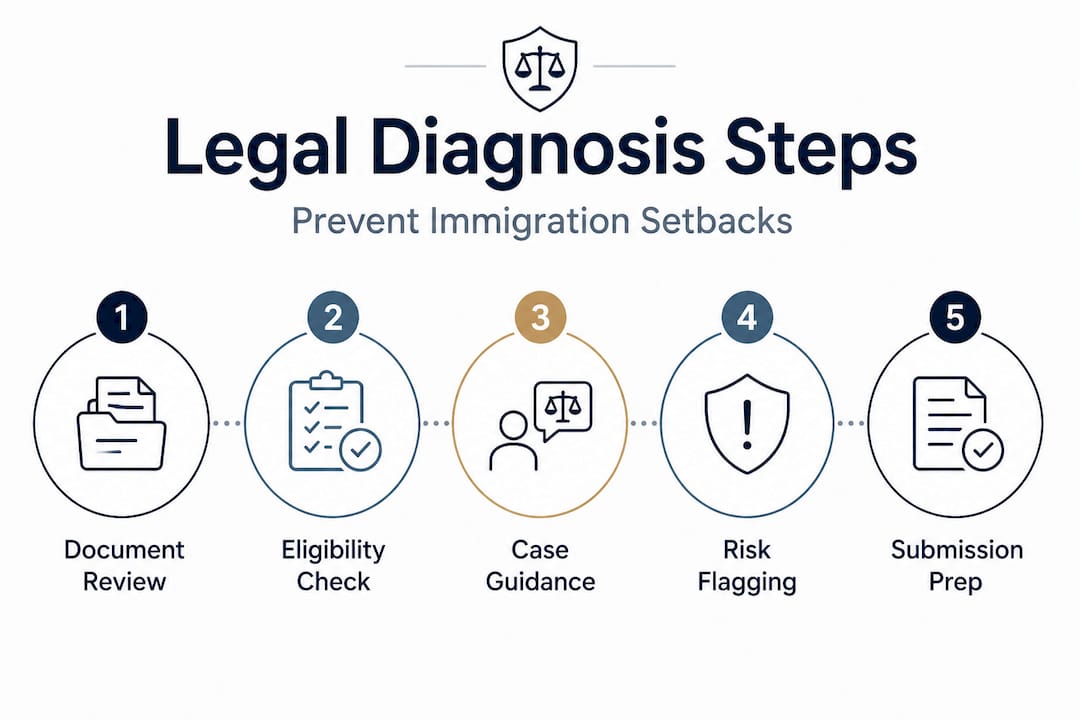
In practical terms, it means a qualified immigration specialist examines your case from the ground up. They look at your current visa or residence permit, your employment situation, your civil status, your length of stay, and any prior issues with Spanish immigration authorities. Then they identify what permit you qualify for, what documents you’re missing, and whether any red flags in your file could cause problems.
This kind of upfront immigration case review is most critical in certain moments. These include:
- Residency renewals, where outdated documents or a missed deadline can reset your entire progress
- Job contract changes that may affect the type of permit you hold or your right to continue working
- Transitioning from student to work permit, which involves different criteria and is one of the most misunderstood paths
- Family reunification, which requires careful documentation on both sides and precise income thresholds
- Arraigo and regularization cases, where background issues or gaps in the timeline can be disqualifying without proper preparation
- Cases involving prior refusals, where previous decisions can shadow new applications if not addressed correctly
The reality is that Spanish immigration law is genuinely complex. Rules change. Required documents vary by autonomous community. Consulate interpretations differ. Without a clear legal map of where you stand, it’s easy to take a wrong turn with real consequences.
Pro Tip: Even if you’ve applied successfully before, your circumstances may have changed. A new employer, a gap in social security contributions, or an expired apostille can all become grounds for refusal. A diagnosis catches these before they become problems.
Avoidable errors cause most refusals, and that pattern holds across all case types. Getting a legal diagnosis before you act is the smartest insurance policy available to any immigrant in Spain.
Common immigration pitfalls in Spain: What applicants overlook
Once you understand what a legal diagnosis does, the next step is understanding why it’s so necessary. Spain’s immigration process is detailed and unforgiving. Officers don’t give credit for effort — they check boxes, and if yours aren’t checked, your application goes back marked refused.
Here are the most common mistakes applicants make, ones that a diagnosis consistently reveals before they cause damage:
- Expired supporting documents: A criminal background check, medical certificate, or apostille has a limited validity window. Submitting one that’s even one day past its expiration date is grounds for refusal.
- Misunderstanding eligibility criteria: Many applicants apply for the wrong permit type entirely, especially those switching from student to worker status, which involves specific qualifying conditions that aren’t always obvious.
- Incomplete or unofficial translations: Spain requires certified translations from official translators for any document not originally in Spanish. Unverified translations are automatically rejected.
- Insufficient proof of economic means: Financial thresholds shift depending on permit type and family size. Many applicants underestimate what they need to demonstrate.
- Missing ties to Spain: For certain permits, authorities want to see social or community integration. Without structured evidence, this is easy to misrepresent or under-document.
- Incomplete application forms: Spanish immigration forms change, and using an outdated version — even if you filled it out perfectly — can cause your application to be rejected on procedural grounds.
“Applications are often rejected for errors that could have been detected with an initial legal review.”
For example, nationality applications in Spain involve years of preparation and specific continuous residence requirements. Many applicants discover late that a short trip abroad or a brief period without valid status has broken their required continuous residence. A legal diagnosis surfaces these issues before you’ve invested years of effort into a doomed application.
Here’s how legal diagnosis directly counters these common mistakes:
| Common applicant mistake | How legal diagnosis pre-empts it |
|---|---|
| Submitting expired documents | Flags document expiration dates early in the review |
| Applying for the wrong permit type | Maps your situation to the correct permit category |
| Using uncertified translations | Identifies which documents require official translation |
| Underestimating financial proof | Calculates exact thresholds for your specific case |
| Incomplete or outdated forms | Confirms current required forms and fields |
| Missing integration evidence | Lists what qualifies as valid proof for your case type |
Refusal rates run around 15% for simpler Schengen applications and substantially higher for complex residency scenarios. These numbers aren’t inevitable. They’re largely the result of applicants flying blind into a system that rewards preparation.
Proactive diagnosis vs. reactive fixes: The real cost of waiting
Most people only think about getting legal help after something has gone wrong. That instinct is understandable, but in immigration, waiting until you receive a refusal letter multiplies your problems significantly.
Here’s what the proactive path looks like when you get a legal diagnosis before submitting:
- Initial assessment: A specialist reviews your documents, residency history, and current situation.
- Eligibility confirmation: You receive a clear picture of which permits you qualify for and what conditions apply.
- Document checklist: Every required document is identified, including which need updating or official translation.
- Pre-submission review: Your completed forms and paperwork are checked against current requirements.
- Submission with confidence: Your application goes in complete, correctly formatted, and on time.
Now contrast that with what happens after a refusal:
- You wait weeks or months for a formal decision letter.
- You must analyze the specific grounds for rejection, often in dense legal language.
- You hire legal help to determine whether to appeal or reapply from scratch.
- If appealing, you enter a process that can take six to eighteen months with no guarantee of success.
- Your residence status may become uncertain during this waiting period, limiting your ability to work or travel.
- You gather the same documents again, this time under pressure, paying for rush translations and certifications.
Upfront assessment dramatically reduces refusals and the bureaucratic spiral that follows a rejection. The immigration guides available through specialist platforms make this comparison even clearer with real case outcomes.
Pro Tip: Early legal review almost always costs a fraction of what fixing a preventable rejection costs, both in money and time. A single appeal can stretch your uncertainty by more than a year.
Here’s a concrete side-by-side comparison:
| Factor | Pre-diagnosis approach | Post-refusal reaction |
|---|---|---|
| Time to resolution | 4 to 8 weeks | 6 to 18 months |
| Financial cost | Low to moderate | High (legal fees, reapplication) |
| Document stress | Organized and structured | Rushed, high-pressure |
| Outcome certainty | High | Uncertain |
| Impact on daily life | Minimal | Significant disruption |
| Emotional toll | Manageable | Very high |
The math isn’t complicated. Spending a modest amount upfront on a legal review is a straightforward investment that pays for itself many times over in avoided delays, legal fees, and anxiety. Understanding terms of legal service engagement early also helps you know exactly what to expect from a professional review.
Who benefits most from legal diagnosis?
While anyone applying for a Spanish visa or residency permit can benefit from a diagnosis, certain groups have the most to gain. For them, skipping this step isn’t just a risk — it’s a significant gamble with their future in Spain.
Students shifting immigration status are among the most vulnerable. Moving from a student permit to a work authorization involves criteria that aren’t widely publicized, specific timelines, and employer involvement. Many students underestimate how much their previous permit type affects their new application. Those considering study center immigration pathways should always get a legal check before making the leap.
Non-EU workers face a layered system of work authorization requirements tied directly to their employer’s situation, sector quotas, and labor market conditions in Spain. A change in employer or contract type can unexpectedly invalidate a permit renewal. Without a diagnosis, these workers often don’t realize their vulnerability until they get a refusal letter.

People with prior refusals carry a documented immigration history that Spanish authorities will review. A past rejection on record can influence how future applications are assessed. Getting a diagnosis helps you understand how to address that history strategically rather than ignoring it and hoping for the best.
Applicants pursuing Arraigo or regularization face some of the most complex requirements in the Spanish system. Arraigo social cases require specific documentation of social integration, economic ties, and continuous residence. The margin for error is small and the documentation required is substantial.
Long-term EU residency applicants must demonstrate uninterrupted legal residence, sufficient financial resources, and health coverage. EU long-term residency applications are reviewed with heightened scrutiny, and a single gap in continuity can disqualify you.
A critical insight: refusal rates are especially high for complex, multi-factor cases. The more moving parts your application has, the more opportunities there are for something to go wrong. A legal diagnosis maps all of those moving parts and identifies where the weak points are before the administration does.
Stat to know: Applicants with non-standard backgrounds or prior immigration difficulties face refusal rates significantly above the baseline — making proactive legal review not optional, but essential.
The overlooked advantage of legal diagnosis: Our view
Here’s something we’ve noticed after working with hundreds of applicants in Spain: legal diagnosis is chronically undervalued precisely because it works best when you don’t notice it. When everything goes smoothly, when your permit arrives on time and your documents are all accepted, you might not even connect that outcome to the careful review that made it possible. Success is invisible.
That invisibility creates a false impression that immigration is simpler than it is. Applicants who sailed through an application once often assume the second time will be just as easy. But their circumstances have changed. A new employer, a different permit type, a child added to the household — any of these shifts the legal picture enough to create new risks.
We’ve seen highly educated professionals get tripped up by procedural details that have nothing to do with their qualifications. We’ve seen long-term residents, people who’ve lived in Spain for a decade, get refused on renewal because of a documentation lapse they genuinely didn’t know about. These aren’t cases of carelessness. They’re cases of navigating a complex system without a map.
The team behind our immigration experience has seen this pattern repeatedly. The applicants who invest in a legal diagnosis upfront are not more cautious by nature — they’re simply better informed about what’s actually at stake. Once you understand how easily an avoidable mistake can cost you six months of legal status uncertainty, the calculus changes completely.
Our honest take: immigration authorities are not there to help you succeed. They process applications against a fixed criteria list. A legal diagnosis is your own advocate in that process, someone looking at your case through the same critical lens the administration will use.
Get peace of mind with a legal diagnosis in Spain
Navigating Spain’s immigration system is manageable when you have the right support from the start. You don’t have to guess which documents you need, whether you qualify, or whether your paperwork is in order.
Vive Legal offers exactly the kind of structured, expert legal diagnosis we’ve been describing throughout this article. Whether you’re handling a standard renewal or a complex extraordinary regularization case, the platform combines professional legal oversight with digital efficiency to review your situation, flag any risks, and prepare you for a successful submission. From students navigating study center immigration solutions to workers managing permit changes, you can access full immigration support online without the stress of traditional gestorías. Your next step is a legal diagnosis, not a gamble.
Frequently asked questions
What does a legal diagnosis include for Spanish immigration?
A legal diagnosis reviews your documents, eligibility, and case type to detect any issues before you submit, giving you a clear action plan based on your specific situation. Upfront assessment helps you avoid the most common causes of preventable refusals.
Is legal diagnosis necessary for simple visa renewals in Spain?
Even for renewals, a diagnosis can catch timing errors, outdated paperwork, or missed requirements that look minor but lead to refusal. Avoidable errors affect all case types, not just complex ones.
How much time can a legal diagnosis save?
It can prevent months of delays caused by refusals or reapplying due to missing information. Legal diagnosis reduces refusals and avoids the lengthy bureaucratic process that follows a rejection.
Are there certain immigrant types who should always get a legal diagnosis?
Applicants with complex backgrounds, prior refusals, or unusual situations benefit the most from an upfront review. Refusals run highest for multi-factor or non-standard residency cases, making diagnosis especially critical for those profiles.
Recommended
Living legally in Spain shouldn't be difficult.
View services and pricesNot sure which procedure you need? Find out in 2 min
Questions? Message us on WhatsApp