
Why Register as Autónomo in Spain: Key Benefits

Starting your independent journey in Spain can feel overwhelming when faced with strict legal responsibilities and unfamiliar paperwork. For many European freelancers and international workers, understanding how to become an autónomo is crucial to avoid fines and access valuable business rights. This guide breaks down the essential procedures, explains how to secure your social security benefits, and outlines key legal protections so you can confidently build your business in Spain.
Table of Contents
- Autónomo Status in Spain Explained
- Essential Requirements for Registration
- Tax Obligations and Social Security
- Professional Rights and Legal Protections
- Common Pitfalls and Alternative Solutions
Key Takeaways
| Point | Details |
|---|---|
| Autónomo Definition | In Spain, an autónomo is a self-employed individual responsible for their own business operations and legal obligations. |
| Registration Requirements | Becoming an autónomo requires obtaining a digital certificate, registering with the Tax Agency and Social Security, and ensuring compliance with legal obligations. |
| Tax and Social Security Responsibilities | Autónomos must handle various tax declarations and social security contributions, which can be complex compared to standard employment. |
| Legal Protections | Autonomous workers receive specific protections under Spanish law, including rights against discrimination and unfair termination of contracts. |
Autónomo Status in Spain Explained
In Spain, being an autónomo represents a unique legal and professional classification for self-employed individuals who operate their own business independently. Autonomous workers in Spain) assume full personal liability and manage their economic activities without traditional employment contracts.
Living legally in Spain shouldn't be difficult.
View services and pricesNot sure which procedure you need? Find out in 2 min
Questions? Message us on WhatsApp
The autónomo status involves several critical components that differentiate it from standard employment arrangements:
- Complete financial and legal responsibility for business operations
- Direct management of professional activities
- Personal contribution to the Spanish Social Security system (RETA)
- Independent selection of business activity codes
- Unlimited personal liability for business debts
Registering as an autónomo requires navigating specific administrative procedures. Individuals must obtain a digital certificate, select an appropriate business activity code, and register with the Social Security scheme for self-employed workers. This process ensures legal compliance and enables professional independence.
The legal framework for autonomous workers in Spain includes specialized protections through the Statute of Autonomous Workers. This legislation provides guidelines for economically dependent autonomous workers (TRADE), offering structured support for independent professionals across various sectors.
Pro tip: Consult with a local legal expert to understand the specific tax implications and registration requirements for your particular business sector before becoming an autónomo.
Essential Requirements for Registration
Registering as an autónomo in Spain involves a comprehensive set of administrative procedures that require careful attention to legal and financial details. Registering requires specific documentation and compliance with multiple government agencies, making the process more complex than standard employment registration.
The essential requirements for becoming an autónomo include several critical steps:
- Obtaining a valid digital certificate
- Acquiring a Spanish social security number
- Selecting an appropriate business activity code
- Registering with the Tax Agency (Agencia Tributaria)
- Declaring mandatory occupational hazard insurance
- Providing valid identification documents
- Completing official registration forms
Foreign entrepreneurs must additionally demonstrate legal residency status and ensure all documentation is properly translated and authenticated. The registration process typically involves interactions with two primary government entities: the Social Security Administration (RETA) and the Tax Agency, each requiring specific forms and verification procedures.

The legal framework mandates that autónomos assume complete personal liability for their business operations. This means entrepreneurs are responsible for all financial obligations, with no legal separation between personal and business assets. Potential autónomos must carefully evaluate their financial capacity and risk tolerance before proceeding with registration.
This summary highlights main government entities and their key registration functions:
| Agency | Role in Registration | Required Documents |
|---|---|---|
| Tax Agency | Tax code assignment, returns | ID, tax form, activity code |
| Social Security (RETA) | Social security enrollment | ID, residency, application form |
| Local Government | Business licenses, activity approval | License application, certifications |
Pro tip: Consult with a Spanish legal professional who specializes in autonomous worker registration to ensure you complete all documentation accurately and avoid potential administrative complications.
Tax Obligations and Social Security
Autónomos in Spain face complex financial responsibilities that extend beyond typical employment taxation. Spanish tax system for autonomous workers requires comprehensive understanding of multiple financial obligations and social security contributions.
Key tax and social security requirements for autónomos include:
- Monthly social security contributions
- Personal income tax (IRPF) declarations
- Value-added tax (VAT) submissions
- Quarterly and annual tax returns
- Mandatory health and pension insurance contributions
- Self-assessment of tax liabilities
- Regional tax variations
The social security contribution system operates on a progressive model that links contributions directly to declared income. Autónomos can choose their contribution base, which determines their future pension and healthcare benefits. This flexibility allows entrepreneurs to balance current financial constraints with long-term social security protection.
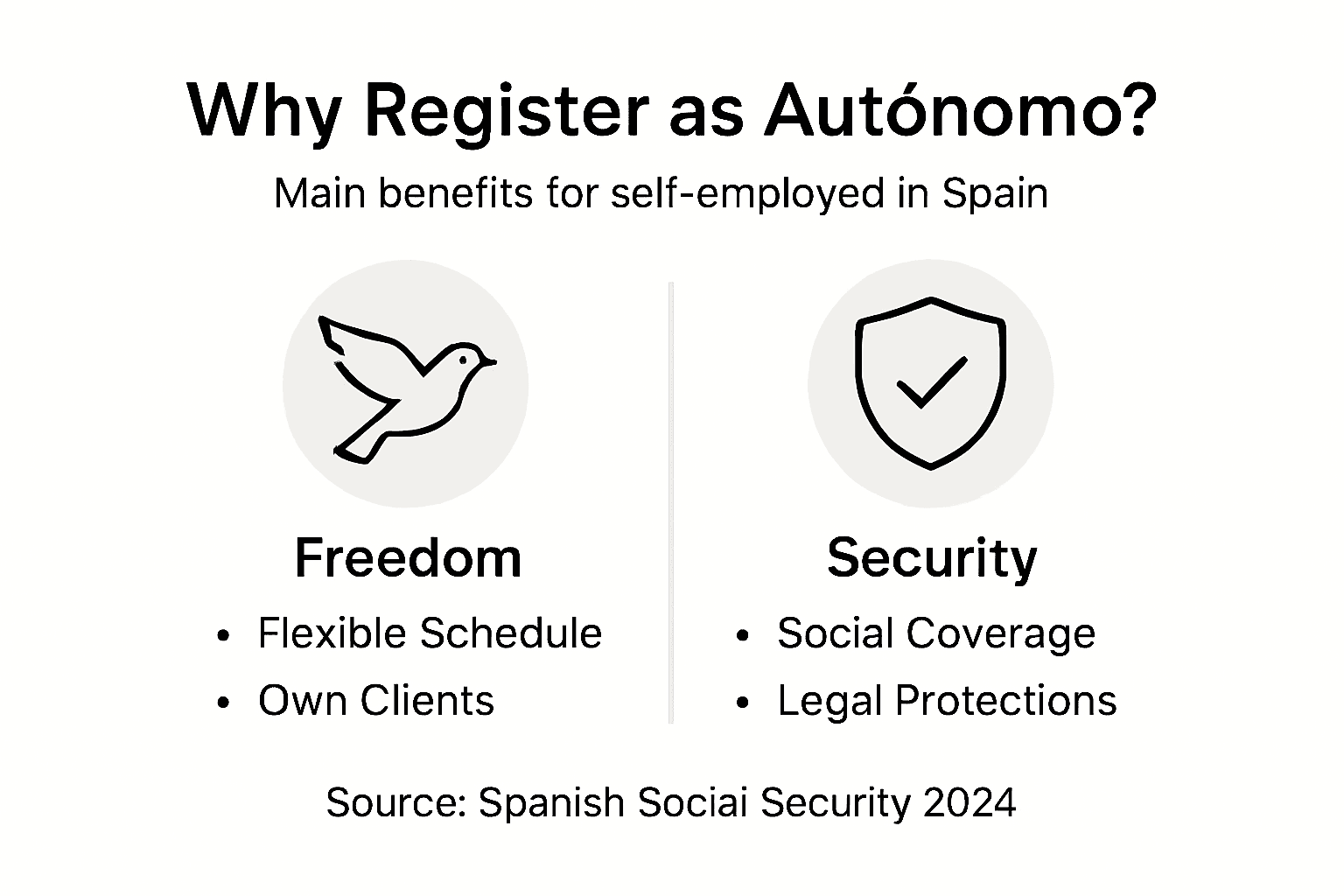
Recent reforms have introduced more flexible contribution structures, enabling new and low-income autonomous workers to pay reduced rates during their initial business years. However, these contributions remain mandatory and provide critical access to healthcare, unemployment benefits, and pension systems. Entrepreneurs must carefully navigate these financial obligations to maintain legal compliance and secure their social safety net.
Pro tip: Consult with a Spanish tax professional who specializes in autonomous worker taxation to optimize your contribution strategy and avoid potential financial penalties.
Professional Rights and Legal Protections
Autónomos in Spain benefit from comprehensive legal protections established under the Estatuto del Trabajo Autónomo which safeguards their professional independence and fundamental worker rights. This specialized legislation ensures autonomous workers receive critical legal and social protections that distinguish their professional status.
Key professional rights for autónomos include:
- Non-discrimination protection
- Right to professional development
- Access to social security benefits
- Occupational accident insurance coverage
- Protection against unfair contract termination
- Right to collective representation
- Legal safeguards for economic dependents (TRADE)
The legal framework recognizes the unique challenges faced by self-employed professionals, providing mechanisms to protect their economic interests and professional autonomy. This includes regulations that prevent arbitrary contract cancellations and ensure fair compensation for services rendered, addressing the vulnerability often experienced by independent workers.
Economically dependent autonomous workers (TRADE) receive additional protections, including minimum contract duration requirements and specific dispute resolution mechanisms. These provisions aim to balance the power dynamic between autonomous professionals and their primary clients, creating a more equitable working environment that recognizes the professional status of self-employed individuals.
Pro tip: Maintain detailed documentation of all professional contracts and communications to effectively leverage your legal protections as an autónomo.
Common Pitfalls and Alternative Solutions
Navigating the autónomo landscape in Spain requires careful understanding of potential challenges and strategic alternatives. Autónomo registration complexities can lead to significant administrative and financial risks for unprepared entrepreneurs.
Common pitfalls for autonomous workers include:
- Misunderstanding tax declaration requirements
- Failing to maintain accurate financial records
- Underestimating social security contribution obligations
- Overlooking mandatory insurance coverages
- Incorrect business activity code selection
- Inadequate financial planning
- Neglecting potential tax deductions
One notable alternative solution is the limited liability autónomo status, which provides additional protection for personal assets. This classification helps mitigate the risks associated with unlimited personal liability, allowing entrepreneurs to shield their primary residence and personal property from potential business debts.
Here’s a comparison of autónomo types and their liability implications:
| Type of Autónomo | Liability Scope | Asset Protection |
|---|---|---|
| Standard autónomo | Unlimited personal liability | No asset protection |
| Limited liability autónomo | Liability limited to business | Primary residence shielded |
| TRADE (economically dependent) | Personal liability with extra protections | Minimum contract protections |
The Spanish legal system offers several strategic alternatives for autonomous workers seeking to minimize financial risks. These include specialized support programs, subsidies for new entrepreneurs, and flexible contribution structures that accommodate varying income levels. Entrepreneurs can also explore hybrid business models that balance professional independence with reduced financial exposure, such as forming a limited liability company or partnering with professional associations that offer additional legal protections.
Pro tip: Consult with a Spanish legal and tax professional to develop a comprehensive strategy that addresses your specific business needs and minimizes potential administrative and financial risks.
Simplify Your Path to Autónomo Registration with Expert Legal Support
Registering as an Autónomo in Spain can be overwhelming due to complex administrative requirements like obtaining a digital certificate, choosing the right business activity code, and handling social security contributions. Many face challenges managing tax obligations and ensuring compliance with legal protections. If you want to avoid costly mistakes and secure your self-employed status with confidence, professional guidance is essential.
Uncategorized Archives - Vive Legal offers tailored legal consultancy that streamlines these procedures with personalized diagnostics, document review, and step-by-step support.
Take control of your Autónomo journey today by leveraging the digital expertise at Vive Legal. Get started now to ensure your registration is smooth, your tax responsibilities are optimized, and your legal protections fully secured. Visit us to simplify your legal path and protect your future as a self-employed professional in Spain.
Frequently Asked Questions
What are the main benefits of registering as autónomo?
Registering as autónomo provides several key benefits, including complete control over your business operations, the ability to choose your work hours, and the opportunity to enjoy tax deductions on business expenses. Additionally, autónomos have access to social security benefits, including healthcare and pensions.
What financial responsibilities do autónomos have?
Autónomos are responsible for various financial obligations, including paying monthly social security contributions, filing personal income tax (IRPF) declarations, and submitting value-added tax (VAT) returns. They must also maintain accurate financial records and ensure compliance with tax regulations.
Can I limit my personal liability as an autónomo?
Yes, you can opt for a limited liability autónomo status, which provides additional protection for your personal assets. This classification helps shield your primary residence and personal property from business debts, unlike the standard autónomo status where you have unlimited personal liability.
What legal protections are available for autónomos?
Autónomos benefit from various legal protections, including non-discrimination rights, access to social security benefits, and occupational accident insurance. Specifically, economically dependent autonomous workers (TRADE) receive additional safeguards against unfair contract termination and minimum contract duration requirements.
Recommended
Living legally in Spain shouldn't be difficult.
View services and pricesNot sure which procedure you need? Find out in 2 min
Questions? Message us on WhatsApp