
Spain Tax Residency Explained for Expats in 2026

TL;DR:
- Spanish tax residency is established by spending over 183 days in Spain, having economic interests there, or maintaining a family in the country. Meeting any one of these criteria makes an individual a resident liable for worldwide income tax, with rules evaluated annually and potentially complicated by dual residency issues. Proper documentation, proactive planning, and understanding these criteria are essential for compliance and avoiding costly surprises.
Spanish tax residency is defined as spending more than 183 days in Spain during a calendar year, or having your primary economic interests or family ties centered there. This distinction matters enormously: residents pay tax on worldwide income, while non-residents pay only on Spanish-sourced income. The rules governing Spain tax residency status are set out in the Ley del IRPF (Personal Income Tax Law) and apply to every expat, remote worker, and foreign national living in or relocating to Spain. Understanding these criteria before you move, not after, is the difference between a manageable tax situation and a costly surprise.
Living legally in Spain shouldn't be difficult.
View services and pricesNot sure which procedure you need? Find out in 2 min
Questions? Message us on WhatsApp
Tax residency explained: Spain’s core criteria
Spanish tax residency is assessed on a calendar-year basis from January 1 to December 31, with no split-year treatment under domestic law. You are either a resident or a non-resident for the entire tax year. There is no partial-year status that softens the obligation. This is the first thing most expats get wrong when they move mid-year.
Three separate criteria can each independently trigger Spanish tax resident status:
- The 183-day rule. You spend more than 183 days in Spain during the calendar year.
- Centre of economic interests. Spain is where your main business activity, investments, or employment income originates.
- Family tie presumption. Your spouse and dependent minor children habitually live in Spain.
Meeting any one of these three criteria is enough. You do not need to satisfy all three. This is a critical point that many expats overlook when planning a move or structuring their finances across borders.
How the 183-day rule determines tax residency in Spain

The 183-day presence test is Spain’s primary statutory method for establishing tax residency, and it works exactly as it sounds. If you are physically present in Spain for more than half the calendar year, you are a Spanish tax resident. The counting method, though, has one detail that catches people off guard.
Any partial day in Spain counts as a full day for this test. Arrive on December 31 at 11:55 PM and that counts as a full day in Spain. This rule is especially consequential during move-in and move-out years, when you may underestimate your total count by several days.
Here is how to count accurately:
- Start a day-by-day spreadsheet from January 1. Log every entry and exit from Spain with dates, destinations, and purpose of travel.
- Count partial days as full days. If you land in Madrid at 10 PM, that day is in Spain.
- Include all trips back, even short ones. A weekend visit to Spain from abroad adds two or more days to your count.
- Do not rely on passport stamps alone. Within the Schengen Area, there are no stamps. Use boarding passes, hotel receipts, and bank transactions as corroborating evidence.
- Review your count quarterly, not just at year-end. By October, you should know whether you are approaching the 183-day threshold.
Pro Tip: Build your travel log in a shared document with your accountant or legal advisor. If the Agencia Tributaria (Spain’s tax authority) ever audits your residency status, a well-maintained log is your strongest defense.
The calendar-year rule also means there is no benefit to leaving Spain in late November if you have already crossed 183 days. Once the threshold is met, residency is confirmed for that full year. Planning your physical presence proactively, before the year begins, is the only way to manage this effectively.
What role do economic interests and family ties play?
Even if you spend fewer than 183 days in Spain, you can still be treated as a Spanish tax resident if Spain is your centre of economic interests. This criterion looks at where your financial life is anchored, not where your body is located.
Economic interests that can trigger residency include:
- A Spanish-registered business or self-employment activity
- Significant investment portfolios held through Spanish banks or brokerages
- Rental income from Spanish property that forms a primary income source
- Employment contracts with Spanish companies, even if you work remotely from abroad
The family tie rule adds another layer. If your spouse and minor children habitually live in Spain, Spanish tax authorities presume you are a resident too. This presumption can be rebutted, but the burden of proof falls on you. You would need to demonstrate tax residency in another country, typically through a foreign tax residency certificate or evidence of substantial presence elsewhere.
Family residency risk often hinges more on where your spouse and children live than on your own day count. A parent who spends 140 days in Spain but whose family lives in Madrid full-time is likely to be treated as a Spanish tax resident. This is a scenario that affects many internationally mobile professionals who assume their limited personal presence protects them.
Pro Tip: If you are separating your physical presence from your family’s location for tax planning purposes, get a formal legal opinion before the tax year begins. Retroactive restructuring is far more expensive than proactive planning.
The 183-day rule is a starting filter, not a complete answer. Economic and family ties can override a low day count entirely. Understanding all three criteria together is what separates informed expats from those who receive unexpected tax bills.
How does tax residency affect your obligations in Spain?
The tax consequences of residency status are significant and affect both your filing obligations and your effective tax rate.
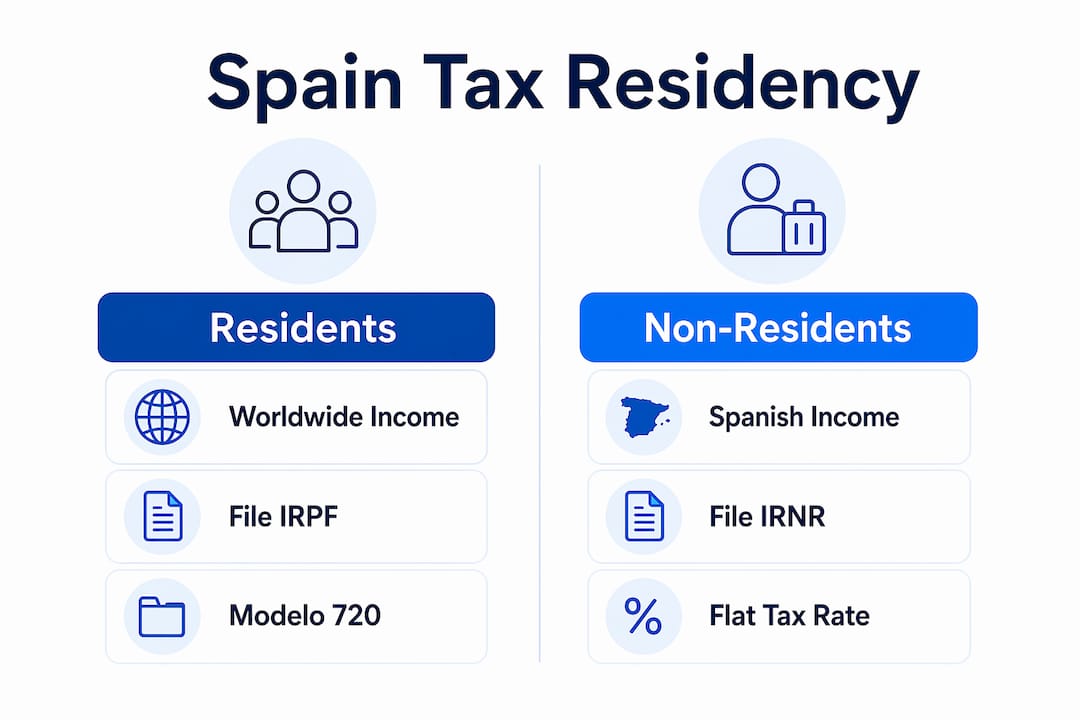
| Category | Tax Residents (IRPF) | Non-Residents (IRNR) |
|---|---|---|
| Income taxed | Worldwide income | Spanish-source income only |
| Tax form | Modelo 100 | Modelo 210 |
| Tax rate structure | Progressive (19% to 47%) | Flat rate |
| Foreign asset reporting | Modelo 720 required | Not required |
Spanish tax residents pay IRPF on all income earned globally, whether from a U.S. brokerage account, a UK rental property, or a remote job paid in dollars. Non-residents, by contrast, are taxed only on what they earn within Spain. Non-residents pay a flat 24% on Spanish-source income, or 19% if they are EU or EEA residents. That lower rate for EU residents reflects Spain’s obligations under European law.
The Modelo 720 is a reporting requirement that surprises many new residents. If you hold foreign assets worth more than €50,000 in any category (bank accounts, investments, or real estate), you must declare them annually. Failure to file carries severe penalties. This obligation applies to residents only, which is one reason some expats actively manage their residency status.
For budgeting purposes, a Spanish tax resident earning €60,000 from a mix of Spanish employment and foreign investments faces a materially different tax bill than a non-resident earning the same amount from a single Spanish rental property. The legal residency options in Spain you choose also interact with your tax status, so the two decisions should be made together.
How do double taxation treaties resolve dual residency?
When two countries both claim you as a tax resident, you face the risk of being taxed twice on the same income. Spain has double taxation treaties with over 90 countries, including the United States, the United Kingdom, Germany, and France. These treaties prevent double taxation and include structured tie-breaker rules that determine which country has the primary right to tax you.
The tie-breaker tests are applied in sequence:
- Permanent home. Where do you have a permanent home available to you? This is the first and most decisive test.
- Centre of vital interests. Where are your personal and economic relations strongest? Family, work, social ties, and financial connections all factor in.
- Habitual abode. Where do you spend more time overall, across a longer reference period?
- Nationality. If the above tests are inconclusive, your nationality determines the outcome.
Treaty tie-breaker rules provide a structured resolution, but they require you to have documentation supporting your position at each step. A Spanish tax residency certificate (Certificado de residencia fiscal), issued by the Agencia Tributaria and valid for 12 months, is the standard document used to claim treaty benefits and prove your status to foreign tax authorities. Without it, banks and foreign tax agencies may default to treating you as a resident of both countries simultaneously.
Practical tips for managing your tax residency status
Staying on the right side of Spain’s tax residency rules requires consistent habits, not just annual attention. These steps apply whether you are newly arrived or have been living in Spain for years.
- Maintain a travel log from day one. Record every entry and exit with dates, destinations, and supporting documents. Boarding passes, hotel invoices, and credit card statements all serve as evidence.
- Understand that family location matters as much as your own. If your family moves to Spain, reassess your residency exposure immediately, regardless of your personal day count.
- Apply for a tax residency certificate proactively. The Certificado de residencia fiscal is issued by the Agencia Tributaria and is required for treaty claims, banking, and foreign tax filings. Apply after you have filed your first Spanish tax return as a resident.
- Review your residency documents annually. Changes in employment, investment structure, or family situation can shift your residency status without you realizing it.
- Do not assume non-residency protects you from all obligations. Non-residents with Spanish property, rental income, or capital gains still have filing obligations under IRNR and must submit Modelo 210.
- Avoid the common mistake of conflating immigration residency with tax residency. Holding a TIE (Tarjeta de Identidad de Extranjero) or NIE does not automatically make you a Spanish tax resident. The two systems operate independently.
Staying ahead of key residency deadlines is part of this process. The Spanish tax year runs January to December, and the annual income tax filing window (Renta) typically opens in April and closes in late June. Missing it as a resident carries financial penalties.
Key takeaways
Spanish tax residency is triggered by the 183-day rule, economic interests, or family ties, and each criterion independently obligates you to pay IRPF on worldwide income.
| Point | Details |
|---|---|
| 183-day threshold | Spending more than 183 days in Spain in a calendar year confirms full-year tax residency. |
| Economic interests criterion | Business activity, investments, or employment in Spain can trigger residency even below 183 days. |
| Family tie presumption | A spouse and minor children living in Spain create a rebuttable presumption of your residency. |
| Resident vs. non-resident tax | Residents file Modelo 100 on worldwide income; non-residents file Modelo 210 on Spanish-source income only. |
| Treaty tie-breakers | Double taxation treaties resolve dual residency using permanent home, vital interests, habitual abode, and nationality tests. |
The 183-day rule is only half the story
I have worked with enough expats navigating Spanish tax law to say this plainly: the 183-day rule gets all the attention, but it is the economic interests and family tie criteria that generate the most unpleasant surprises. I have seen people meticulously count their days, stay under 183, and still receive a residency assessment from the Agencia Tributaria because their spouse relocated to Barcelona and their main consulting income came from a Spanish client.
The Spanish tax system is not designed to trap people, but it is designed to be thorough. The three-criteria framework reflects a genuine policy intent: if your life is centered in Spain, Spain expects you to contribute to its tax base. That is a reasonable position. The problem is that most expats only learn about criteria two and three after the fact.
What I consistently recommend is treating tax residency as a live question, not a one-time calculation. Your status can change mid-year based on decisions that seem unrelated to taxes. A new job, a family move, a property purchase. Each one can shift the analysis. Proactive documentation is not paranoia. It is the only practical way to defend your position if you are ever questioned.
For complex situations, particularly dual residency conflicts or cases involving multiple income sources across countries, professional advice is not optional. The cost of a proper legal and tax review is a fraction of what a residency dispute with the Agencia Tributaria will cost you in time, penalties, and stress.
— Martín
How Vive can help you stay compliant in Spain

Vive Legal specializes in immigration and residency procedures for expats living in or moving to Spain. If you are unsure about your tax residency status, need help gathering the right documentation, or want to understand how your residency permit interacts with your tax obligations, Vive’s team combines legal expertise with a fully digital process to give you clarity fast. From NIE and TIE applications to document review and compliance support, everything is managed through a secure online portal with professional oversight at every step. Review the full range of services and get started through the Vive Legal service agreement page.
FAQ
What is the 183-day rule for Spain tax residency?
The 183-day rule means that spending more than 183 days in Spain during a single calendar year makes you a Spanish tax resident for that full year. Any partial day in Spain counts as a full day toward this total.
Can I be a Spanish tax resident without living there full-time?
Yes. If Spain is your centre of economic interests, such as where your business or primary investments are based, you can be treated as a tax resident even if you spend fewer than 183 days in the country.
What taxes do non-residents pay in Spain?
Non-residents pay Non-Resident Income Tax (IRNR) on Spanish-sourced income only, at a flat rate of 24%, or 19% for EU and EEA residents. They file using Modelo 210 and are not required to report foreign assets via Modelo 720.
How do I get a Spanish tax residency certificate?
The Certificado de residencia fiscal is issued by the Agencia Tributaria after you have filed a Spanish tax return as a resident. It is valid for 12 months and is required for claiming benefits under double taxation treaties.
Does holding a NIE or TIE make me a Spanish tax resident?
No. A NIE (Número de Identificación de Extranjero) and TIE (Tarjeta de Identidad de Extranjero) are immigration documents. Tax residency is determined separately by the 183-day rule, economic interests, and family ties, not by the type of permit you hold.
Recommended
Living legally in Spain shouldn't be difficult.
View services and pricesNot sure which procedure you need? Find out in 2 min
Questions? Message us on WhatsApp