
How to get expedited residency in Spain: a 2026 guide

TL;DR:
- The 2026 Spanish regularisation offers a faster route for certain foreigners without valid status who meet specific criteria. Applicants must prepare extensive documentation, including criminal records and proof of continuous stay, and submit online before June 30, 2026. Proper eligibility verification and early preparation significantly increase the likelihood of successful and timely residency approval.
Securing legal residency in Spain has long frustrated foreigners who find themselves drowning in bureaucratic paperwork, unclear eligibility requirements, and appointment wait times that stretch for months. The good news is that 2026 brings a concrete official route that could put your residency permit in hand far faster than the standard process. This guide breaks down exactly who qualifies, what to prepare, the precise application steps, and the most common mistakes that derail applicants who are otherwise eligible. Whether you are an unregistered foreign worker, an international student looking to switch status, or an expatriate trying to formalize your stay, the information here applies directly to you.
Living legally in Spain shouldn't be difficult.
View services and pricesNot sure which procedure you need? Find out in 2 min
Questions? Message us on WhatsApp
Table of Contents
- Who qualifies for expedited residency in Spain?
- What you need to prepare for your application
- Step-by-step: How to apply for expedited residency
- What to expect after applying: timelines, next steps, and pitfalls
- Why “expedited” residency is rarely one-size-fits-all: lessons from 2026
- Fast-track your Spanish residency with proven legal guidance
- Frequently asked questions
Key Takeaways
| Point | Details |
|---|---|
| Check eligibility first | Confirm you meet at least five months’ presence and other requirements for Spain’s 2026 expedited residency before applying. |
| Prepare documents early | Gather proof of residence, a clear criminal record, and all official paperwork well before the June 30, 2026 deadline. |
| Follow each step | Submit your application to the designated Spanish authority, using digital tools for fastest results where available. |
| Know what to expect | Once accepted, you’ll receive a one-year permit with work rights, but watch out for common mistakes that can cause delays. |
| Expert help is available | Consult professional services for form reviews, document collection, and guided support if your status or path is complex. |
Who qualifies for expedited residency in Spain?
Before diving into the step-by-step process, let’s clarify whether you actually qualify for the fastest available residency options right now.
Spain has an active extraordinary regularisation process under Royal Decree 316/2026, intended specifically for certain foreign nationals already living in Spain but lacking valid legal status. This is not a general amnesty for everyone. It is a structured, time-limited program with specific eligibility gates that you must meet before the window closes on June 30, 2026.
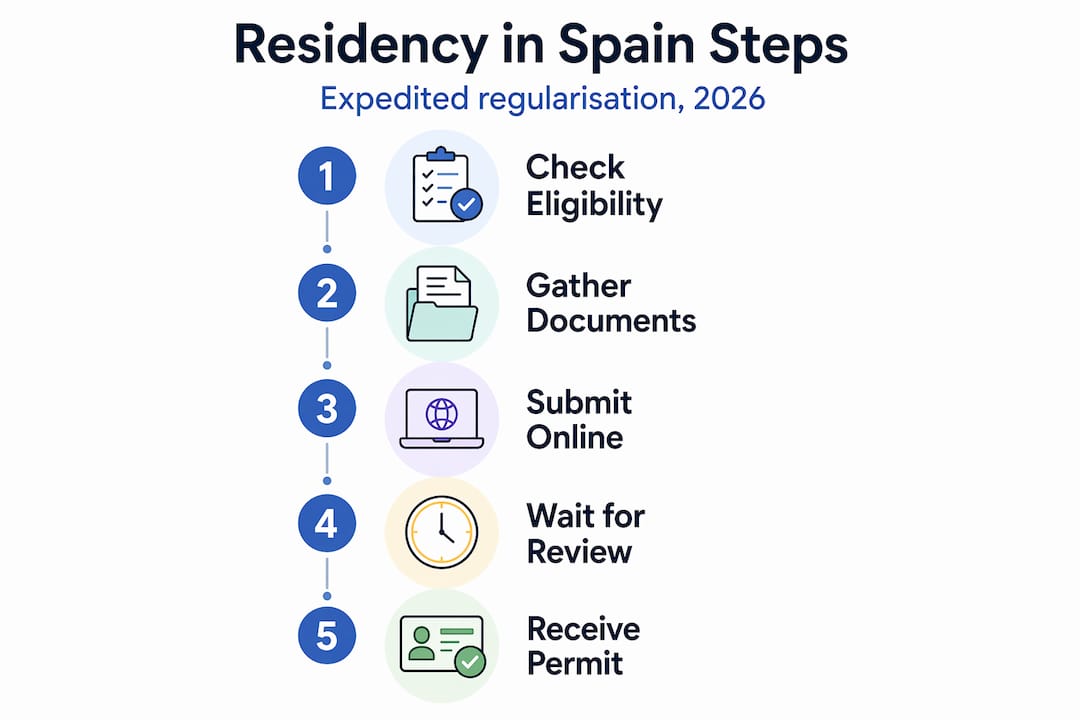
Here is a clear breakdown of the core eligibility requirements:
| Requirement | Details |
|---|---|
| Minimum stay | At least 5 months continuous presence in Spain before December 31, 2025 |
| Criminal record | Clean record from Spain and all countries of residence in the last 5 years |
| Current status | Must NOT already hold a valid Spanish residence permit |
| Nationality | NOT available for EU/EEA citizens |
| Legal barriers | Not subject to an enforceable expulsion order |
The extraordinary regularisation route specifically excludes EU/EEA nationals, since they have their own, separate registration pathway through the EU citizen registration certificate. It also requires at least five months’ continuous presence in Spain before the relevant cut-off date, a clean criminal record, and not being subject to enforceable expulsion.
Who else might qualify for faster residency?
- International workers with a valid job offer may qualify through work authorization, though that follows a longer, employer-sponsored sequence.
- International students seeking to stay after graduation can explore switching status, though no official student-specific fast track currently exists. Check out student residency options for details on indirect routes.
- Applicants seeking international protection have a separate and parallel eligibility track through CEAR (Spanish Commission for Refugee Aid).
- Arraigo social or laboral routes remain available for those who have been in Spain longer but do not meet the 2026 regularization window.
A key point many applicants miss: if you currently hold any valid Spanish residency permit, even an expired one under appeal, the extraordinary regularisation is not your route. You must use renewal or modification procedures instead, which are covered separately on the required residency documents page.
Statistic to know: Royal Decree 316/2026 is expected to affect hundreds of thousands of undocumented foreign nationals currently residing in Spain, making it the largest regularisation effort in over two decades.
What you need to prepare for your application
Once you’re certain you qualify, gathering the right documentation is critical to a fast, successful application.

Spanish immigration authorities are strict about documentation. Submitting incomplete or improperly formatted documents is one of the top reasons applications are delayed or outright denied. Preparing everything before the June 30, 2026 deadline is not optional. It is survival strategy.
Core documents you must gather:
- Valid passport (with at least six months’ validity remaining at submission)
- Proof of continuous stay in Spain for at least five months before December 31, 2025 (padron municipal certificate, utility bills, bank statements, rental contracts)
- Criminal background certificate from Spain’s Ministry of Justice and from every country you lived in during the last five years
- Proof that you are not subject to an enforceable expulsion or deportation order
- Completed application form (EX-10 or equivalent as specified by authorities at the time of submission)
- Recent passport-size photographs meeting Spanish official standards
The extraordinary regularisation route specifically requires no criminal record from Spain or prior countries of residence in the last five years, and confirmation that you are not subject to any enforceable expulsion order. These two documents alone can take weeks to obtain if requested late.
| Document | Where to obtain | Typical wait time |
|---|---|---|
| Spanish criminal record certificate | Ministry of Justice online portal | 3 to 10 business days |
| Foreign criminal record | Embassy of your home country or national authority | 2 to 8 weeks |
| Padron municipal certificate | Your local town hall (Ayuntamiento) | Same day to 5 days |
| Passport renewal (if needed) | Your country’s consulate in Spain | Varies widely |
Pro Tip: Request your foreign criminal record certificate as soon as you confirm eligibility. This document is consistently the slowest to arrive and the one that pushes applicants past the deadline. Starting even one week late can cost you the entire window.
Digital submission is available through Spain’s cl@ve and Sede Electrónica portals. Using online application tools shortens the process significantly because you avoid in-person appointment scheduling, which can add weeks. For online filing, you will need a valid digital certificate from Spain’s police (Certificado Digital FNMT) or a cl@ve PIN linked to your NIE.
Make sure every document in a foreign language is accompanied by an official sworn translation (traducción jurada) into Spanish. Authorities will not accept machine translations or informal translations. The full residency paperwork guide covers translation requirements in detail.
Step-by-step: How to apply for expedited residency
With your documentation in hand, here’s the exact sequence you’ll follow from start to finish.
-
Confirm your eligibility using the criteria in the table above. If you are unsure, consult a licensed immigration advisor before investing time in document collection.
-
Obtain your NIE (Número de Identificación de Extranjero) if you do not already have one. The NIE is your foreign identification number in Spain and is required for virtually every official transaction.
-
Register on the padron municipal at your local Ayuntamiento if you have not already done so. This is your official proof of residence and forms the foundation of your continuous stay evidence.
-
Request your criminal record certificates from both Spain and your country or countries of prior residence. Do this first. It takes longest.
-
Complete the official application form (check Spain’s Ministry of Inclusion, Social Security and Migration for the current approved form). Fill it out in full with no blank fields.
-
Submit your application either digitally through Sede Electrónica or in person at your provincial immigration office (Oficina de Extranjería). The streamlined application process guide explains how to navigate the digital portal step by step.
-
Collect your proof of submission (resguardo de presentación). Keep this document safe. It is your legal proof that you applied within the window and may grant you temporary protection while your case is reviewed.
-
Monitor your application status through Spain’s official immigration tracking system or through digital residency management tools that send automated notifications at each stage.
Pro Tip: Submit as early in the window as possible. The application window closes June 30, 2026, and the initial permit grants immediate temporary work rights upon acceptance. Earlier submission means earlier work authorization and less backlog risk.
| Stage | Who handles it | Typical duration |
|---|---|---|
| Document collection | Applicant | 2 to 8 weeks |
| Application submission | Applicant or legal advisor | 1 day (digital) to 2 weeks (in person) |
| Initial review | Oficina de Extranjería | 2 to 6 weeks |
| Permit issuance | Immigration authority | Additional 2 to 4 weeks |
For anyone applying for the first time and unsure what to expect at each stage, the first-time residency steps guide walks through each office visit and portal interaction with clarity.
What to expect after applying: timelines, next steps, and pitfalls
After submitting, here’s what you can expect and how to stay on track as your application is processed.
Once your application is submitted and acknowledged, you enter a review period managed by the Oficina de Extranjería in your province. The pace varies by location. Madrid and Barcelona offices tend to be slower due to volume, while smaller provincial offices can process cases faster.
What happens during review:
- Authorities verify your documentation for completeness and authenticity
- Background checks are confirmed with national and international databases
- You may receive a notification requesting additional documents (subsanación). Respond within the stated deadline or your application may be archived.
- Upon approval, you receive a resolution letter and are called to collect your TIE (Tarjeta de Identidad de Extranjero), your physical residency card
The initial permit validity is one year, and acceptance grants you immediate temporary work rights in any sector and location throughout Spain. This is significant: you are not restricted to a specific employer or region during this initial period.
“The extraordinary regularisation permit is valid for one year and grants immediate work authorization across all sectors in Spain upon acceptance.” — Council of Ministers, January 2026
Common mistakes that derail applications:
- Submitting under the wrong route because eligibility was not checked carefully
- Missing documents or out-of-date paperwork (criminal records older than three months)
- Late padron registration that does not cover the full five-month minimum
- Failing to include sworn translations for all non-Spanish documents
- Submitting after the June 30, 2026 deadline, which is absolute and non-negotiable
Pro Tip: Set a calendar reminder now for your permit’s renewal date. A one-year permit runs out faster than you expect. Missing the renewal window can create a gap in your legal status, forcing you to restart the process. The avoid common residency mistakes resource covers the full list of errors that cost applicants their status.
If your application is denied, do not panic. You have the right to appeal (recurso de alzada or recurso contencioso-administrativo depending on the stage). Learn your residency appeal options immediately after any negative resolution, as appeal deadlines are strict, typically one to three months from notification.
Why “expedited” residency is rarely one-size-fits-all: lessons from 2026
The extraordinary regularisation process looks clean and accessible on paper. In practice, outcomes vary enormously based on factors applicants often overlook until it is too late.
The most frequent mistake we see is applicants investing weeks of effort and money into documentation for a route they are categorically excluded from. The extraordinary regularisation specifically excludes people who currently hold any valid residence authorization or are EU/EEA nationals. Yet a significant portion of inquiries we receive come from people in exactly those categories who saw news about the process and assumed it applied to them.
The legal status “trap” is real. Your current status determines your pathway entirely, and the routes do not overlap neatly. An unregularised non-EU national living in Spain since 2023 with no criminal record is the ideal candidate. A person holding an expired student visa that is under appeal is in a legally different position. An EU citizen who simply never registered is in yet another category. Treating these as equivalent situations leads to failed applications, wasted preparation time, and in some cases, adverse legal consequences from submitting incorrect forms.
What consistently makes the difference is early preparation combined with smart use of digital residency strategy tools. Applicants who gather documents proactively, use digital submission channels, and get their eligibility confirmed by a licensed immigration professional before starting the process have measurably higher approval rates. The technology exists to automate case tracking, flag missing documents, and schedule appointments without relying on manual follow-up. Using those tools is not a luxury. In a process where a single missing document can archive your case, it is the smartest thing you can do.
The uncomfortable truth is that “expedited” in Spanish immigration law still means weeks to months, not days. The difference between a fast outcome and a slow one almost always comes down to preparation quality, not luck.
Fast-track your Spanish residency with proven legal guidance
If you want an even smoother residency process or expert help navigating the complexities above, here’s your best next step.
Vive Legal specializes in exactly the kind of situation this guide addresses: complex Spanish residency applications where a single error can cost you months. Our platform combines AI-powered document review with licensed immigration professionals who know the 2026 regularisation rules in detail.
From personalized eligibility diagnostics to appointment scheduling and real-time case tracking, we manage the entire process online so you never have to guess where your application stands. Whether you need legal residency support for your own case, help setting up immigration guidance for study centers, or access to essential immigration forms already formatted for Spanish authorities, Vive Legal gives you the tools and the expertise to get it right the first time.
Frequently asked questions
Can I get expedited Spanish residency if I am a student?
Expedited residency for students is typically indirect; the extraordinary regularisation is not designed for the student track, so most students must apply through the standard student route and switch status afterward.
How long is the expedited residency permit valid under the 2026 regularisation?
The initial permit issued under the 2026 extraordinary regularisation is valid for one year and grants immediate temporary work rights in any sector across Spain upon acceptance.
Who cannot apply for the expedited residency route in Spain?
EU/EEA nationals, people who already hold a valid residence authorization, and those subject to an enforceable expulsion order are all excluded from the extraordinary regularisation route.
What is the deadline for 2026 extraordinary regularisation applications?
The application window for the extraordinary regularisation closes on June 30, 2026, and no late submissions are accepted under the current decree.
Recommended
Living legally in Spain shouldn't be difficult.
View services and pricesNot sure which procedure you need? Find out in 2 min
Questions? Message us on WhatsApp