
Legal Stay in Spain: What You Need to Know in 2026

TL;DR:
- Legal stay in Spain requires ongoing compliance with residence and physical presence rules, not just initial permits.
- Most permits demand meeting specific requirements like 183 days physical residence and financial thresholds, with strict work restrictions.
Many people assume that having a visa or a residence permit is all it takes to stay legally in Spain. That assumption has cost real people their residency status. Understanding what is legal stay Spain actually means, in full legal terms, is the difference between living here with confidence and living here with risk. This guide breaks down every layer of the framework: the permit types, the specific requirements, the path toward permanent residence, and the 2026 changes that affect anyone currently in Spain without documentation.
Living legally in Spain shouldn't be difficult.
View services and pricesNot sure which procedure you need? Find out in 2 min
Questions? Message us on WhatsApp
Table of Contents
- Key takeaways
- What legal stay in Spain actually means
- Spain residence requirements and what keeps your status valid
- Permanent residence and the path to citizenship
- Regularization options and the 2026 program
- Practical steps to protect your legal stay
- My take on how most people get this wrong
- How Vive can simplify your residency process
- FAQ
Key takeaways
| Point | Details |
|---|---|
| Legal stay is an active authorization | It requires ongoing compliance, not just an initial permit approval. |
| 183-day rule is now enforced | As of May 2025, physical presence over 183 days is mandatory for permit renewal. |
| Permits differ significantly | Non-lucrative, work, student, and family permits carry different rights and restrictions. |
| Permanent residence requires 5 years | Continuous, legal residence for 5 years unlocks full rights including work and benefits. |
| 2026 regularization is a real window | Undocumented residents present before January 2026 may qualify for a legal status pathway. |
What legal stay in Spain actually means
Legal stay is not a single concept. It is an umbrella term covering every form of administrative authorization that permits a foreign national to reside in Spain without violating immigration law, formally governed by Organic Law 4/2000 on the rights and freedoms of foreigners in Spain.
The law divides residency into three broad categories. Short-term stay covers periods up to 90 days within any 180-day window, typically under a tourist visa or the Schengen visa-free arrangement for qualifying nationalities. Temporary residence applies to stays between 90 days and five years and requires a formal permit. Long-term or permanent residence kicks in after five continuous years of legal presence.
Within temporary residence, the main permit types are:
- Non-lucrative visa: For individuals with sufficient passive income who do not intend to work in Spain
- Work and employer-sponsored permits: For those employed by a Spanish company or self-employed under the autónomo framework
- Student residence permits: For full-time students enrolled in Spanish educational institutions
- Family reunification permits: Granted to non-EU family members joining a legal resident in Spain
- Digital nomad visa: Introduced in 2026 for remote workers employed by foreign companies
Two documents cut across all of these categories. The NIE (Número de Identificación de Extranjero) is an identification number required for virtually every legal transaction in Spain. The TIE (Tarjeta de Identidad de Extranjero) is the physical residence card issued once your permit is approved. Neither document is a substitute for the permit itself. You need the permit first. The TIE is the card that proves it.
Spain residence requirements and what keeps your status valid
Getting a permit is step one. Keeping it valid is where most people underestimate the complexity.
The 183-day presence rule is the most significant recent change. Permit holders must now physically reside in Spain for more than 183 days in the previous calendar year to qualify for renewal. This rule has always existed in the law but was rarely enforced before May 2025. It is enforced now. If you spent most of the year working remotely from another country while holding a Spanish residence permit, that permit may not be renewable.
Financial thresholds depend on the permit type. For the non-lucrative visa, applicants must demonstrate passive income of approximately €28,800 annually for the primary applicant, plus €7,200 for each additional dependent. The 2026 digital nomad visa requires a minimum monthly income of €2,849 for non-EU citizens working remotely. These are not suggestions. They are hard cutoffs.
Work restrictions matter more than many realize. Non-lucrative visa holders are prohibited from any employment or business activity during their stay. Freelancing, consulting, or running even a small online business while on this visa puts your legal status at direct risk.
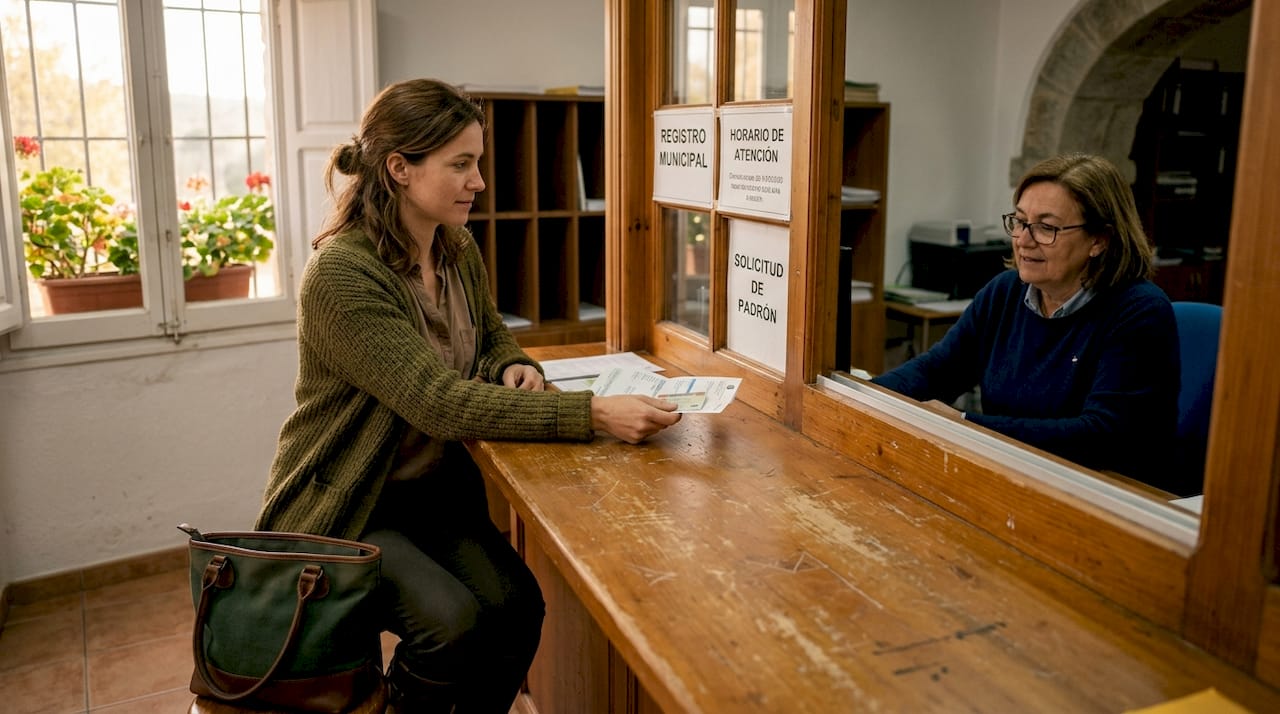
Registration requirements include two key steps. You must register on the padrón municipal, the local census, at your town hall. You must also apply for and renew your TIE as your physical proof of residency. Missing either of these does not immediately revoke your permit, but it creates administrative gaps that complicate renewals.
Consequences of failing to maintain legal stay range from a permit refusal at renewal to formal expulsion proceedings for serious or repeated violations. A lapse in status also restarts the residency clock, which matters enormously if you are working toward permanent residence.
Pro Tip: Set a calendar reminder 90 days before your permit expiration date. Spanish immigration offices frequently have appointment backlogs, and submitting your renewal application on time, even before a decision is issued, keeps your current permit technically valid.
Permanent residence and the path to citizenship
Permanent residence in Spain is a different legal category from a temporary permit. It grants you the right to live and work in Spain indefinitely without needing to renew your status every one or two years.
EU citizens and eligible family members acquire permanent residence after five years of continuous legal residence. Non-EU nationals follow a parallel but stricter path under the same five-year threshold. “Continuous” is the operative word. Absences of more than six consecutive months or absences totaling more than ten months across the five-year period will reset or interrupt the qualifying period.
The table below compares legal stay stages to clarify what each status actually gives you:
| Status | Duration | Work rights | Path to citizenship |
|---|---|---|---|
| Short-term stay (tourist/Schengen) | Up to 90 days | None | No |
| Temporary residence permit | 1 to 5 years (renewable) | Depends on permit type | Begins the 5-year clock |
| Permanent residence | Indefinite | Full | Yes, after meeting nationality criteria |
| Spanish nationality | Permanent | Full | N/A |
Spanish nationality for most non-EU nationals requires ten years of legal residence. However, Latin American nationals, nationals of Equatorial Guinea, the Philippines, Andorra, and Sephardic Jews qualify after just two years. Refugees may apply after five years. The nationality process is separate from the permanent residence process and requires demonstrating cultural integration, language ability, and civic knowledge.
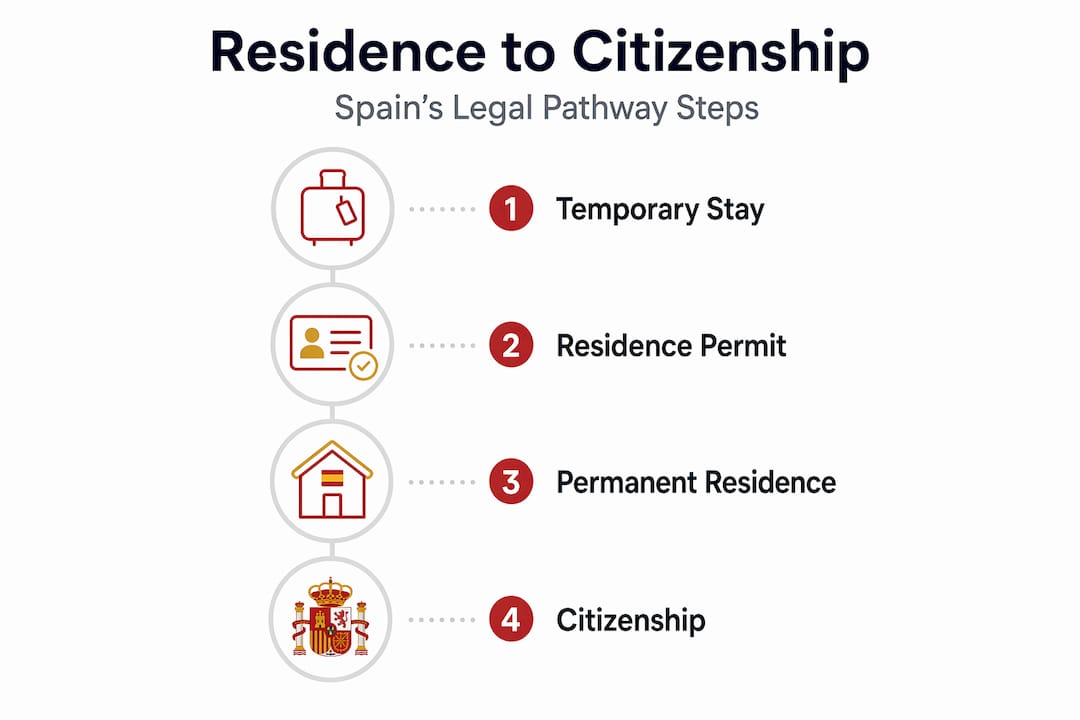
A common confusion worth clearing up: permanent residence and citizenship are not the same thing, and you do not need citizenship to access most rights in Spain. Permanent residence already gives you access to the labor market, public healthcare, and social benefits on equal terms with Spanish citizens.
Regularization options and the 2026 program
If you are currently in Spain without valid documentation, the situation is serious but not hopeless. Spain has a history of extraordinary regularization programs, and 2026 brings another real opportunity.
Spain’s 2026 Extraordinary Regularization program targets undocumented residents who were present in Spain before January 2026 and can demonstrate at least five months of continuous residence. The application window runs from April to June 2026, the processing fee is €38.28, and applicants receive provisional work authorization while their case is reviewed. That last point is significant. You can legally work while waiting for a decision.
Key eligibility points:
- You must prove continuous residence before January 1, 2026
- No criminal record in Spain or your country of origin
- You must not be subject to an active expulsion order
- Application is submitted in person at the relevant immigration office
For those who do not qualify for the 2026 program, other pathways exist. The arraigo social permit requires three years of continuous illegal residence plus demonstrable social roots. The arraigo laboral route requires two years of presence plus proof of ongoing employment relationships. There is also the arraigo formativo pathway, which combines residency proof with enrollment in vocational training programs. These are not fast routes, but they are legal ones.
Enforcement in Spain tends to prioritize recent irregular arrivals and individuals with criminal histories. Long-term undocumented residents with established community ties are more likely to access regularization programs than to face immediate expulsion proceedings. That does not mean the risk disappears. It means the window to act is open right now.
Pro Tip: If you are applying through the 2026 program, gather proof of continuous residence immediately. Rental contracts, utility bills, bank statements, school enrollment records, and medical appointment records all serve as supporting evidence. More documentation is always better than less.
Practical steps to protect your legal stay
Staying legally in Spain is an ongoing process that requires attention every year, not just when you first arrive. Here is how to manage it well:
- Track your physical presence. Keep a record of every trip outside Spain: departure dates, return dates, and destination countries. This directly affects both your renewal eligibility and your tax residency status.
- Understand the tax residency distinction. Registering on the padrón does not establish tax residency. Tax residency is determined by separate criteria, including the 183-day threshold and your center of economic interests. The two systems can and do diverge, and each carries its own obligations.
- Renew early and completely. Incomplete applications are the leading cause of renewal rejections. Review the residency deadlines for 2026 and build in enough time to gather every document before submission.
- Upgrade your visa category when eligible. If you entered on a student visa and now have a job offer, applying for a work permit before your student permit expires is far easier than letting your status lapse and reapplying from scratch.
- Get legal help before you have a problem. Consulting a qualified immigration specialist is significantly cheaper and faster when your case is clean versus when you are already out of status.
My take on how most people get this wrong
I’ve worked with hundreds of people navigating Spain’s immigration system, and the same misunderstanding shows up constantly. People treat their permit like a ticket they’ve already bought, something that entitles them to stay rather than something they have to keep earning.
The 183-day enforcement change that took effect in May 2025 blindsided a lot of non-lucrative visa holders who had been splitting their time between Spain and another country. They assumed that having a valid permit meant they were fine. They were not. What I’ve learned is that the gap between “having legal documentation” and “maintaining legal stay” is where most problems originate.
I’ve also seen people dismiss the 2026 regularization program because they assume they won’t qualify or that the process is too complicated. In my experience, the bigger risk is doing nothing. Spain’s immigration system does create pathways for people who make the effort to use them. The legal compliance guide for 2026 lays out the current framework clearly, but the deeper truth is that residency in Spain rewards people who stay proactive. The 183-day tax residency rule has been upheld in court at the highest levels. It is not a gray area. Treat your residency status with the same seriousness you would treat any significant legal obligation, because that is exactly what it is.
— Martín
How Vive can simplify your residency process
Getting your legal status right in Spain means paperwork, deadlines, documentation reviews, and appointment scheduling at offices that rarely move quickly. That is where Vive comes in.
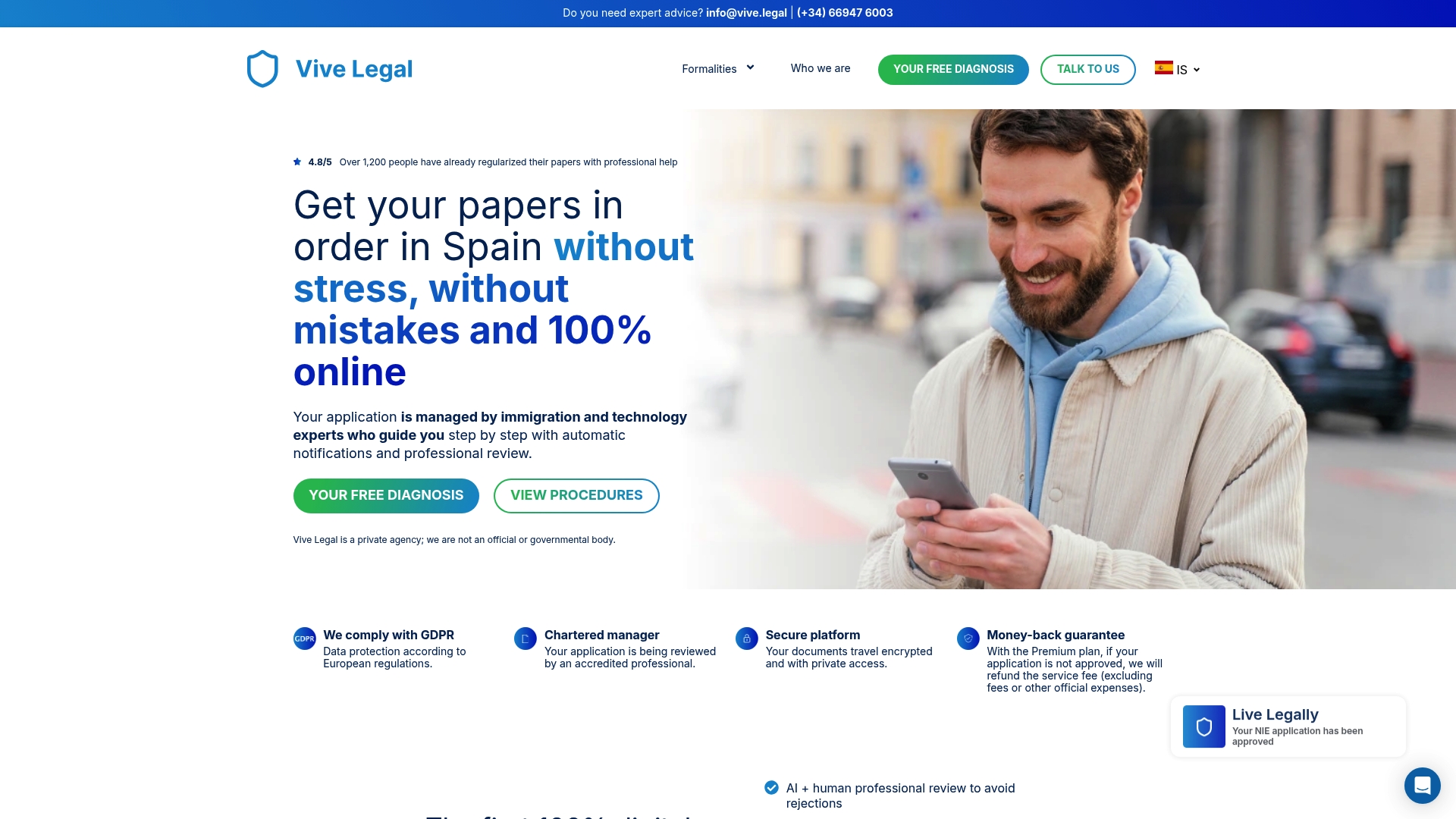
Vive is an online legal consultancy that handles the full residency process digitally, from your initial case assessment through document preparation, appointment booking, and case tracking via a secure portal. Whether you need to get your NIE as the first step toward legal residence or you are ready to apply for your TIE residence card, Vive combines professional legal oversight with a fully digital process so nothing falls through the cracks. Cases are typically ready to submit within 24 hours. The platform gives you status updates at every stage so you are never left guessing where your application stands.
FAQ
What is legal stay in Spain?
Legal stay in Spain is an administrative authorization that permits a foreign national to reside in Spain lawfully, ranging from short-term tourist stays up to 90 days under Schengen rules to long-term temporary and permanent residence permits governed by Organic Law 4/2000.
How many days do you need to stay in Spain to keep your residence permit?
As of May 2025, residence permit holders must physically reside in Spain for more than 183 days in the previous calendar year to qualify for renewal. Falling below this threshold risks non-renewal of the permit.
Can you work on a non-lucrative visa in Spain?
No. Non-lucrative visa holders are prohibited from any form of employment or business activity in Spain. Engaging in work while on this visa violates the terms of the permit and can result in loss of legal status.
How long does it take to get permanent residence in Spain?
Permanent residence in Spain requires five continuous years of legal residence. Significant absences, specifically more than six consecutive months or more than ten total months across the five-year period, can interrupt or reset the qualifying period.
Who qualifies for Spain’s 2026 regularization program?
Undocumented residents who were present in Spain before January 1, 2026, can demonstrate at least five months of continuous residence, have no active expulsion order, and hold no criminal record may apply during the April to June 2026 window for provisional legal status and work authorization.
Recommended
Living legally in Spain shouldn't be difficult.
View services and pricesNot sure which procedure you need? Find out in 2 min
Questions? Message us on WhatsApp