
Legal Aid in Spain: What Immigrants Need to Know

TL;DR:
- Legal aid in Spain is a constitutional right offering free legal representation for those unable to afford private counsel, including non-residents and undocumented individuals. The system is administered through local SOJ offices that assess eligibility based on income and exempt categories, providing legal defense, fee exemptions, and document assistance. Applying involves submitting a standard form at your local office, with eligibility and support available even amidst immigration and residency cases, emphasizing the importance of early, accurate legal engagement.
Legal aid in Spain is a constitutionally guaranteed right that provides free legal representation and defense to individuals who cannot afford private legal counsel. Governed by Law 1/1996, the system covers Spanish citizens, EU nationals, and non-EU residents alike, including those without official residency status. For immigrants and families dealing with residency rejections, permit appeals, or documentation disputes, understanding this system is the difference between facing the courts alone and having qualified legal support at no cost.
Living legally in Spain shouldn't be difficult.
View services and pricesNot sure which procedure you need? Find out in 2 min
Questions? Message us on WhatsApp
What is legal aid in Spain and who administers it?
Legal aid in Spain, formally called asistencia jurídica gratuita, is the state-funded system that guarantees access to justice for people who lack the financial means to hire a lawyer. Article 119 of the Spanish Constitution establishes this right, and Law 1/1996 sets out the practical framework for how it operates. The Spanish Bar Association (Consejo General de la Abogacía Española) and local Bar Associations (Colegios de Abogados) administer the system through a network of Judicial Guidance Services, known as SOJ (Servicio de Orientación Jurídica).

The SOJ offices are your first point of contact. They assess whether you have a valid legal claim, determine if you meet the financial criteria, and assign a qualified lawyer from a duty roster if you qualify. This is not a charity service. It is a formal legal mechanism with professional oversight, meaning the lawyer assigned to your case is a licensed member of the Bar and accountable to the same ethical standards as any private attorney.
Every major Spanish city has at least one SOJ office, and many operate within or adjacent to courthouse buildings. Madrid, Barcelona, Valencia, and Seville have multiple offices with dedicated immigration desks. Knowing where your local SOJ is located is the single most practical first step you can take.
Who qualifies for legal aid in Spain?
Eligibility for Spanish legal aid services rests primarily on a means test, measured against the IPREM (Indicador Público de Renta de Efectos Múltiples), Spain’s official income reference index. Income thresholds are set at twice the annual IPREM for individuals and higher multiples for families, with assets also factored into the assessment. The IPREM figure is updated annually, so the exact threshold shifts each year.
Certain groups receive automatic entitlement regardless of income. These include:
- Victims of gender-based violence under Spain’s domestic violence protection framework
- Minors involved in legal proceedings
- Victims of human trafficking and forced labor
- People with recognized disabilities above a defined threshold
- Victims of terrorism in proceedings related to the attack
One of the most misunderstood aspects of legal aid eligibility in Spain is residency status. People without official residency can access legal aid confidentially. This protection exists specifically to prevent vulnerable individuals from being deterred by fear of immigration enforcement when they need legal help most. Undocumented immigrants facing deportation orders or residency disputes have the same right to apply as a Spanish national.
Pro Tip: Never self-exclude from applying because you assume you earn too much or lack the right papers. The SOJ office makes that determination, not you. Many applicants are surprised to find they qualify once their full household situation is assessed.
What types of legal aid services does Spain provide?
The scope of free legal services in Spain is broader than most people realize, but it is not unlimited. The system covers specific, formal legal proceedings rather than general advice on any topic you bring to a lawyer. Here is what is included:
- Initial legal assessment at the SOJ, where a duty lawyer reviews your situation and advises whether you have a valid claim worth pursuing.
- Full legal defense and representation by a qualified abogado (lawyer) and procurador (court representative) in civil, criminal, administrative, and labor proceedings.
- Exemption from court fees and procedural costs, including filing fees, expert witness costs, and notary fees in certain cases.
- Access to mediation information and alternative dispute resolution guidance.
- Assistance with legal documents, including drafting formal appeals and responses to official notices.
The distinction between an initial SOJ assessment and full legal aid coverage matters. The initial consultation is available to anyone who walks in, regardless of income. Full legal aid, with an assigned lawyer for ongoing representation, requires passing the means test or belonging to an exempt category.
| Service | Available to all | Requires means test |
|---|---|---|
| Initial SOJ legal assessment | Yes | No |
| Assigned lawyer for court proceedings | No | Yes (or exempt category) |
| Court fee exemption | No | Yes (or exempt category) |
| Expert witness cost coverage | No | Yes (or exempt category) |
| Mediation guidance | Yes | No |
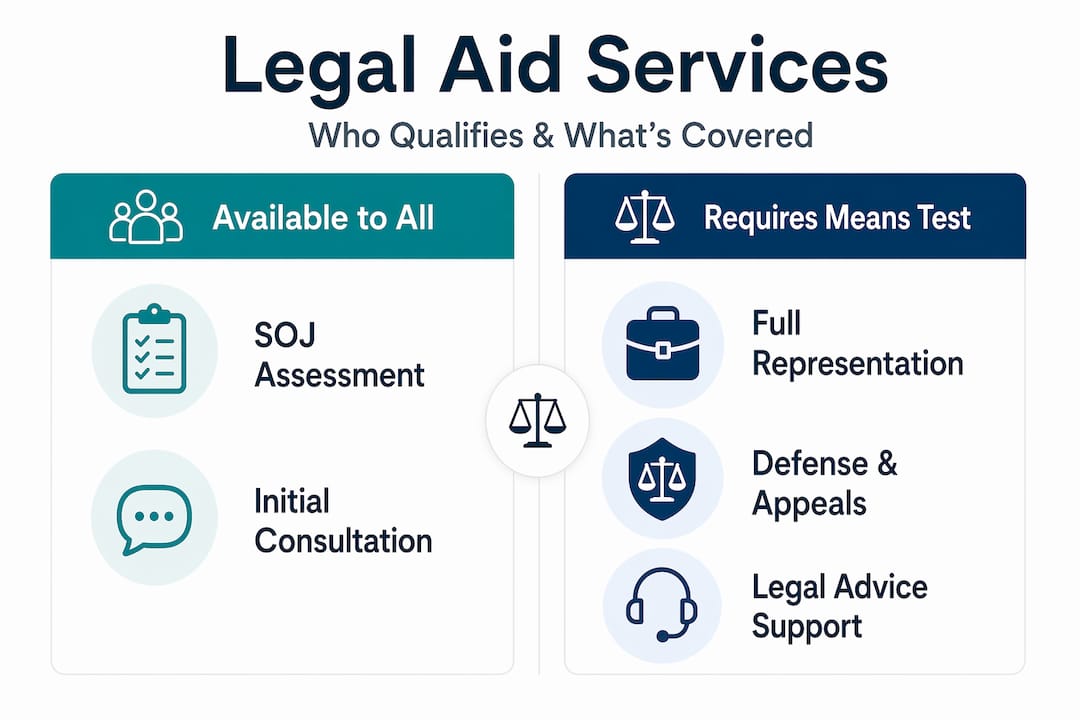
This table clarifies why the SOJ appointment is always worth making. Even if you do not qualify for full representation, the initial assessment is free and can point you toward the right next step.
How does the legal aid application process work in Spain?
The application process starts at your local Bar Association’s SOJ office. You submit a standardized application form along with supporting documents, and the Free Legal Aid Commission (Comisión de Asistencia Jurídica Gratuita) reviews your case within 30 days. That 30-day window is a legal requirement, not a guideline.
The documents you typically need to prepare include:
- A completed solicitud de asistencia jurídica gratuita form (available at the SOJ or online through the Bar Association website)
- Proof of income, such as your most recent tax return or a certificate from the Spanish Tax Agency (Agencia Tributaria)
- Proof of assets, including bank statements and property records
- Your NIE, TIE, or passport as identity documentation
- Any court summons or official notices relevant to your case, if proceedings have already started
If you are already involved in active legal proceedings, you can submit the application directly at the court handling your case. The court forwards it to the Commission. During the review period, a provisional lawyer is often assigned to prevent any gaps in your legal defense.
If your application is denied, you have the right to appeal the decision. The denial notice must explain the grounds, and you can challenge it through the same Commission or through the courts if necessary.
Pro Tip: Town hall social services offices (servicios sociales municipales) in larger cities often have faster access points to legal aid providers through local advice surgeries. If the Bar Association SOJ has a long wait, your local ayuntamiento is worth contacting first.
Practical tips for immigrants seeking legal aid
Getting legal aid is one thing. Using it effectively for immigration and residency matters requires a few additional steps that most guides skip over.
Start by booking your SOJ appointment before you think you need it. Immigration cases move faster than people expect, and a residency rejection or deportation notice can trigger tight appeal deadlines. Waiting until you are in crisis limits your options significantly.
Use only Bar-registered lawyers. The Spanish Bar Association actively campaigns against unqualified legal advisors who target immigrants with promises of fast results at low prices. These operators cause real harm, from missed deadlines to fraudulent applications, and their clients have no legal recourse. You can verify any lawyer’s registration through the Consejo General de la Abogacía Española website.
Be completely accurate in your financial disclosure. Understating income or hiding assets does not help your application. It creates grounds for rejection and can bar you from reapplying. The Commission cross-references your submission with Agencia Tributaria records.
“Confidential free legal aid extends to non-residents and undocumented individuals, a key protection often misunderstood by vulnerable populations.” Source
For immigrants specifically, understanding your legal guarantees in Spain before you apply helps you frame your case correctly at the SOJ. Lawyers who handle immigration cases regularly know which arguments carry weight with the Commission and which do not.
How legal aid supports immigration and residency cases
Legal aid covers a defined set of immigration and residency scenarios where formal legal proceedings are involved. Cases eligible for coverage include residency permit rejections and administrative appeals, deportation orders, fines issued by immigration authorities, eviction proceedings, and family reunification disputes.
The coverage is particularly significant for residency appeals. A residency appeal in Spain involves submitting a formal recurso de alzada or recurso contencioso-administrativo through the courts, which requires a licensed lawyer and procurador. Without legal aid, these costs are prohibitive for many families.
Non-residents and undocumented individuals have the same access rights as residents in these proceedings. The confidentiality protection means that applying for legal aid does not trigger any immigration enforcement action. This is a deliberate design feature of the system, not an oversight.
Common immigration cases where legal aid makes a decisive difference include:
- Arraigo social or laboral rejections, where the grounds for denial are often procedural and appealable
- TIE renewal refusals based on disputed employment or income records
- NIE-related administrative disputes with government agencies
- Asylum and international protection claims that require formal legal representation
The system is not perfect. Wait times at SOJ offices in high-demand cities can stretch several weeks, and the quality of duty lawyers varies. But having a qualified, Bar-registered lawyer on your case, even an imperfect one, is categorically better than facing Spanish administrative courts without representation.
Key takeaways
Legal aid in Spain is a constitutional right that covers formal legal proceedings for anyone who cannot afford private counsel, including undocumented immigrants and non-residents.
| Point | Details |
|---|---|
| Constitutional foundation | Legal aid is guaranteed by Article 119 and Law 1/1996, not a discretionary benefit. |
| Eligibility threshold | Income up to twice the annual IPREM qualifies; certain groups like trafficking victims get automatic access. |
| Application entry point | Start at your local Bar Association’s SOJ office; the initial assessment is free to everyone. |
| Undocumented access | Non-residents and undocumented individuals can apply confidentially without immigration risk. |
| Immigration coverage | Residency rejections, deportation orders, and permit appeals are all covered under legal aid. |
Why the system works better when you go in prepared
I have worked with enough immigrants navigating Spanish bureaucracy to know that the biggest obstacle to legal aid is not eligibility. It is hesitation. People assume the system is not for them, that their income is too high, or that their lack of papers disqualifies them. Almost every time, that assumption is wrong.
The SOJ appointment is the most underused tool in the Spanish legal system. It costs nothing, commits you to nothing, and gives you a qualified legal opinion on your situation within a single visit. I have seen families spend months paying informal advisors for advice that was wrong, when a single SOJ appointment would have told them exactly what they needed to do for free.
The other thing I want to be direct about is the risk of unqualified legal help. In immigrant communities, word-of-mouth referrals to unlicensed gestores or informal advisors are common. Some of these people are well-meaning. Others are not. None of them are accountable to the Bar Association, and none of them can represent you in court. When your residency status is on the line, that accountability gap matters enormously.
The role of accredited lawyers in immigration is not just procedural. A Bar-registered lawyer can spot appealable errors in rejection decisions, file protective measures to pause deportation timelines, and negotiate with administrative bodies in ways that informal advisors simply cannot. That is the practical value of the system, and it is available to you at no cost if you qualify.
— Martín
How Vive can help with your residency process in Spain
Understanding legal aid is the foundation. Getting your residency documents right the first time is how you avoid needing it. Vive specializes in online management of immigration procedures in Spain, including NIE, TIE, arraigo permits, and EU registration. The platform combines professional legal oversight with digital case tracking, so you always know where your application stands and what comes next.
If you are working through a residency application or renewal and want professional support without the uncertainty of navigating it alone, Vive offers full residency management services with transparent pricing and a satisfaction guarantee. For families and individuals who need their paperwork done correctly the first time, that combination of expertise and accountability is exactly what the process demands.
FAQ
What is legal aid in Spain?
Legal aid in Spain (asistencia jurídica gratuita) is a state-funded system that provides free legal representation and defense to individuals who cannot afford private legal counsel, guaranteed by Article 119 of the Spanish Constitution and Law 1/1996.
Can undocumented immigrants apply for legal aid in Spain?
Yes. People without official residency status can apply confidentially for legal aid in Spain, and the application process does not trigger any immigration enforcement action.
How long does the legal aid application process take?
The Free Legal Aid Commission is legally required to process applications within 30 days. If you are already in active proceedings, a provisional lawyer is typically assigned during the review period.
What income level qualifies for legal aid in Spain?
Individuals with income up to twice the annual IPREM threshold generally qualify, with higher limits for families. Victims of gender violence, trafficking, and terrorism qualify automatically regardless of income.
Does legal aid cover immigration and residency cases?
Yes. Legal aid covers residency permit rejections, deportation orders, administrative appeals, and related immigration proceedings where formal legal representation is required.
Recommended
Living legally in Spain shouldn't be difficult.
View services and pricesNot sure which procedure you need? Find out in 2 min
Questions? Message us on WhatsApp