
Spain Entry Requirements Explained for Travelers in 2026

TL;DR:
- Travelers to Spain must carry valid passports, supporting documents, and, after April 2026, undergo biometric registration under EES. Visa requirements depend on nationality, intended stay, and purpose, with current visa-exempt nations needing ETIAS authorization starting late 2026. Long-stay residents must obtain a visa before arrival and register for a TIE within one month, ensuring legal residency.
Spain’s entry requirements are defined by three factors: your nationality, the length of your intended stay, and your purpose of travel. Whether you are visiting for two weeks or relocating permanently, the rules governing your arrival at Spanish borders differ significantly. Since April 2026, the EU Entry/Exit System (EES) has replaced manual passport stamping with automated biometric recording at all Schengen external borders. Later in 2026, the European Travel Information and Authorisation System (ETIAS) will add a pre-travel authorization step for visa-exempt travelers. Knowing which category applies to you before you book your flight is not optional. It is the difference between a smooth arrival and a denied entry.
Living legally in Spain shouldn't be difficult.
View services and pricesNot sure which procedure you need? Find out in 2 min
Questions? Message us on WhatsApp
What are the standard entry rules for traveling to Spain?
Every traveler entering Spain must cross through an authorized border point and present a valid travel document. For most non-EU nationals, that means a passport with sufficient remaining validity, not just an ID card. Border officers verify identity, check travel documents, and since April 2026, record biometric data through the EES automated system at all Schengen external borders. This replaces the old ink stamp and creates a digital record of every entry and exit.
Beyond your passport, Spanish border officers can ask for supporting documents that prove your trip is legitimate and self-funded. The standard checklist for short-stay travelers includes:
- Valid passport: Must have sufficient validity for the duration of your stay, plus a buffer depending on your visa category.
- Proof of onward travel: A return or connecting ticket confirming you plan to leave within the authorized period.
- Proof of accommodation: Hotel bookings, a rental agreement, or a signed letter of invitation from a host in Spain.
- Proof of financial means: Bank statements, credit card evidence, or cash showing you can support yourself without working illegally.
- Travel insurance: Coverage of at least €30,000 for medical emergencies, required for Schengen visa holders and strongly recommended for all travelers.
Pro Tip: Carry printed copies of your accommodation bookings and return ticket. Border officers at Madrid Barajas and Barcelona El Prat occasionally request physical documents, and a dead phone battery at the wrong moment can complicate things.
Biometric registration under EES happens at the border on arrival and requires no prior action or fee. First-time enrollment collects your fingerprints and a facial image. Subsequent entries are faster once your profile exists in the system. Plan for extra time at the border on your first visit under EES, particularly at busy international airports.
Who needs a visa to enter Spain, and what types are available?
Spain’s visa requirements split travelers into two groups: those who can enter visa-free for short stays, and those who must apply for a visa before traveling. Nationals of the United States, Canada, Australia, the United Kingdom, and most Latin American countries currently enter Spain without a visa for stays up to 90 days. Nationals of countries not on the EU’s visa-exempt list must apply for a Schengen short-stay visa or a national long-stay visa depending on their plans.
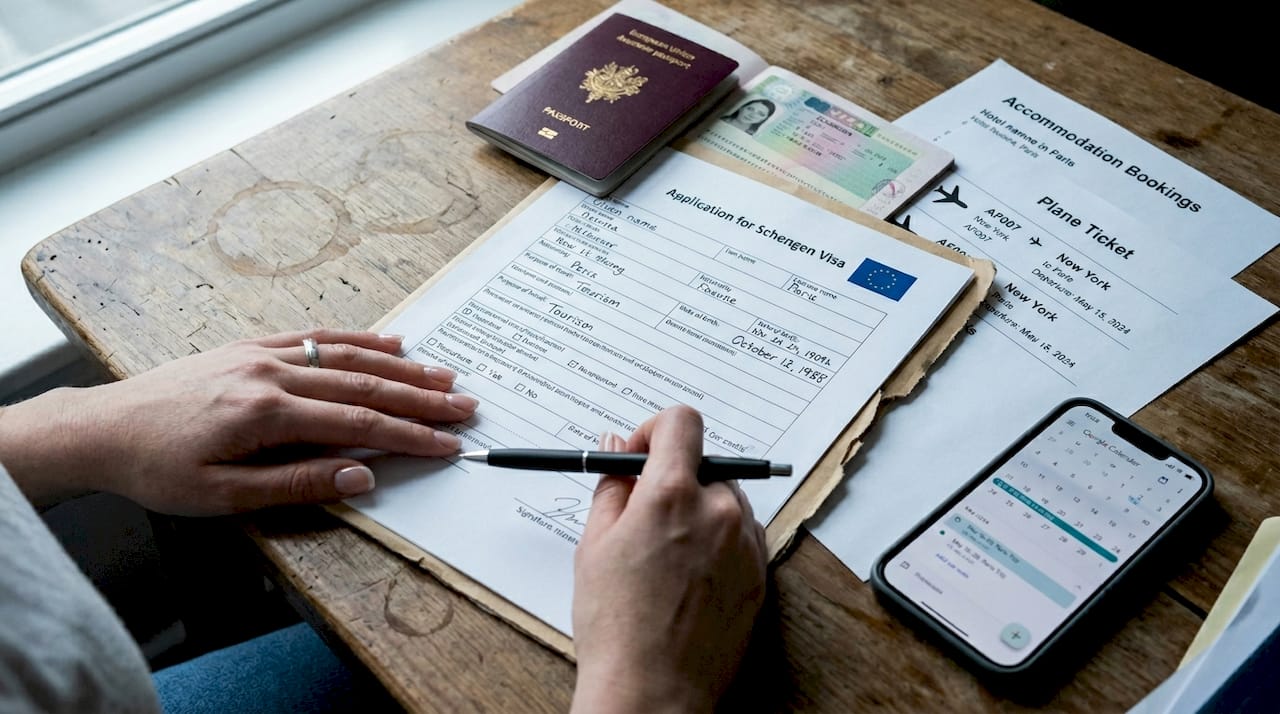
The table below summarizes the two main visa categories:
| Visa type | Duration | Purpose | Key documents |
|---|---|---|---|
| Schengen short-stay visa (Type C) | Up to 90 days in any 180-day period | Tourism, business, family visits | Application form, valid passport, travel insurance, accommodation proof, financial means |
| National long-stay visa (Type D) | More than 90 days | Study, work, family reunification, residence | Purpose-specific documents, passport valid for at least one year, two blank pages |
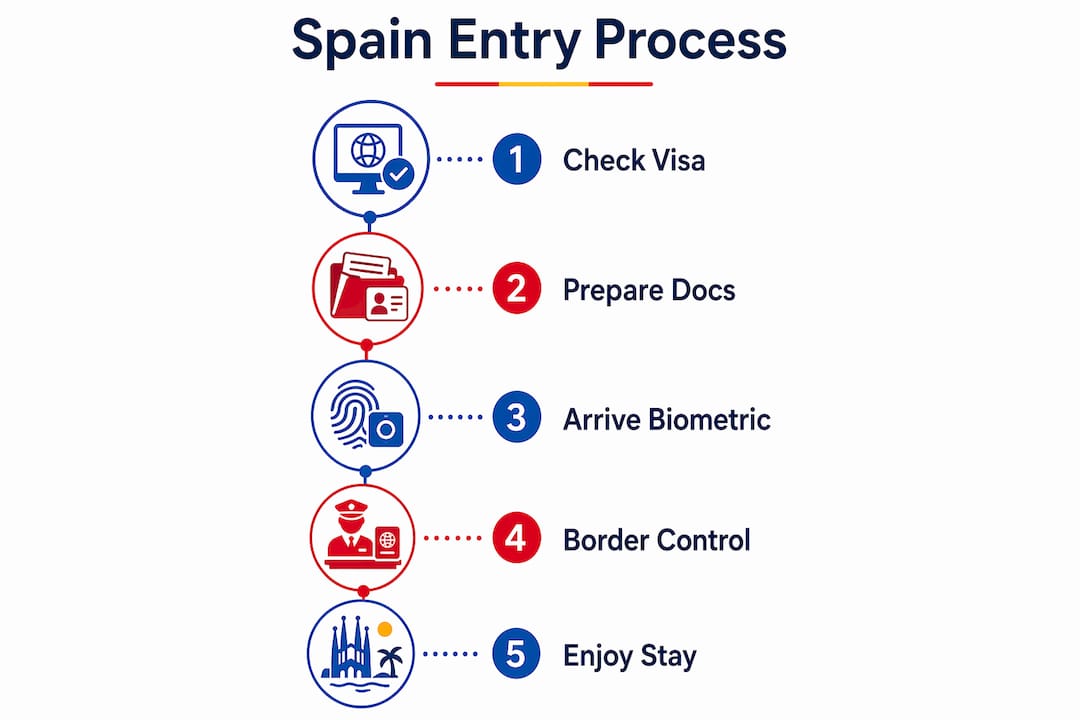
The Schengen short-stay visa carries a fee of approximately €90 for adults and requires a full document package submitted at a Spanish consulate in your home country. The 90-day limit is not per trip to Spain. It counts all days spent in any Schengen Area country within the rolling 180-day window. Overstaying triggers immigration penalties and can result in a ban from re-entering the Schengen Area.
National long-stay visas cover study, employment, and residency purposes. For a study visa, the Spanish Ministry of Foreign Affairs requires applications submitted two months before the program start date. Your passport must have at least one year of validity remaining and contain at least two blank pages. Missing either condition is one of the most common reasons consulates reject applications outright.
For travelers combining visits across multiple Schengen countries, the 90/180-day rule is cumulative across the entire zone. A week in France plus three weeks in Spain counts toward the same 90-day allowance. Tracking your days carefully is not bureaucratic caution. It is a legal obligation enforced by EES.
What is EES and how does ETIAS affect your trip to Spain?
EES and ETIAS are two separate EU systems that together reshape how non-EU travelers enter Spain. Understanding the difference between them prevents confusion and missed preparation steps.
Here is how each system works in sequence:
- ETIAS (pre-travel, launching late 2026): Visa-exempt travelers apply online before booking travel. The application collects personal data and passport information and charges a one-time fee. Authorization lasts up to three years and links directly to your passport. Without it, visa-exempt travelers will be denied boarding.
- EES (at the border, active since April 2026): On arrival, non-EU nationals on short stays submit biometric data including fingerprints and a facial scan. The system records entry and exit dates automatically, replacing passport stamps.
- Subsequent entries: Once enrolled in EES, your biometric profile is on file. Border crossings become faster, but the system still logs every entry and exit against your 90-day allowance.
- Overstay detection: EES flags travelers who exceed their authorized stay. Border officers can see your full entry history in real time, making overstays far harder to dispute than under the old stamp system.
“EES and ETIAS address different needs: EES handles biometric recording at borders, while ETIAS provides pre-travel authorization for visa-exempt travelers to reduce illegal entries.” — European Commission, Migration and Home Affairs
The practical implication is clear. Travelers who previously arrived in Spain with nothing more than a passport and a return ticket now face a two-step process: ETIAS authorization before departure and EES biometric enrollment on arrival. Prepare for border delays during peak travel periods, particularly at land borders like La Jonquera and Irún where queues build faster than at airports.
How do long-stay and residency requirements differ from short-stay travel?
Staying in Spain longer than 90 days requires a national long-stay visa obtained before you arrive, not a conversion of a tourist entry. This is a hard rule. You cannot enter on a short-stay basis and then switch to a residency permit from inside Spain in most cases. The process starts at a Spanish consulate in your country of residence.
For a study visa, the document checklist from the Spanish Ministry of Foreign Affairs includes:
- A valid passport with at least one year of remaining validity and two blank pages.
- Proof of enrollment at a recognized Spanish educational institution.
- Proof of financial means calculated against Spain’s IPREM (Public Multiple Effects Income Indicator). The minimum is 100% of IPREM, with 75% added for the first accompanying family member and 50% for each additional member.
- Private health insurance covering the full period of study.
- A clean criminal record certificate from every country where you have lived in the past five years.
Pro Tip: Get your criminal record certificate apostilled and translated into Spanish by a certified translator before submitting. Consulates in Los Angeles and Miami routinely reject applications where this step is incomplete, adding weeks to processing times.
After arriving in Spain on a long-stay visa, foreign nationals staying longer than six months must apply for the Foreigner Identity Card, known as the TIE. The application goes to the local Foreign Nationals’ Office or a designated police station and must be submitted within one month of arrival. The TIE is your proof of legal residency status in Spain. Without it, you cannot open a bank account, sign a lease, or access public services. Getting your residency documents right from the start avoids the cascading problems that follow a rejected or delayed TIE application.
Common failure points in long-stay visa applications include expired passport validity, missing apostilles, financial proof calculated incorrectly against IPREM, and applications submitted too close to the program or job start date. National visa applications require strict adherence to passport validity, timing, and supporting document guidelines. These are not technicalities. They are the most common reason applications fail.
Key takeaways
Spain’s entry requirements in 2026 are governed by nationality, stay duration, and purpose of travel, with EES biometric recording now active at all Schengen borders and ETIAS authorization launching later this year.
| Point | Details |
|---|---|
| EES is active now | Biometric enrollment happens on arrival at all Schengen borders since April 2026. |
| ETIAS launches late 2026 | Visa-exempt travelers must obtain pre-travel authorization before departing for Spain. |
| 90/180-day rule is cumulative | Days in any Schengen country count toward your 90-day allowance, tracked automatically by EES. |
| Long-stay visas require advance planning | National visas must be obtained from a Spanish consulate before arrival; conversion inside Spain is not permitted. |
| TIE application is mandatory | Foreign nationals staying over six months must apply for the Foreigner Identity Card within one month of arrival. |
What I’ve learned from watching travelers get Spain’s entry rules wrong
I have reviewed hundreds of immigration cases involving Spain, and the pattern is consistent. Travelers who run into trouble are not uninformed. They are under-prepared at specific, predictable points. The most common mistake I see is treating the 90/180-day rule as a Spain-specific limit rather than a Schengen-wide one. Someone spends six weeks in Portugal, flies to Madrid for three weeks, and genuinely believes they have 90 days left in Spain. They do not. EES now makes this error impossible to hide and very expensive to fix.
The second pattern involves long-stay visa timing. Applicants submit documents two weeks before their program starts, not two months. Consulates do not rush processing for late applicants. The program starts without them, and the visa arrives after the fact. The Spanish Ministry of Foreign Affairs is explicit about the two-month window for study visas. That timeline exists for a reason.
What I find genuinely underappreciated is how much ETIAS will change the experience for visa-exempt travelers who have never had to think about pre-authorization. Americans, Canadians, and Australians have entered Spain with nothing but a passport for decades. Starting late 2026, that changes. The ETIAS application is not difficult, but it requires a valid passport, an email address, and a fee paid in advance. Travelers who show up at the airport without it will be denied boarding, not turned away at the Spanish border. Airlines will check.
My practical advice: treat your Spain trip preparation the same way you treat your passport renewal. Start earlier than you think you need to, verify document validity against the specific requirements for your visa category, and keep proof of your ticketed exit. That last point matters more than most travelers realize. Under EES, a ticketed exit proof is your strongest defense if a border officer questions your stay duration.
— Martín
How Vive can simplify your Spain immigration process
Spain’s entry and residency rules involve more moving parts in 2026 than they did even two years ago. Vive Legal manages the paperwork, document review, and procedural steps that trip up even experienced travelers. Whether you need help obtaining your NIE, applying for a TIE, or preparing a long-stay visa application, Vive’s online platform handles the process from document upload to appointment scheduling. Every case gets professional oversight combined with automated tracking, so nothing falls through the cracks. If you are planning a long stay or relocation, start your residency process with Vive and avoid the delays that come from incomplete or incorrectly prepared applications.
FAQ
Do I need a visa to enter Spain as a US citizen?
US citizens can enter Spain visa-free for stays up to 90 days in any 180-day period under the Schengen Agreement. Starting late 2026, they will also need to obtain ETIAS authorization before traveling.
What documents do I need to enter Spain?
All travelers need a valid passport, proof of onward travel, proof of accommodation, and evidence of sufficient financial means. Schengen visa holders must also carry travel insurance with at least €30,000 in medical coverage.
What is the EES and does it affect my trip?
The EU Entry/Exit System records biometric data and entry/exit dates for non-EU nationals at all Schengen borders, replacing manual passport stamps. First-time enrollment happens on arrival and may add time to your border crossing.
How long can I stay in Spain without a visa?
Visa-exempt travelers can stay up to 90 days in any rolling 180-day period across the entire Schengen Area, not just Spain. The EES system tracks this automatically and flags overstays in real time.
What is the TIE and when do I need one?
The Foreigner Identity Card (TIE) is the official residency document for non-EU nationals staying in Spain longer than six months. You must apply at a local Foreign Nationals’ Office or police station within one month of arriving on a long-stay visa.
Recommended
Living legally in Spain shouldn't be difficult.
View services and pricesNot sure which procedure you need? Find out in 2 min
Questions? Message us on WhatsApp