
Student-Friendly Legal Resources in Spain: 2026 Guide

TL;DR:
- Navigating Spain’s legal resources as a student is easier with university clinics, AI platforms, and government aid, which offer free or affordable assistance. Combining digital tools for orientation with legal clinics or official aid ensures timely, credible guidance on residency and work permits. Acting early and verifying information prevents costly mistakes in Spain’s complex immigration landscape.
Studying abroad is exciting until your visa expires, your work authorization is unclear, or you need to renew a TIE card with zero idea where to start. Finding reliable, student-friendly legal resources in Spain is harder than it should be, especially when most official sites are in Spanish and most lawyers charge fees that a student budget simply cannot cover. This guide cuts through the confusion. You will find the most practical, affordable, and accessible options available right now, ranked and explained so you can act fast.
Living legally in Spain shouldn't be difficult.
View services and pricesNot sure which procedure you need? Find out in 2 min
Questions? Message us on WhatsApp
Table of Contents
- Key takeaways
- 1. What makes a legal resource student-friendly
- 2. University legal clinics (Clínicas Jurídicas)
- 3. AI-powered legal platforms and digital tools
- 4. Official government legal aid services
- 5. Comparing your options: a side-by-side view
- My honest take on finding legal help as a student in Spain
- How Vive helps international students stay on the right side of Spanish law
- FAQ
Key takeaways
| Point | Details |
|---|---|
| University clinics are underused | Clínicas Jurídicas offer free, supervised legal advice that most students never know about. |
| Digital tools save time on simple questions | AI platforms like ALEX give instant answers on residency and work permits at no cost. |
| Official free legal aid is real but strict | Spain guarantees free legal assistance for low-income residents, including foreign students. |
| Layer your resources | Combine digital tools for orientation with human experts for anything complex or high-stakes. |
| Get documents right early | NIE and TIE cards are required for nearly every legal and financial activity in Spain. |
1. What makes a legal resource student-friendly
Before you pick a resource, you need a checklist for evaluating it. Not every affordable option is actually useful, and not every official source is easy to use.
Here are the factors that matter most when evaluating affordable legal resources in Spain for students:
- Language accessibility. Is the resource available in English or other major languages? Spanish-only platforms slow you down when you are already under pressure.
- Cost. Free is better, but low-cost professional help beats free-but-wrong advice.
- Relevance to student situations. Resources should cover residency permits, NIE and TIE procedures, student work authorizations, and enrollment requirements.
- Credibility. Look for university oversight, bar association endorsement, or government backing.
- Digital access. The best resources work online, around the clock, without requiring an in-person trip to an office during hours you are supposed to be in class.
As context, international students need both a NIE (Número de Identificación de Extranjero) and a TIE (Tarjeta de Identidad de Extranjero) for bank accounts, housing contracts, and employment. Getting those documents right is where most students first realize they need real legal guidance.
Pro Tip: When testing any new legal resource, ask it one question you already know the answer to. If it gets that wrong, do not rely on it for questions where you do not know the answer.
2. University legal clinics (Clínicas Jurídicas)
This is the most underused option in Spain, and that is not an opinion. University legal clinics combine law student training with real community legal help, giving you supervised, professional-quality advice at no charge.

What exactly happens at a Clínica Jurídica? Law students handle your case under direct supervision from licensed lawyers. The advice you get is real and legally sound. Sessions are confidential, typically in Spanish but sometimes in English at international universities.
These clinics typically cover:
- Residency permit questions and renewals
- Work authorization for students (up to 30 hours per week with proper employer authorization)
- Documentation questions, including NIE and TIE applications
- Housing disputes and tenant rights
- Employment contract reviews
To find a clinic, search your university’s law faculty website for “Clínica Jurídica” or ask the international students office directly. Major Spanish universities including Universidad Complutense de Madrid, Universidad de Barcelona, and Universidad de Navarra run established clinics. Some require an appointment scheduled weeks in advance, so do not wait until you have a deadline breathing down your neck.
The main limitation is scope. If your situation involves a denied visa appeal, a complex arraigo procedure, or a work permit that crosses into tax law, a student clinic may not have the depth to handle it. That is when you need a specialist.
Pro Tip: Bring all your documents to the first appointment, even ones that seem irrelevant. Clinic lawyers often spot issues in paperwork that you had no idea were problems.
3. AI-powered legal platforms and digital tools
The fastest way to get a clear answer on a basic residency or immigration question in Spain is no longer a phone call. It is an AI assistant.
Tools like ALEX by Legálitas provide free legal answers around the clock, specifically designed for common Spanish legal queries including residency, work permits, and immigration procedures. You type a question in plain language. You get a direct, referenced answer. No appointment, no waiting room, no fee.
Digital platforms serving international students typically offer:
- Instant answers to common immigration questions
- Step-by-step guides for specific procedures
- Document checklists tailored to your permit type
- Alerts when regulations change
Platforms like Extranjería Clara go further, reducing errors in immigration paperwork by walking users through each requirement based on their specific profile. That matters more than it sounds. A single missing document can delay a permit renewal by weeks.
The key limitation is that legaltech tools work best as supplements, not replacements, for qualified legal professionals when a situation is genuinely complex. Use them to orient yourself, build your question list, and understand your options. Then take the hard questions to a human.
4. Official government legal aid services
Spain guarantees free legal assistance to anyone who cannot afford legal representation, including foreign nationals legally residing in Spain. This is a constitutional right, not a charity program.
Here is how eligibility and access work in practice:
Eligibility requirements
Income thresholds are tied to the IPREM (Indicador Público de Renta de Efectos Múltiples). Most full-time students without employment will qualify, but you need to document your financial situation clearly.
What legal aid covers
Spanish legal aid extends well beyond just having a lawyer. Benefits include:
- Pre-trial legal advice at no cost
- Full representation by an assigned lawyer
- Exemption from court fees and procedural costs
- Access to legal documents and expert reports
- Assistance with appeals
How to apply
Submit your application to the local Colegio de Abogados (bar association). You will need proof of income (or lack of it), identification documents, and a description of your legal situation. Applications are processed within 30 days, and the assigned lawyer handles your case from there.
The most common pitfall is submitting incomplete financial documentation. Students often forget to include proof of family contributions or bank statements from their home country. Missing any of these will delay or reject your application.
5. Comparing your options: a side-by-side view
Choosing the right combination of resources depends on your situation, budget, and timeline. Here is a direct comparison of the main student legal aid services in Spain:
| Resource | Cost | Speed | Best for | Limitations |
|---|---|---|---|---|
| University legal clinic | Free | Moderate (weeks) | Residency, employment basics | Complex or specialized cases |
| AI legal platforms | Free | Instant | Quick orientation, document checklists | Not for high-stakes decisions |
| Official legal aid | Free (if eligible) | 30 days | Court cases, formal representation | Income eligibility required |
| Online legal platforms (like Vive) | Low to moderate | 24 to 48 hours | Full permit management, document review | Costs money, but saves errors |
The smartest approach is to layer these resources. Use an AI platform to understand your situation. Visit a university clinic to verify your understanding. If your case escalates, apply for official legal aid or engage a specialist platform that handles the full process for you.
When should you escalate immediately to professional help? If your residence permit has been denied, if you are facing deportation proceedings, or if your work authorization is under investigation, do not rely on free resources alone. The stakes are too high and the timelines too short.
Pro Tip: Keep a digital folder with scans of every legal document you have in Spain. When you need help fast, not wasting 20 minutes finding your TIE card number will matter.
My honest take on finding legal help as a student in Spain
I have worked with hundreds of international students dealing with Spanish immigration law, and the pattern I see repeat itself is always the same. Students wait. They assume the process is simpler than it is, they miss a deadline, and suddenly a fixable problem becomes an urgent crisis.
What I have learned is that the students who handle this best are the ones who start early, before there is any actual problem. They register with their university clinic in the first month. They download a legal AI tool on their phone for quick questions. They read up on their student legal rights before they ever need to assert them.
The warning I give everyone is about misinformation. Student Facebook groups and WhatsApp chats are full of confident-sounding advice that is simply wrong, sometimes dangerously so. I have seen students miss TIE renewal deadlines because someone in a group chat told them the deadline was flexible. It is not.
Official channels and credentialed professionals exist for a reason. Free resources like university clinics and government legal aid are genuinely good. Use them. But when you are in doubt, a small investment in professional guidance is almost always worth more than the cost of fixing a mistake made without it.
The legal residency options in Spain are more varied than most students realize, and the right path depends on your specific situation. There is no one-size-fits-all answer. What there is, though, is a clear roadmap if you know where to look.
— Martín
How Vive helps international students stay on the right side of Spanish law
Legal paperwork should not be the hardest part of studying abroad, but for many international students it is.
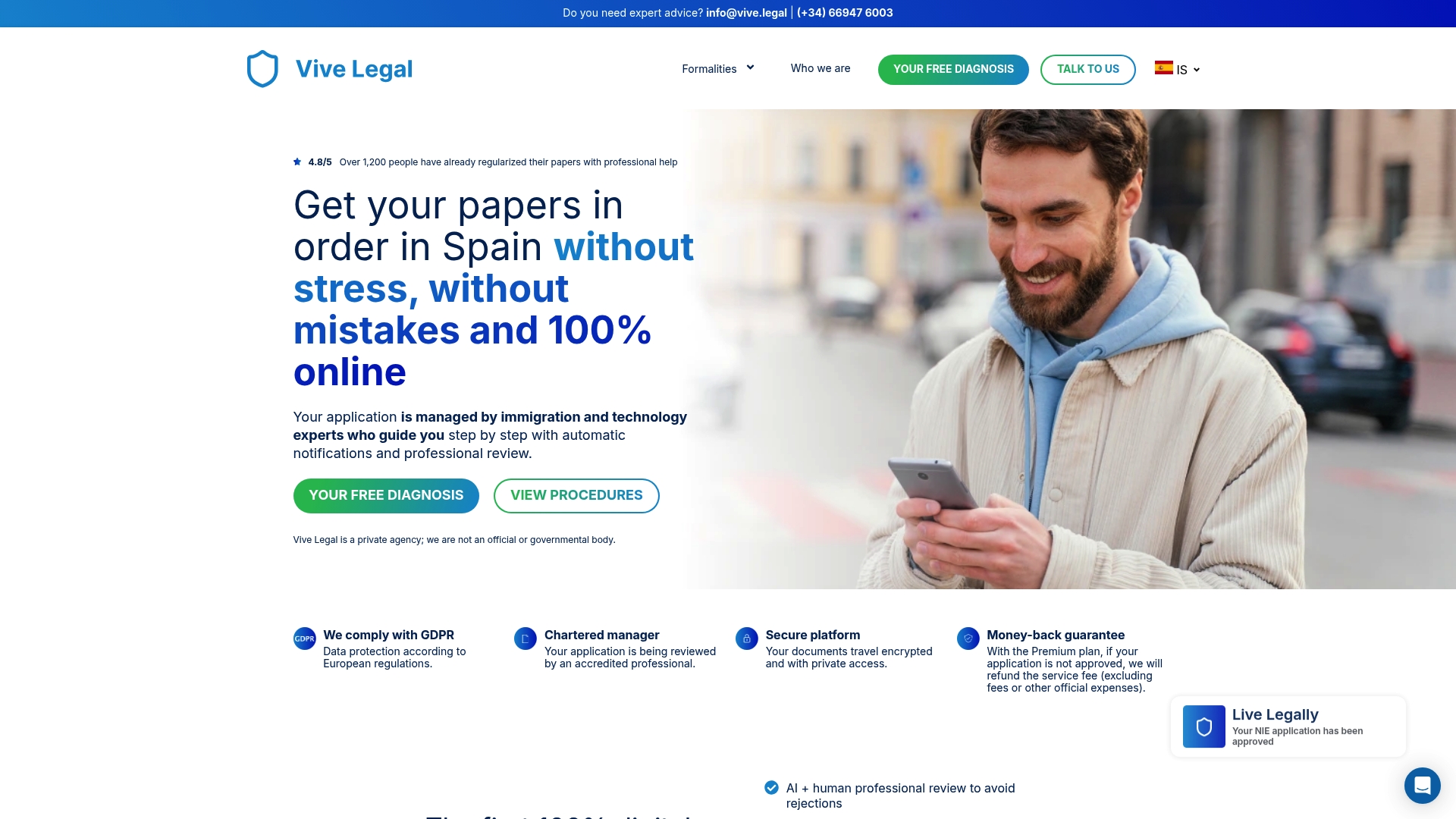
Vive is an online legal platform built specifically for immigration and residency procedures in Spain. You get document review, form preparation, appointment scheduling, and case tracking from one place, all online, in clear language. Vive combines professional legal oversight with a system that catches errors before they reach an official desk. For students managing NIE applications, TIE renewals, or internship residency permits, Vive handles the process from start to confirmation. You can review exactly how the service works and what it covers at Vive’s service terms before committing to anything. When you are ready to stop guessing and start moving, Vive is worth the look.
FAQ
What are the best free legal resources for students in Spain?
University Clínicas Jurídicas and Spain’s official legal aid system are the strongest free options. AI platforms like ALEX by Legálitas are excellent for quick orientation on residency and immigration questions.
Can international students qualify for free legal aid in Spain?
Yes. Spain’s free legal assistance applies to foreign nationals who meet income thresholds tied to the IPREM. Most full-time students without significant income will qualify.
How do I find a university legal clinic in Spain?
Search your university’s law faculty website for “Clínica Jurídica” or contact the international student office. Most major Spanish universities operate these clinics, though appointment availability varies by institution.
How many hours can a student legally work in Spain?
Student residence permits allow part-time work up to 30 hours per week, provided you have employer authorization and your work aligns with your social security registration.
When should I stop using free resources and hire a legal professional?
Move to a professional immediately if your permit has been denied, if you are facing a formal legal proceeding, or if your situation involves multiple overlapping permit types. The cost of professional help is far lower than the cost of a procedural mistake at that stage.
Recommended
Living legally in Spain shouldn't be difficult.
View services and pricesNot sure which procedure you need? Find out in 2 min
Questions? Message us on WhatsApp