
2026 Legal Updates in Spain: What You Need to Know

TL;DR:
- Spain’s 2026 legal reforms introduce a short window for irregular migrants to regularize their status with strict documentary requirements. Child protection law now allows children of any age to testify in legal procedures, and AI in legal services must be manually verified to ensure accountability. The application deadline is June 30, 2026, requiring applicants to prepare nominative, date-specific documents and seek professional guidance to meet rigorous standards.
Spain is in the middle of one of its most significant legal overhauls in years, and the 2026 legal updates in Spain touch nearly every area that matters to immigrants, residents, and newcomers alike. The centerpiece is Real Decreto 316/2026, an extraordinary regularisation process that could benefit up to 500,000 people currently living in irregular status. Alongside that, reforms in child protection law, AI accountability in legal services, and EU driving regulations are reshaping what it means to live and work here in 2026.
Living legally in Spain shouldn't be difficult.
View services and pricesNot sure which procedure you need? Find out in 2 min
Questions? Message us on WhatsApp
Table of Contents
- Key Takeaways
- 1. Understanding the 2026 extraordinary regularisation process
- 2. Document standards that will make or break your application
- 3. LOPIVI reform and strengthened child protections in Spain
- 4. AI accountability rules for lawyers practicing in Spain
- 5. Driving license changes coming under EU Directive 2025/2205
- 6. Comparing the 2026 regularisation to previous Spanish schemes
- 7. Practical steps to prepare your regularisation application
- 8. What the AI compliance rules mean for your legal experience
- My take on Spain’s 2026 legal reforms
- How Vive can help you meet Spain’s 2026 requirements
- FAQ
Key Takeaways
| Point | Details |
|---|---|
| Regularisation window is short | Applications for Real Decreto 316/2026 run only from April 16 to June 30, 2026. |
| Documents must be nominative | Generic paperwork without your name and a validity date will get your application rejected. |
| LOPIVI reform expands child rights | Children of any age can now testify in judicial and administrative procedures in Spain. |
| AI use in law is now regulated | Lawyers must manually verify all AI-generated outputs or face disciplinary sanctions. |
| Regularisation is not an amnesty | Applicants must prove five months of continuous residence and a clean criminal record. |
1. Understanding the 2026 extraordinary regularisation process
The single biggest Spain law update in 2026 is Real Decreto 316/2026, which came into force on April 16, 2026. It creates a structured, time-limited path for irregular migrants to obtain legal residence and work permits. The application window closes on June 30, 2026, so there is no room to wait.
The government has been explicit that this is not a blanket amnesty. It is a carefully designed legal mechanism with strict conditions, and the burden of proof sits entirely with the applicant. You need to show the Spanish authorities that you have been present, law-abiding, and contributing to society.
Eligibility requirements at a glance:
- Presence before January 1, 2026. You must prove you were in Spain before this date.
- Five months of continuous residence. The period must be unbroken and documented.
- Clean criminal record. No criminal history in Spain or your country of origin.
- No threat to public order. Applicants flagged for security reasons are excluded.
Applications can be filed online or in person at provincial immigration offices. Successful applicants receive a one-year residence and work permit, access to social security, and the right to public healthcare. After that year, you can transition into standard renewable residency categories. For a full breakdown of your options after regularisation, the residency options guide from Vive covers the most relevant pathways.
Pro Tip: Start gathering evidence now, even if you have not yet submitted your application. A padron municipal certificate, utility bills in your name, employment contracts, and school enrollment records for your children all count as supporting proof.
2. Document standards that will make or break your application
Spain’s evidentiary standards for this process are not just bureaucratic formalities. The government treats nominative documents with explicit validity dates as the legal baseline for what constitutes proof. If a document does not name you personally and state when it was valid, it will not be accepted.
This is where most applications run into trouble. A generic lease agreement with no tenant name fails. A bank statement from a joint account may not suffice. An employer letter without letterhead and dates is rejected outright.
What works:
- Padron municipal registration certificates with your full name and address
- Official employment contracts with start dates
- Social security contribution records (vida laboral)
- School or medical enrollment letters addressed directly to you
The common failure point across applications is the submission of generic or non-nominative documents. Think of each document as a witness statement. It only holds up if it speaks directly about you, in a specific time period, with no ambiguity.
3. LOPIVI reform and strengthened child protections in Spain
Beyond immigration, one of the most socially significant 2026 legal reforms in Spain is the update to LOPIVI, the organic law on child and adolescent protection. The reform removes the previous 12-year age cutoff that had limited when children could testify in judicial and administrative proceedings.

Under the updated law, children of any age have the right to be heard in procedures that affect them. Courts and professionals are now required to use child-sensitive approaches regardless of how young the child is. The reform also bans the use of Parental Alienation Syndrome as a legal argument in family court proceedings.
For families navigating custody disputes, immigration hearings, or child welfare procedures in Spain, this is a material change. If you have a minor who is part of your residency application or a pending family law case, your legal representative needs to be aware of these new obligations.
4. AI accountability rules for lawyers practicing in Spain
Spain’s General Council of Lawyers issued Circular 3/2026 early this year, and it changes how every law firm in the country must handle AI tools. The rule is direct: generative AI outputs must be manually verified before they are used in any legal work. Delegating a task to AI and submitting the result without review is now a disciplinary offense.
This matters to you as a client. Legal professionals who treat AI as a final answer rather than a starting draft now face sanctions. In practice, law firms using AI must implement multi-level review workflows to meet compliance requirements, adding a layer of human accountability to every AI-assisted output.
When choosing a legal service provider for your immigration case, ask whether they use AI tools and how they verify those outputs. It is a reasonable question, and any reputable firm should have a clear answer.
5. Driving license changes coming under EU Directive 2025/2205
Spain will eventually allow 17-year-olds to obtain a category B driving license with accompaniment, following EU Directive 2025/2205. The directive is in place at the European level, but Spain has not yet transposed it into national law. Until that happens, the minimum driving age remains 18 in Spain.
For families relocating to Spain with teenagers, or for parents planning around driving arrangements, this is worth monitoring. Once transposed, Spanish law will allow supervised driving from age 17, which aligns with several other EU member states.
This update is a good reminder that EU-level legislation does not automatically take effect in Spain. National transposition is required, and timelines vary. Always check the current Spanish national rules, not just the EU directive.
6. Comparing the 2026 regularisation to previous Spanish schemes
Spain has run regularisation processes before. The 2021 arraigo reforms expanded pathways for long-term residents, and 2024 introduced updates to Arraigo Social and Arraigo para la Formación. How does 2026 compare?
| Feature | 2021/2024 Arraigo | 2026 Regularisation |
|---|---|---|
| Residence requirement | 2 to 3 years depending on route | 5 months continuous |
| Employment requirement | Required for Arraigo Social | Not required to apply |
| Application window | Rolling, no deadline | Fixed: April 16 to June 30, 2026 |
| Document specificity | Standard | Strictly nominative with validity dates |
| Post-approval permit | 1 year, renewable | 1 year, transition to standard permits |
The 2026 process is notable for its shorter residence threshold (just five months versus two or three years under arraigo routes). However, the document rigor is significantly higher. You are trading a longer wait for stricter paperwork standards.
Pro Tip: If you are already mid-process on an arraigo application, speak with a legal advisor before switching to the 2026 regularisation route. Abandoning an arraigo can reset your timeline depending on where you are in the process.
7. Practical steps to prepare your regularisation application
Whether the deadline feels close or you think you have time, the reality is that strong applications take weeks to build properly. Here is how to approach it.
Start by reading Vive’s step-by-step compliance guide to understand exactly which documents apply to your situation. Then work backward from June 30.
Key preparation steps:
- Build your evidence file early. Request a padron certificate from your local ayuntamiento, collect utility bills and rental contracts, and compile any employment records with named references and dates.
- Get your criminal record certificate. You need one from Spain (Certificado de Antecedentes Penales) and one from your country of origin. Apostille and certified translation are required for foreign documents.
- Verify translation requirements. Any foreign-language document needs a sworn translation by a certified translator. This takes time. Do not leave it until the last week of June.
- Track your application status. After submission, use the Spanish immigration portal to monitor updates. Vive’s guide on tracking your application walks through each step in the online system.
Pro Tip: Do not rely solely on digital evidence like WhatsApp location data or screenshots. Physical, dated, nominative documents carry far more weight with reviewers.
8. What the AI compliance rules mean for your legal experience
For anyone using a legal firm or consultancy to manage their immigration case, Circular 3/2026 has indirect but real consequences. AI used in legal work must be treated as a draft, not a deliverable. Traceability and manual review are now legal requirements.
This is genuinely good news for clients. It means your lawyer cannot generate a document in 10 seconds and send it without reading it. The rule enforces a baseline standard of professional accountability that some clients previously had no guarantee of receiving.
At the same time, AI tools used responsibly can speed up timelines. Firms that have adapted correctly use AI to handle first drafts and administrative formatting, then apply human review at every critical step. That combination, when executed properly, gives clients faster and more accurate service.
My take on Spain’s 2026 legal reforms
I have spent years helping people work through Spain’s immigration system, and I want to be direct about something that gets lost in the excitement around the 2026 extraordinary regularisation.
This process is not designed to be easy to pass. It is designed to be hard to cheat. Those two things are different. The five-month residence threshold is low by Spanish standards, but the document quality bar is arguably higher than anything I have seen in previous schemes. I have watched applications get denied not because the person was ineligible but because their proof of residence was addressed to a previous tenant or their employment letter was undated.
The LOPIVI reform and the AI accountability rules signal something broader: Spanish law is moving toward greater transparency and individual accountability across the board. Child testimony reforms matter for families in family court proceedings that overlap with immigration hearings. AI verification rules matter because they protect you from getting a rushed, unreviewed document filed in your name.
My honest recommendation is this. Do not navigate the June 30 deadline alone. The stakes are too high and the document requirements too specific. Get professional eyes on your file before you submit, not after a rejection.
— Martín
How Vive can help you meet Spain’s 2026 requirements
Staying on top of the Spain legal news in 2026 is one thing. Submitting a correct, complete application before the deadline is another.
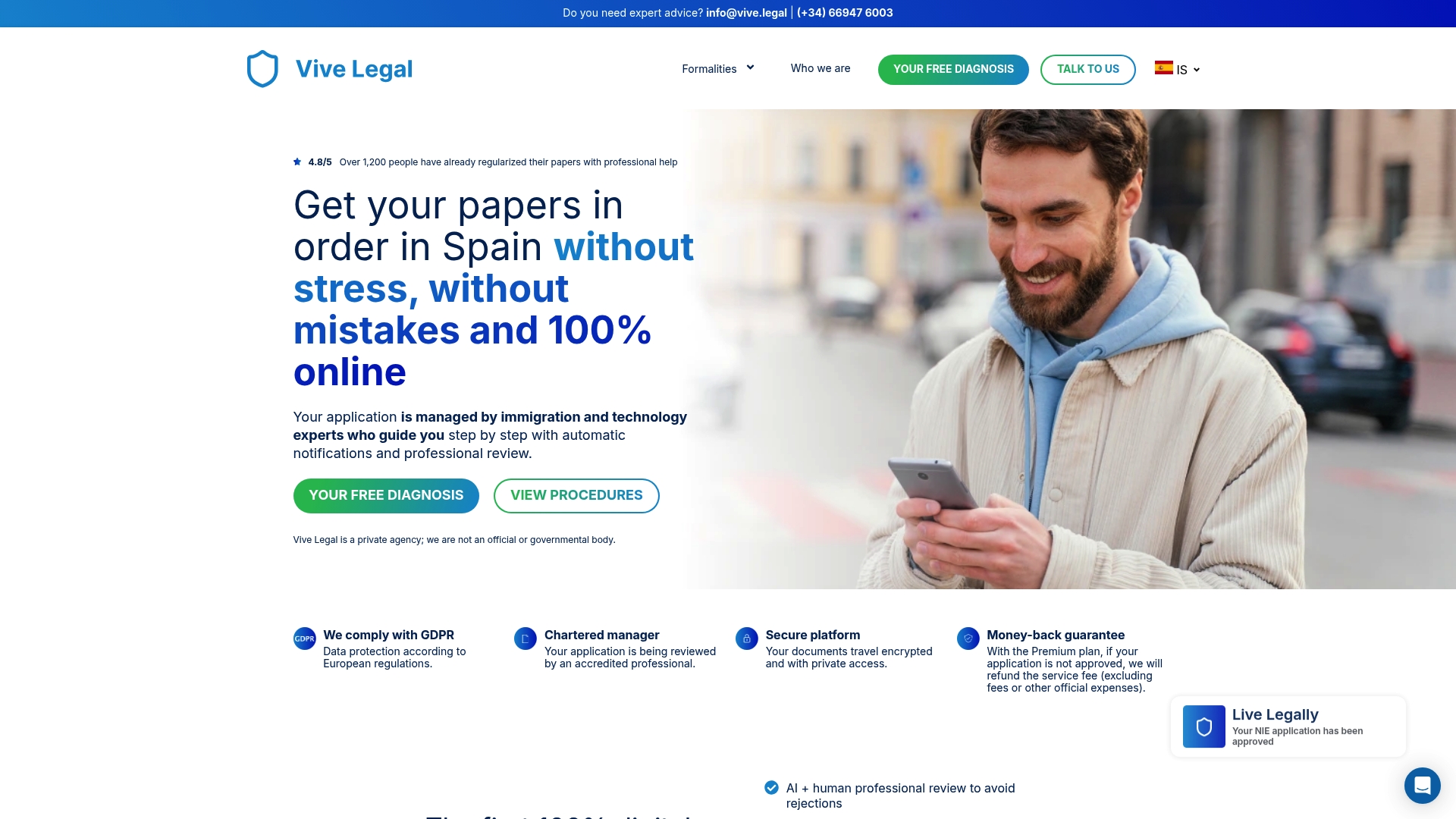
Vive combines legal expertise with a fully digital case management system to help you prepare, review, and submit your residency documents with confidence. From document review and sworn translation coordination to appointment scheduling and real-time application tracking, every step is handled in one place. If you are ready to move forward, start by reviewing the service terms and see exactly what is included. Vive’s team understands the 2026 reforms inside and out, and that knowledge is directly applied to every case.
FAQ
Who qualifies for Spain’s 2026 regularisation?
You qualify if you were present in Spain before January 1, 2026, have maintained continuous residence for at least five months, hold no criminal record, and do not represent a threat to public order.
What documents do you need for the regularisation application?
You need nominative documents with explicit validity dates, including a padron certificate, employment records or utility bills in your name, and a criminal record certificate from Spain and your country of origin with sworn translations.
When does the 2026 regularisation application window close?
The application deadline is June 30, 2026. Applications opened on April 16, 2026, and can be submitted online or in person at provincial immigration offices.
What permit do you receive if your application is approved?
Successful applicants receive a one-year residence and work permit that includes access to social security and public healthcare, with the option to transition to a standard renewable permit after the first year.
Can a lawyer use AI to prepare your immigration documents in Spain?
Yes, but under Circular 3/2026 all AI-generated legal outputs must be manually verified by a qualified lawyer before use. Failure to verify can result in disciplinary sanctions.
Recommended
Living legally in Spain shouldn't be difficult.
View services and pricesNot sure which procedure you need? Find out in 2 min
Questions? Message us on WhatsApp