
Types of Arraigo Eligibility in Spain: 2026 Guide

TL;DR:
- Spain’s arraigo system offers irregular residents a legal route to residency, but eligibility depends entirely on individual circumstances. Understanding the specific criteria for each pathway—social, labor, family, training, or extraordinary arraigo—is essential for a successful application and timely processing.
Spain’s arraigo system gives irregular residents a legal path to residency, but the route you qualify for depends entirely on your specific circumstances. Understanding the types of arraigo eligibility before you apply is not optional. It determines which documents you need, how long you have to wait, and whether your application even has a chance. This guide breaks down every recognized category under Spanish immigration law, including the new extraordinary arraigo that closes June 30, 2026, so you can identify your best option and move forward with confidence.
Living legally in Spain shouldn't be difficult.
View services and pricesNot sure which procedure you need? Find out in 2 min
Questions? Message us on WhatsApp
Key takeaways
| Point | Details |
|---|---|
| Five distinct pathways exist | Spain recognizes social, labor, family, training, and extraordinary arraigo, each with different criteria. |
| Residence time varies widely | Requirements range from no minimum (family) to five years (some extraordinary conditions). |
| Extraordinary arraigo deadline | The 2026 temporary window closes June 30, 2026, requiring just five months of proven presence. |
| No active permit allowed | Applicants must not hold or be processing any valid residence authorization to qualify. |
| Professional preparation matters | Documentation errors are among the top reasons for rejection across all arraigo types. |
1. General eligibility criteria for all types of arraigo
Before examining each pathway individually, you need to understand the floor-level requirements. These apply regardless of which arraigo category you pursue.
You must be physically present in Spain and not currently hold a valid residence permit. Critically, no pending permit applications are allowed. If you have an active file at extranjería for any other authorization, you are disqualified until that process concludes.
Your criminal record must be clean. Spanish authorities check both Spanish police databases and the criminal record from your country of origin. Any serious offense is grounds for automatic denial. You will also need to prove your identity with a valid passport and document your continuous physical presence through:
- Municipal registration (empadronamiento) certificates
- Bank statements or utility bills showing your address over time
- Medical records or school enrollment for children
- Employer letters, social security reports, or inspection records
Pro Tip: Get your empadronamiento certificate stamped with the date range it covers. A single certificate showing “registered since X date” carries more weight than multiple short-term ones.
The legal status in Spain you hold before applying also affects which category you can access. People who entered legally but overstayed a visa and those who entered without authorization both qualify in principle, but their documentation strategies differ.
2. Arraigo social: the most widely used pathway
Arraigo social is the traditional backbone of Spain’s regularization system. It requires at least 3 years continuous residence and is the most frequently pursued option for people who have been building a life in Spain without papers.

Beyond the three-year residency threshold, you need to prove social integration. This happens in one of two ways: you demonstrate strong family ties to legal residents in Spain, or you obtain a social integration report issued by your local municipal government. The second option, known as an informe de arraigo, is a community ties document from local authorities confirming your participation in Spanish social life, language ability, and neighborhood connections.
The third requirement is economic. You must show either a signed pre-employment contract or proof of sufficient financial means to support yourself without public assistance. The job offer does not need to be full-time, but it must be from a real employer and cover the period of your initial permit.
Once approved, arraigo social grants a two-year residence and work authorization. You can work for any employer in any sector.
Common pitfalls to avoid:
- Gaps in your empadronamiento history that break the three-year continuity requirement
- Integration reports that are too vague or issued by a municipality where you are not actually registered
- Job offer letters that look informal or lack proper company registration details
Pro Tip: Request your informe de arraigo at least three months before you plan to file. Some municipalities have backlogs of 60 to 90 days, and an expired or outdated report can invalidate your entire application.
3. Arraigo laboral: the two-year work history route
Arraigo laboral is designed for people who can prove they have worked in Spain, even without authorization. It requires 2 years continuous residence plus evidence of at least six months of employment history in Spain.
The key distinction from social arraigo is that you do not need a current job offer. Instead, you prove past work. This is done through:
- Labor inspection reports confirming undeclared employment
- Employer letters acknowledging your work history
- Social security contribution records if any were ever registered
- Witness statements in certain circumstances
This pathway is often underused because people assume they need formal employment contracts. They do not. A labor inspection that found you working on a job site is valid documentation. Informal work in domestic service, agriculture, or construction all count if you can substantiate them.
The criminal record requirement still applies, and your two years of residence must be proven with the same documentation standards as social arraigo. The permit duration upon approval is also two years, with full work authorization.
Pro Tip: If you were ever found working by the Inspección de Trabajo, request a copy of that inspection report. It is one of the strongest pieces of evidence you can submit for arraigo laboral and many applicants do not realize it is obtainable.
4. Arraigo familiar: family ties without a residence minimum
Arraigo familiar operates on completely different logic from the other pathways. No minimum residence period is required. What matters is the nature of your family relationship to a Spanish citizen or legal resident.
The qualifying scenarios are specific:
- You are the parent of a child who holds Spanish nationality
- You are the ascendant or descendant of a Spanish citizen with legal residence in Spain
- You are the spouse or unmarried partner of a legal resident, where the relationship is genuine and documented
The parent-of-a-Spanish-child route is the most commonly used scenario. If your child was born in Spain and registered as Spanish, you qualify regardless of how long you have been in the country. You need a birth certificate, proof of the child’s Spanish nationality, and documentation proving your parental relationship.
For family-based residency paths, the focus is entirely on proving the authenticity and legal standing of the family connection. Authorities will check whether the Spanish child is actually registered and whether the parent-child relationship is legally recognized.
The permit granted is also two years with full work authorization.
5. Arraigo formativo: regularize through training
Arraigo formativo is one of the newer additions to Spain’s residency options and it appeals to people who want to invest in their future while gaining legal status. It requires 2 years of continuous residence plus enrollment in an accredited training program leading to a recognized qualification.
The training must be formal and tied to Spain’s official vocational education framework. Programs typically run 12 to 24 months. You can work part-time during the training period, but there are limits on working hours to ensure training remains your primary activity.
Here is how arraigo formativo compares to arraigo social at a glance:
| Feature | Arraigo formativo | Arraigo social |
|---|---|---|
| Minimum residence | 2 years | 3 years |
| Job offer required | No | Yes (or financial means) |
| Integration report needed | No | Often required |
| Work rights | Part-time during training | Full-time from approval |
| Training obligation | Yes, accredited program | No |
The advantage of this route is that it removes two of the most difficult requirements in social arraigo: the job offer and the integration report. If you have two years of presence and can get accepted into an accredited vocational program, you can apply. Vive offers dedicated support for arraigo formativo applications to help you get your file ready faster.
6. Extraordinary arraigo: the 2026 temporary window
This is the most time-sensitive pathway in the entire arraigo system. The extraordinary arraigo, introduced under RD 316/2026, closes June 30, 2026 and is not expected to be renewed.
The residence requirement is much shorter than any standard pathway. You need to prove just five months of continuous presence in Spain before the date of application. You must not hold any current residence permit and must not have previously applied for asylum.
Beyond the five-month presence, you must meet at least one of three conditions:
- Labor link or intent to work: You have a job offer, an existing employment relationship, or a demonstrated connection to the labor market.
- Family unit cohabitation: You are living as part of a stable family unit in Spain, even if the family members are also in an irregular situation.
- Certified vulnerability: A recognized social services body certifies that you are in a situation of social vulnerability.
The procedural benefit is substantial. Resolution must happen within three months of application, and during that waiting period, you receive a provisional residence and work permit. That means you can work legally while your case is processed.
Pro Tip: Do not wait until late June to file. Immigration offices in major cities typically see a surge of last-minute applications before temporary windows close, which can delay initial processing and put your timeline at risk.
This pathway is specifically designed for people who arrived before January 1, 2026 and cannot easily meet the longer residence or documentation thresholds of other arraigo types. If you qualify, this is probably your fastest route to legal status this year.
7. Comparing all arraigo types side by side
Use this table to see where you fit across all five recognized pathways:
| Type | Min. residence | Job offer needed | Key requirement | Permit length | Work rights |
|---|---|---|---|---|---|
| Social | 3 years | Yes (or funds) | Integration report or family ties | 2 years | Full |
| Labor | 2 years | No | 6 months work history | 2 years | Full |
| Family | None | No | Qualifying family relationship | 2 years | Full |
| Training | 2 years | No | Accredited training enrollment | 2 years | Part-time |
| Extraordinary | 5 months | Situational | Labor, family unit, or vulnerability | 1 year (provisional) | Full (provisional) |
A few patterns stand out. Arraigo familiar is the fastest route for parents of Spanish children because there is no waiting period tied to years of residence. Arraigo laboral is often underused but genuinely accessible to people with work history in informal sectors. Extraordinary arraigo offers the lowest time barrier of any pathway but expires in weeks.
Common misconceptions worth clearing up:
- You do not need to be fluent in Spanish for most types, though it strengthens your integration report.
- A criminal record in Spain does not automatically block you. Minor offenses that have been served may not count, depending on the nature.
- Arraigo formativo is not just for young people. Any adult enrolled in qualifying vocational training can apply.
For checking residency proof requirements, the documentation standards differ by pathway but the empadronamiento certificate remains central to all of them.
My honest take on choosing the right arraigo path
I have worked with hundreds of people who came to me confused, holding a mix of documents and unsure which category fit their story. What I have learned is this: most people fixate on the pathway that sounds easiest rather than the one they can actually prove.
The biggest mistake I see is people pursuing social arraigo because it is the most familiar, when they actually qualify for labor or family arraigo with less documentation and a lower residence threshold. If you ever worked without papers, get that labor inspection report. It is worth more than six months of integration meetings.
The extraordinary arraigo window genuinely changes the math for 2026. I have never seen a legal pathway in Spain with a five-month residence requirement and immediate provisional work rights. For people who arrived in the second half of 2025 and have even one of the three qualifying conditions, this is not something to defer. The 2026 immigration changes that introduced this window were designed specifically for people who could not wait three years to get legal.
My practical advice: start by mapping your strongest evidence, then match that evidence to the appropriate pathway. Do not build your case around the pathway first. Build it around the proof you already have, then file accordingly.
— Martín
Get your arraigo application right the first time
Knowing which pathway fits your situation is only half the challenge. Preparing the documentation correctly, submitting on time, and tracking your case through the system is where most applications run into trouble.
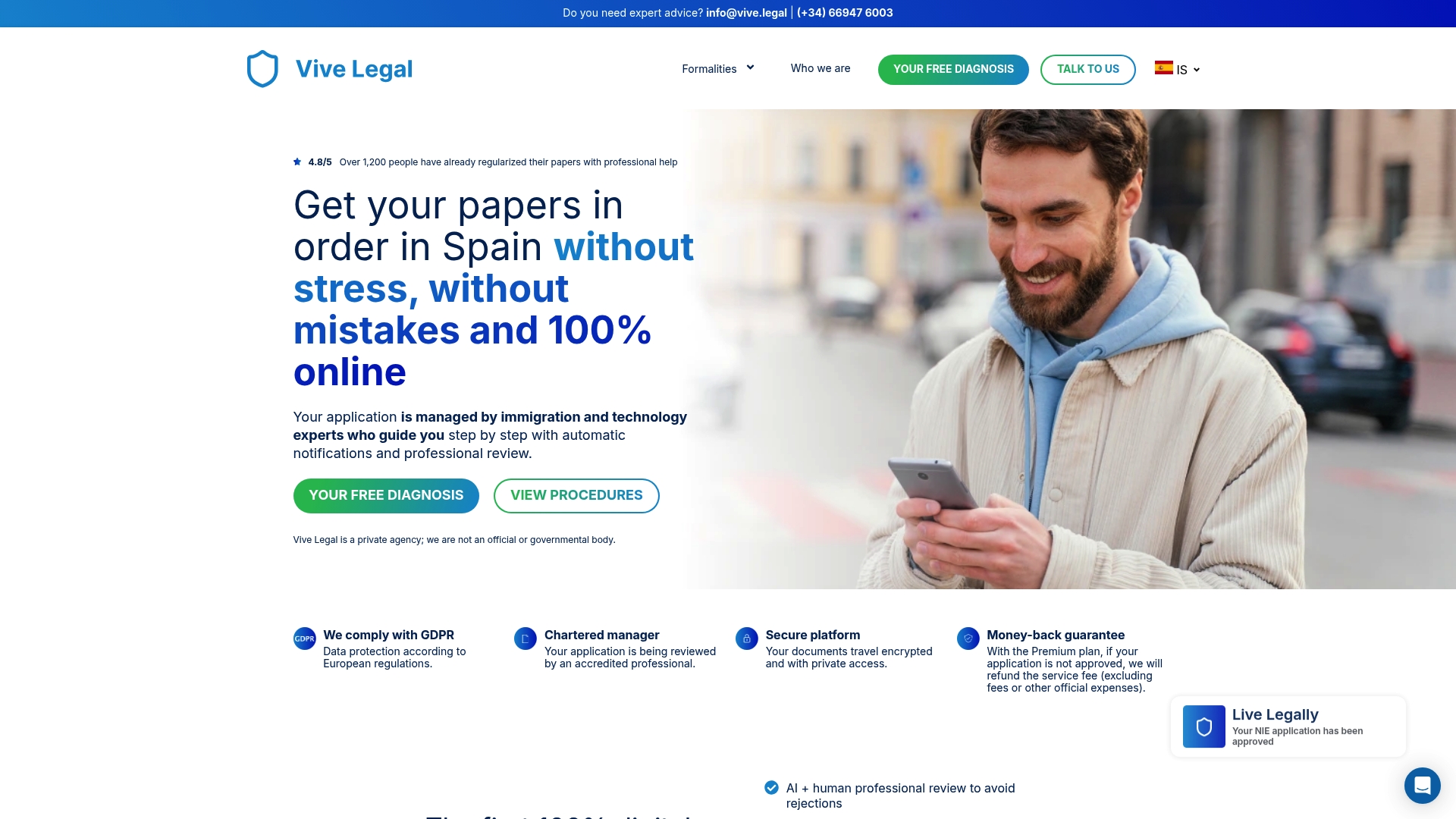
Vive handles the entire arraigo process online, from diagnosing your eligibility across all five pathway types to preparing your documents, scheduling your appointment, and tracking every step through a secure client portal. For applicants who need a job offer as part of their social arraigo, Vive’s job search service connects you with compliant employers who understand the arraigo process. For those pursuing arraigo formativo, the platform coordinates directly with accredited training centers. With the extraordinary arraigo deadline approaching fast, the time to get your file reviewed is now, not after the window closes.
FAQ
What are the types of arraigo available in Spain?
Spain currently recognizes five arraigo categories: social, labor, family, training (formativo), and the temporary extraordinary arraigo available through June 30, 2026. Each has different eligibility criteria and residence time requirements.
Who qualifies for arraigo without a long residence history?
Arraigo familiar requires no minimum residence period and is available to parents of Spanish children or close relatives of Spanish citizens. The extraordinary arraigo also has a very low threshold, requiring just five months of continuous presence.
How long does an arraigo application take to resolve?
Standard arraigo applications typically take three to six months. The extraordinary arraigo has a legal resolution maximum of three months from acceptance, with provisional work rights granted immediately.
Can you work in Spain while an arraigo application is being processed?
For the extraordinary arraigo, yes. Provisional residence and work authorization begins from the moment the application is accepted. For standard arraigo types, work rights begin only after formal approval.
What document proves continuous residence for arraigo applications?
The primary document is the empadronamiento certificate from your municipal registry. Supporting evidence includes bank records, utility bills, and medical records. For arraigo laboral, labor inspection reports and employer letters also count toward proving your residence and employment history.
Recommended
Living legally in Spain shouldn't be difficult.
View services and pricesNot sure which procedure you need? Find out in 2 min
Questions? Message us on WhatsApp