
Explain Legal Status in Spain: Your 2026 Guide

TL;DR:
- Having an NIE does not grant the legal right to live or work in Spain, only an identification number. The TIE card proves valid residence authorization, while actual legal residence depends on the residence permit obtained separately. The 2026 regularisation offers undocumented migrants a pathway, but timely preparation and understanding these distinctions are crucial for successful application.
Most people moving to Spain assume that getting an NIE number means they are legally allowed to live and work there. That assumption is wrong, and it costs people real time and opportunity every year. To explain legal status in Spain properly, you need to understand three separate layers: the identification number, the physical permit card, and the actual authorization to reside. These are not the same thing, and mixing them up leads to failed applications, denied employment, and missed regularisation deadlines. With Spain’s 2026 extraordinary regularisation now open, understanding these distinctions has never mattered more.
Living legally in Spain shouldn't be difficult.
View services and pricesNot sure which procedure you need? Find out in 2 min
Questions? Message us on WhatsApp
Table of Contents
- Key takeaways
- How to understand Spain legal status: NIE, TIE, and residency
- Pathways to acquire legal status and nationality
- Recent updates in Spain immigration law affecting legal status
- Practical impact of legal status on daily life
- My perspective on Spain’s legal status complexity
- How Vive can help you manage your legal status in Spain
- FAQ
Key takeaways
| Point | Details |
|---|---|
| NIE is not residency | The NIE is an ID number for administrative tasks; it does not grant the right to live or work in Spain. |
| TIE proves your status | The TIE card is physical evidence of your residency permit type and how long it is valid. |
| 2026 regularisation window | Spain’s extraordinary program accepts applications from April 16 to June 30, 2026, for undocumented migrants. |
| Nationality requires registration | Spanish nationality only becomes legally effective once recorded in the Civil Register. |
| Padrón registration matters | Registering on the municipal Padrón is one of the most practical steps for protecting your legal rights. |
How to understand Spain legal status: NIE, TIE, and residency
The single biggest source of confusion in Spain immigration law is treating the NIE, the TIE, and legal residency as interchangeable. They are not. Each one does something completely different.
The NIE (Número de Identidad de Extranjero) is a lifelong identification number. Think of it as your administrative fingerprint in Spain. You need it to open a bank account, sign a rental contract, register for employment, or pay taxes. That said, the NIE does not confer any right to reside or work. A tourist can have one. A property buyer with no plans to live in Spain can have one. The NIE simply identifies you in the system.
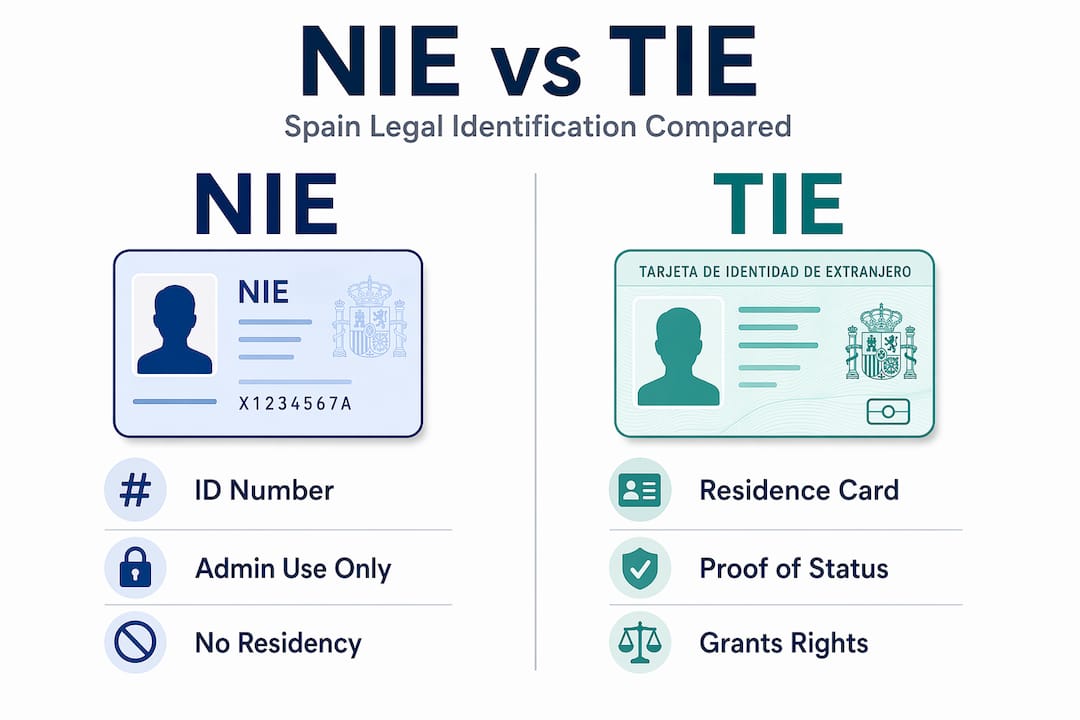
The TIE (Tarjeta de Identidad de Extranjero) is fundamentally different. It is a physical residency card that proves you hold a valid residence authorization. The TIE shows the permit type, whether that is a work and residence permit, a non-lucrative visa authorization, or a student permit. It also shows the expiration date. If your TIE expires and you do not renew it, you lose your legal right to remain. You can learn more about the TIE card requirements and how to apply before the 30-day deadline to avoid fines.
Here is a quick comparison to make the distinction clear:
| Document | What it is | What it grants |
|---|---|---|
| NIE | Identification number | Administrative access only |
| TIE | Physical residency card | Proof of valid residence authorization |
| Residence authorization | Legal permit issued by immigration authorities | Right to reside and, depending on type, work |
Pro Tip: Never show up to a job interview or a bank appointment with only your NIE paperwork and assume that proves you can legally work. Employers need to see your TIE to confirm your work authorization status.
The practical takeaway is this: you can hold an NIE for decades without ever being a legal resident. Your legal status in Spain is determined by your residence authorization and evidenced by your TIE card.
Pathways to acquire legal status and nationality
Once you understand that legal residency requires an actual authorization, not just an ID number, the next question is how to get that authorization. Spain offers several routes depending on your circumstances.
Main routes to legal residency:
- Work and residence authorization through an employer sponsoring a work permit
- Family reunification with a legal resident or Spanish national
- Non-lucrative residence for those with sufficient income who do not plan to work
- Arraigo (social, family, or work roots), which allows undocumented individuals with ties to Spain to regularize their status
- Student residence permits linked to enrollment in an accredited program
- The 2026 extraordinary regularisation for undocumented migrants meeting specific criteria
Naturalisation routes to Spanish nationality follow four distinct pathways: by option (for certain individuals with a family connection to Spain), by discretionary conferral (exceptional cases), by possession of status (long-term documented conduct as a Spanish national), and by residency. The residency route is the most common. It requires ten years of continuous legal residence for most nationalities, five years for recognized refugees, two years for nationals of Latin American countries and several others, and just one year in special cases like marriage to a Spanish national or being born in Spain.
Integration requirements include passing language tests (DELE A2 or higher) and a constitutional and cultural knowledge exam called CCSE. Nationals of Spanish-speaking countries are exempt from the language test.
For the 2026 extraordinary regularisation, the process works like this:
- Confirm you meet the eligibility criteria: five months of continuous residence in Spain, a clean criminal record in Spain and your country of origin, and valid identity documentation.
- Gather your supporting evidence. This includes proof of residence such as Padrón certificates, utility bills, and employer letters.
- Submit your application telematically or in person starting April 16, 2026. In-person submissions were accepted from April 20 onward.
- Wait for resolution. The government has up to three months to respond. If no response arrives, silent denial applies.
- If approved, you receive a one-year renewable residence and work permit.
Pro Tip: Start gathering residence evidence now, not when the deadline is close. Padrón registrations, utility contracts, and employment records all take time to obtain, and missing documentation is the most common reason applications fail.
Recent updates in Spain immigration law affecting legal status
The 2026 extraordinary regularisation is the most significant shift in Spain immigration law in years. Spain’s government approved a plan to grant permits to roughly 500,000 undocumented migrants through this window. The application period runs from April 16 to June 30, 2026, with resolutions issued within three months of submission.
Here is what makes this program different from standard arraigo permits:
- The residence requirement is shorter (five months versus the typical three years for arraigo social)
- Applications can be filed telematically or in person, reducing access barriers
- Provisional residence and work authorization is granted upon submission, meaning you can legally work while your case is processed
- If the application is denied, that provisional authorization ends immediately
One major policy shift running alongside the regularisation is the end of Venezuela’s fast-track pathway. The humanitarian fast-track for Venezuelans that had been in place since 2018 ended in June 2026. Venezuelan nationals must now follow the standard immigration path, including the extraordinary regularisation if eligible.
Timeliness matters more than people realize. Missing the June 30 deadline is not a minor inconvenience. It means waiting for the next available pathway, which could be years away. Documentation preparation should be planned backwards from fixed deadlines, not assembled at the last minute.
For those who receive approval, the one-year permit is renewable. But renewal is not automatic. You will need to demonstrate continued compliance, including maintaining your Padrón registration and, ideally, documented employment or income. Starting to build that evidence file from day one of your permit is the smartest thing you can do.
Practical impact of legal status on daily life

Understanding legal status matters not just on paper but in how you live every day in Spain. Your rights in Spain shift significantly depending on whether you are documented, undocumented, or in a provisional status.
What changes when you have legal status:
- You can legally work under contract and access social security contributions
- You qualify for public healthcare through the general health system
- You can rent property through formal contracts without risk of housing discrimination tied to undocumented status
- Your children have the right to public education regardless of your status, but your own access to subsidized services depends on it
- You can apply for social benefits and access certain integration programs funded by regional governments
Registering on the Padrón (the municipal population registry) is one of the most underused tools available. Even undocumented individuals can and should register. Padrón registration is not an immigration check. It is an administrative record, and it is one of the primary forms of evidence accepted in regularisation applications. It also unlocks access to local health centers and schools.
Common mistakes that put legal status at risk include:
- Letting your TIE expire without starting the renewal process at least 60 days before expiration
- Failing to update your address on the Padrón after moving, which can invalidate residency evidence
- Assuming that a job offer alone is enough to obtain a work permit without employer sponsorship paperwork
- Missing integration test deadlines when applying for nationality
For a practical overview of what to prepare before applying, Vive’s guide on avoiding residency rejection covers the most common filing errors that lead to denials.
My perspective on Spain’s legal status complexity
I’ve worked with hundreds of people trying to understand where they stand in Spain’s immigration system, and the pattern I see most often is this: people know they need “some document” but have no idea which one actually protects them. They hold an NIE and feel safe. They are not.
The NIE confusion is not their fault. Spain’s system uses similar-sounding acronyms for very different things, and the administrative processes are not set up to explain the difference clearly. What I’ve learned is that the moment someone understands the NIE is just a number and the TIE is the actual shield, everything else clicks into place faster.
On the 2026 regularisation: I think the window is real and the criteria are genuinely accessible, but the risk of missing it through poor preparation is high. Most people I’ve spoken with underestimate how long it takes to get official Padrón certificates, criminal record clearances from their country of origin, and certified translations. These are not same-day tasks.
My honest advice: treat the June 30 deadline like it is April 30. Give yourself a two-month buffer for document collection and review. The people who succeed in these processes are not those with the cleanest situations. They are the ones who showed up prepared.
— Martín
How Vive can help you manage your legal status in Spain
Understanding your legal status is the first step. Taking action on it is where Vive comes in. Vive is an online legal consultancy built specifically for immigration and residency procedures in Spain, covering everything from NIE and TIE applications to arraigo permits and nationality filings. The platform combines professional legal oversight with digital tools so you can track your case, upload documents, and receive status updates without visiting an office.
Whether you are applying for a TIE for the first time, renewing a residence permit, or preparing a regularisation file before June 30, Vive handles the paperwork, checks for errors before submission, and keeps you informed at every stage. For those pursuing Spanish nationality, Vive can prepare a case ready for submission in as little as 24 hours.
If you are unsure where you stand or what your next step should be, start with a personalized diagnostic on the Vive platform. Clear answers, no jargon, and real support from people who know Spain immigration law.
FAQ
What is the difference between NIE and TIE in Spain?
The NIE is a lifelong identification number used for administrative tasks like banking and tax registration. The TIE is a physical card that proves you hold a valid residence authorization and shows your permit type and expiration date.
Who qualifies for Spain’s 2026 extraordinary regularisation?
Undocumented migrants who have lived continuously in Spain for at least five months, hold a clean criminal record in Spain and their home country, and can prove their identity are eligible. The application window runs from April 16 to June 30, 2026.
Does registering on the Padrón give me legal residency in Spain?
No. Padrón registration is a municipal administrative record and does not grant residency rights. However, it is accepted as evidence of continuous residence in regularisation and permit applications.
How long does it take to get Spanish nationality by residency?
The standard requirement is ten years of continuous legal residence. It drops to two years for nationals of Latin American countries and one year in special cases such as marriage to a Spanish national or birth in Spain.
What happens if my regularisation application is denied?
The provisional residence and work authorization granted at the time of submission ends immediately upon denial. Applicants should prepare for this possibility by maintaining Padrón registration and other residency evidence for future applications.
Recommended
Living legally in Spain shouldn't be difficult.
View services and pricesNot sure which procedure you need? Find out in 2 min
Questions? Message us on WhatsApp