
Understanding Extranjería in Spain: Your Complete Guide

TL;DR:
- Many foreigners in Spain mistakenly believe that obtaining a NIE grants legal residence and work rights, which is incorrect. Extranjería refers both to the legal framework governing foreigners and to the administrative procedures or offices involved in managing residence, permits, and documentation. Understanding the distinctions between NIE, TIE, residence authorization, and regional agencies is essential to maintaining legal status and avoiding costly mistakes in the immigration process.
Thousands of people arrive in Spain each year convinced that getting a NIE (Número de Identidad de Extranjero, or Foreigner Identification Number) means they are free to live and work legally. This is one of the most persistent and costly misunderstandings in the entire Spanish immigration process. Under Ley Orgánica 4/2000, “extranjería” is the official legal and administrative regime governing all foreigners in Spain, covering everything from entry rights to residence and work authorizations. This guide gives you a clear, practical breakdown of what extranjería really means and what it requires from you.
Living legally in Spain shouldn't be difficult.
View services and pricesNot sure which procedure you need? Find out in 2 min
Questions? Message us on WhatsApp
Table of Contents
- What is extranjería? Legal definition and real-world meaning
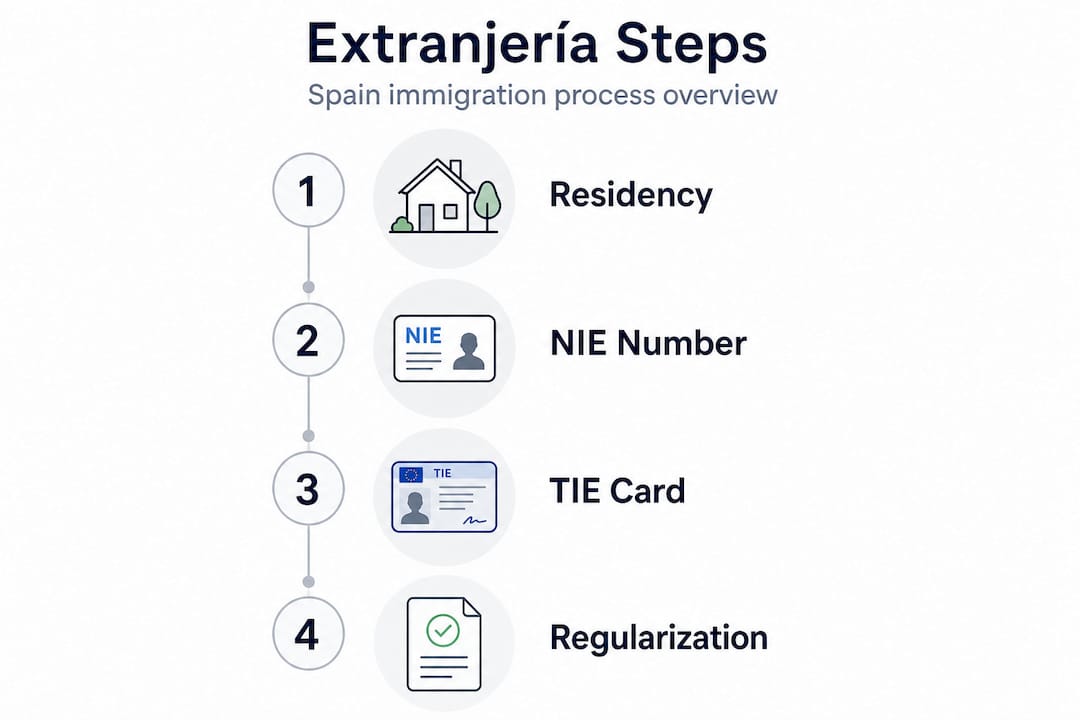
- The core processes: Residency, NIE, TIE, and regularization
- Who manages extranjería? Agencies, offices, and overlapping roles
- Common mistakes and expert tips when navigating extranjería
- Why understanding extranjería is crucial for successful life in Spain
- How Vive Legal helps you navigate extranjería efficiently
- Frequently asked questions
Key Takeaways
| Point | Details |
|---|---|
| Extranjería is multi-layered | It is both a legal framework and a practical set of procedures for foreigners living in Spain. |
| NIE is not residence | Holding a NIE does not grant you the right to reside in Spain—it is simply an identifier. |
| Agencies vary | Multiple Spanish agencies manage different aspects of extranjería, so processes can overlap. |
| Documentation is crucial | Ensuring you have the correct documents is the main determinant of a smooth extranjería process. |
| Expert support saves time | Professional guidance can prevent common mistakes and help navigate complex circumstances. |
What is extranjería? Legal definition and real-world meaning
The word “extranjería” trips people up constantly, and for good reason: it means at least three different things depending on the context. Understanding which meaning applies to your situation is the first practical skill you need.
The formal legal definition is straightforward. Extranjería refers to the legal and administrative regime for foreigners in Spain, shaped primarily by Ley Orgánica 4/2000. This law, often called the “Ley de Extranjería,” establishes who qualifies as a foreigner under Spanish law, what rights they hold, how they can enter and exit the country, and what permits they need to stay or work legally. It applies to every non-Spanish national, whether you are from the EU or outside it, though the rules differ significantly between those two groups.
“Extranjería refers to the legal and administrative regime for foreigners (those without Spanish nationality), regulating rights, documentation, entry and exit, and residence and work authorizations.” — Ley Orgánica 4/2000
The practical, everyday meaning is where people get confused. In daily speech, “extranjería” often refers to the actual trámites (administrative procedures) that foreigners must complete: applying for permits, renewing residency cards, registering as a resident, and so on. Locals and expats alike say “tengo que ir a extranjería” (I have to go to extranjería) when they mean they have an appointment at a government immigration office. So the same word can describe the law, the system of procedures, or the physical office where you show up with your paperwork.
Why this matters for you: If a fellow expat tells you “I sorted out my extranjería,” that could mean they renewed their TIE card, obtained a residence permit, or simply got their NIE for tax purposes. Those are very different legal outcomes. Being precise about which process applies to your situation is not just bureaucratic detail — it determines whether you are living legally in Spain or unknowingly violating the terms of your stay.
The key legislation you should know:
- Ley Orgánica 4/2000: The main immigration law, covering rights and obligations of foreigners
- Real Decreto 557/2011: The implementing regulation that spells out exact procedural requirements
- Ley 14/2003: Updates to the original law, expanding EU citizen provisions
- Directive 2004/38/EC: The EU directive governing free movement, transposed into Spanish law for EU nationals
Good reading on Spanish residency compliance can help you understand which specific rules apply to your category before you even book your first appointment.
The core processes: Residency, NIE, TIE, and regularization
Once you understand what extranjería is, the next step is knowing which specific process you actually need. This is where most people make expensive mistakes.
NIE: What it is (and what it is not)
The NIE is your unique identification number as a foreigner in Spain. Think of it purely as a tax and admin identifier, similar to a Social Security number in the United States. You need it to open a bank account, buy property, sign a contract, or do almost any official transaction in Spain. But here is what many people do not realize: the NIE does not grant you the right to reside in Spain. It is an identifier, not a residence authorization. You can obtain your NIE while still on a tourist visa and it will not change your legal residency status one bit.
TIE: Your physical proof of status
The TIE (Tarjeta de Identidad de Extranjero, or Foreigner Identity Card) is the actual card that shows your legal immigration status in Spain. It displays your name, photo, NIE number, and crucially, your type of residence authorization. A TIE marked “residencia temporal” (temporary residence) tells authorities you have up to five years of legal stay. A TIE marked “residencia permanente” shows long-term legal status. The TIE is what you show when police, employers, or landlords need to verify your right to be in Spain.
Residence and stay authorizations
These are the actual legal permits that allow you to live and, in some cases, work in Spain. There are many types, including:
- Residencia no lucrativa (non-lucrative residency): For those with sufficient income who do not plan to work in Spain
- Residencia y trabajo por cuenta ajena (residency and employment): For people with a job offer from a Spanish employer
- Residencia y trabajo por cuenta propia (self-employment residency): For freelancers and entrepreneurs
- Reagrupación familiar (family reunification): For family members of legal residents
- Residencia de larga duración (long-term residency): Available after five continuous legal years of residence
- EU registration (Certificado de Registro de Ciudadano de la Unión): The streamlined process for EU/EEA nationals
| Document | Purpose | Grants residency? | Issued by |
|---|---|---|---|
| NIE | Tax and ID number | No | Police/Consulate |
| TIE | Physical identity card | Shows existing status | National Police |
| Residence authorization | Legal right to stay/work | Yes | Ministry/Delegación |
| EU registration certificate | EU national registration | Yes | National Police |
Pro Tip: When you move to Spain, figure out which authorization you need before worrying about the NIE. The NIE will come as part of most residency processes anyway, but confusing the two can lead you to complete step three before step one.
Extraordinary regularization in 2026
Spain’s immigration landscape shifted significantly in 2026. The government introduced an extraordinary regularization process giving eligible undocumented migrants a path to legal residency. This is not a blanket amnesty — applicants must meet specific requirements around time in the country, lack of criminal record, and other criteria. If you believe you may qualify, understanding the arraigo social process is an important first step, as it is one of the most common pathways for long-term undocumented residents to regularize their status.

For a full breakdown of what documents you will need, the Spanish residency requirements guide walks you through each application category in detail.
Who manages extranjería? Agencies, offices, and overlapping roles
One reason the extranjería system feels overwhelming is that multiple agencies are involved, and different procedures fall under different authorities. Here is a clear breakdown.
The extranjería framework is both a legal structure and a network of offices managed by different agencies, which is exactly why applicants often find themselves bouncing between institutions. Understanding which agency handles which task saves you enormous time.
| Agency | Primary role | Example tasks |
|---|---|---|
| Ministerio de Inclusión y Migraciones | Policy and residence authorizations | Issuing work and residency permits |
| Policía Nacional | Identity documents and registration | TIE, NIE, fingerprinting |
| Oficinas de Extranjería | Regional processing offices | Permit applications, renewals |
| Ayuntamiento (town hall) | Empadronamiento (local registration) | Padrón municipal certificate |
| Consulados españoles | Applications from abroad | Initial visa, NIE from outside Spain |
The National Police handles TIE issuance and biometric data collection, which means you will almost always need a police appointment at some point, even if your main permit application goes through the regional immigration office (Oficina de Extranjería).
Key points about overlapping roles:
- Your empadronamiento (municipal registration) at the town hall is separate from your residency permit, but you often need it to apply for one
- Your residency permit is often processed by the Delegación del Gobierno or Oficina de Extranjería, not the police
- Your TIE card is picked up at the police station after your permit is approved
- EU citizens register at the police station and receive a certificate, not a TIE in the traditional sense
When people say “I’m going to extranjería,” they might mean the police station, the regional immigration office, or even the town hall. Always clarify which specific appointment or office you need before showing up. A good resource to help you gather residency documents before any of these appointments can prevent frustrating return visits.
Common mistakes and expert tips when navigating extranjería
Understanding the theory is one thing. Surviving the actual process is another. Here are the most frequent errors people make and how to avoid them.
The five most common extranjería mistakes:
-
Confusing the NIE with a residency permit. As the Ministry of Foreign Affairs clearly states, having a NIE is not the same as having a residence permit. Many people live in Spain for years thinking their NIE makes them legal residents when they actually have no valid authorization to stay.
-
Submitting incomplete documentation. Spanish immigration offices are strict about document completeness. Missing a single supporting document — a padrón certificate, a bank statement, an apostilled birth certificate — can mean rejection or long delays. Always check the exact list for your specific permit type and region.
-
Missing renewal deadlines. Most temporary residency permits must be renewed before they expire. If you miss the window, you may lose your legal status and have to start from scratch. Some permits allow renewal applications up to 60 days before expiry and up to 90 days after, but do not count on the grace period.
-
Ignoring regional differences. The extranjería process is not uniform across Spain. An application in Catalonia may require different supporting documents than the same application in Andalusia. Always verify with the local Oficina de Extranjería.
-
Applying for the wrong permit category. A common scenario: someone applies for a non-lucrative residency while planning to work freelance. This creates a direct legal conflict and can result in permit denial. Know your intended activity before choosing your permit type.
Pro Tip: Before submitting any application, cross-reference the requirements on the official government website and confirm with the specific regional office. Requirements can differ not just by region but by individual office interpretation.
If you are an EU citizen, the EU Registration process is your starting point. For families moving together, reviewing the compliance steps for families ensures everyone in your household stays legally covered throughout the process.
Why understanding extranjería is crucial for successful life in Spain
Here is a perspective that most immigration guides skip over: the extranjería system is not actually that complicated. What makes it feel complicated is linguistic and conceptual imprecision, specifically, the fact that the same word covers wildly different things.
We see this constantly. Someone researches “extranjería” online and reads articles about the legal framework. Then they show up at an office expecting a conversation about rights and authorizations, only to be told they are at the wrong building. Or an expat confidently tells a newcomer “just get your NIE sorted and you’re good,” when the newcomer actually needs a family card process to legally join their EU citizen spouse.
The real risk is not legal complexity. It is time lost and money spent correcting avoidable mistakes. We have seen applicants pay for unnecessary legal translations, attend wrong appointments, and even unknowingly overstay their authorized period simply because they conflated getting a NIE with getting full residency rights.
Our perspective is this: treat extranjería as a system with distinct parts, not a single process with a single endpoint. Your NIE, your empadronamiento, your residence permit, and your TIE card are four separate milestones, each with its own timeline and requirements. Completing one does not mean you have completed the others. Understanding this distinction, before you start, is worth more than any lawyer or translator you could hire after things go wrong.
The people who navigate extranjería most smoothly are not necessarily the most educated or the most fluent in Spanish. They are the ones who took the time to understand which specific box they are in, which specific permit they need, and which specific office handles that permit in their specific city. That kind of precise thinking saves weeks of frustration.
How Vive Legal helps you navigate extranjería efficiently
Extranjería involves multiple agencies, overlapping deadlines, and region-specific requirements that change more often than most guides can keep up with. Getting the details right the first time is not just convenient — it directly affects your legal status in Spain.

Vive Legal’s extranjería services are built specifically for this reality. The platform combines AI-driven document review with professional legal oversight, so every application is checked for completeness and accuracy before submission. Whether you need help establishing residency proof for expats or need to locate and complete the right forms for Spain immigration, Vive Legal handles the full process digitally, from diagnostic to appointment scheduling to case tracking. No unnecessary office visits, no paperwork guesswork — just a clear path to your legal status in Spain.
Frequently asked questions
Does having a NIE mean I am legally a resident of Spain?
No. A NIE does not entitle the holder to reside in Spain. It is simply a tax and identification number that you need for financial and administrative transactions.
What is the difference between extranjería and immigration in Spain?
Extranjería is the official legal and administrative regime for foreigners in Spain, covering all specific procedures and compliance requirements. Immigration is a broader concept that includes the social, economic, and policy dimensions of people moving between countries.
Is the 2026 regularization open to all undocumented migrants?
No. The 2026 extraordinary regularization sets specific eligibility criteria around time in Spain, clean criminal record, and other requirements, so not every undocumented migrant will qualify.
Which agency issues the TIE card in Spain?
The National Police issues the TIE card, typically at the Oficina de Extranjería or local police station with immigration services, after your residence authorization has been approved.
Do EU citizens have to follow extranjería procedures?
Yes, EU citizens must still register in Spain through extranjería procedures, but their process is simplified compared to non-EU nationals. They receive a registration certificate rather than a TIE card, and the requirements are generally less burdensome under EU free movement rules.
Recommended
Living legally in Spain shouldn't be difficult.
View services and pricesNot sure which procedure you need? Find out in 2 min
Questions? Message us on WhatsApp