
Your Guide to Legal Translations in Spain (2026)

TL;DR:
- Obtaining legal documents in Spain requires a sworn translation certified by a MAEC-registered translator to meet official standards. Proper preparation involves apostilling foreign documents beforehand, ensuring high-quality scans, and verifying translator credentials to avoid rejection. Since 2025, digital signatures are legally valid, but confirming acceptance with authorities saves time and prevents costly rejections.
Getting a document translated in Spain sounds simple until you submit it and it comes back rejected. The core confusion for most people is the difference between a regular professional translation and a traducción jurada, the sworn translation that Spanish authorities legally require. This guide to legal translations in Spain walks you through every step: understanding translation types, preparing your documents correctly, what digital submissions now allow, and how to avoid the mistakes that cause delays. Whether you are applying for residency, studying, or managing professional documents, what follows will save you time and money.
Living legally in Spain shouldn't be difficult.
View services and pricesNot sure which procedure you need? Find out in 2 min
Questions? Message us on WhatsApp
Table of Contents
- Key Takeaways
- Your guide to legal translations in Spain: the three types you need to know
- Step-by-step: how to get a sworn translation in Spain
- Common mistakes that cause rejections
- Understanding the cost of sworn translations in Spain
- Digital sworn translations: what changed in 2025
- My honest take on getting translations right in Spain
- How Vive can take the complexity out of your document process
- FAQ
Key Takeaways
| Point | Details |
|---|---|
| Sworn translations are mandatory | Spanish public bodies and courts only accept translations certified by a MAEC-registered sworn translator. |
| Apostille comes before translation | Foreign public documents must be apostilled or legalized before being sent for sworn translation. |
| Digital submissions are now valid | Since 2025, qualified electronic signatures on sworn translations carry the same legal weight as handwritten ones. |
| Poor scans cause rejections | Documents must be scanned at 300 dpi minimum with all stamps and signatures fully visible. |
| Get itemized quotes upfront | Pricing varies by language pair, urgency, and complexity, so request a written breakdown before ordering. |
Your guide to legal translations in Spain: the three types you need to know
Not all translations are created equal in Spain, and the gap between them is not just semantic. There are three distinct categories, and confusing them is one of the most common reasons documents get rejected.
A simple translation is what most people picture: a bilingual professional converts text from one language to another. This works fine for personal use, internal business communication, or understanding a document you received. Spanish authorities will not accept it as a legal document.
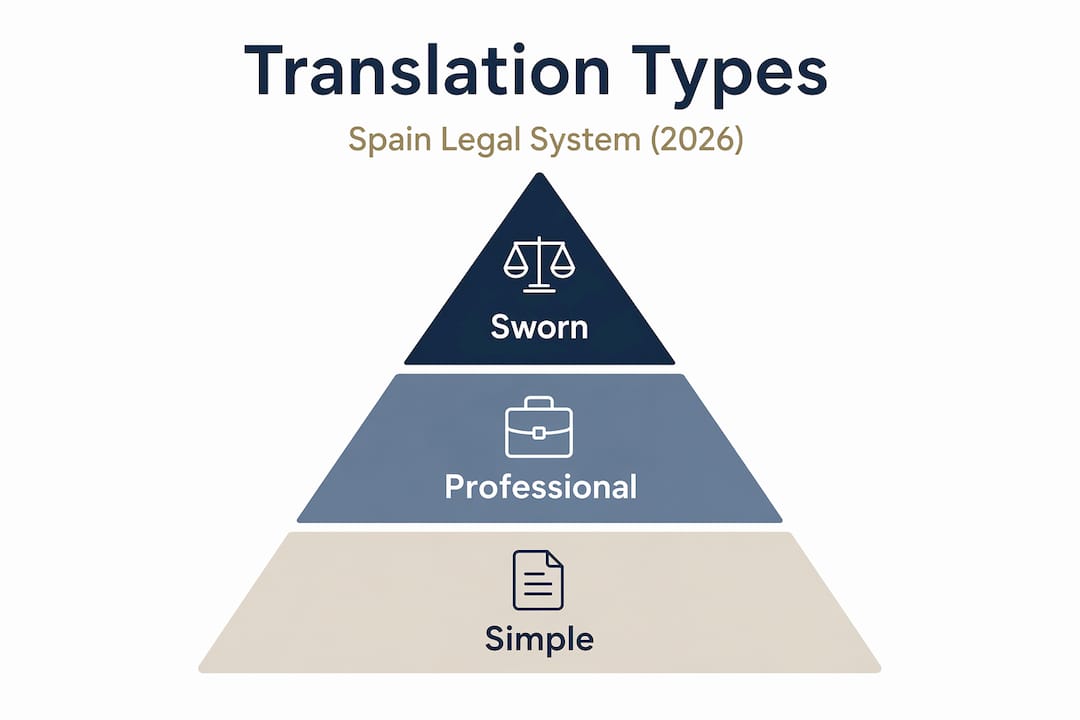
A professional translation steps it up in quality and accuracy but still carries no official legal stamp. Translators with specialist knowledge in law, medicine, or finance produce these. Again, for official procedures in Spain, this is not enough.
The category that matters most here is the sworn translation (traducción jurada). This is a translation produced and signed by a translator officially authorized by Spain’s Ministerio de Asuntos Exteriores, Unión Europea y Cooperación (MAEC). The sworn translation includes a signed declaration of fidelity, the translator’s official seal, and their credentials. It is the only format accepted by Spanish public administrations, notaries, courts, and immigration offices.
The traducción jurada does not just convert words. It preserves legal-relevant details such as names, dates, seals, and document structure to maintain legal effect. A name formatted differently, or a seal left untranslated, can undermine the entire submission.
Pro Tip: Not every page of a document always needs to be translated. Some Spanish institutions request translation of all file components, including apostille pages, while others do not. Always check the specific checklist for your receiving authority before ordering, so you do not pay for unnecessary pages or miss required ones.
Common document types requiring sworn translations include: birth and marriage certificates, criminal record checks, academic diplomas and transcripts, powers of attorney, corporate registration documents, and medical records for legal or administrative use.
Step-by-step: how to get a sworn translation in Spain
Follow this process in order. Skipping a step or reversing the sequence is where most people lose time.
- Gather your original documents. Collect complete originals or certified copies. Every page must be included, stamps and signatures must be visible, and no corners or margins should be cropped.
- Check apostille or legalization requirements. For foreign public documents, the correct order is apostille or legalization first, then sworn translation. The apostille certifies that the document is authentic, but it does not make the content readable in Spanish. Both steps serve different functions.
- Prepare high-quality scans. If you are submitting digitally, scan at 300 dpi minimum with full-page coverage. All stamps, seals, and handwritten signatures must be fully legible. Poor scan quality is one of the most cited reasons for rework or rejection.
- Verify your translator’s credentials. Look up the official directory on the MAEC website. Translations from unregistered translators have no legal effect and will be rejected, no matter how accurate the content is.
- Submit your translation request with clear instructions. Specify the language pair, the purpose of the translation, the receiving authority, and whether you need a digital or physical signed copy. This prevents back-and-forth and speeds up turnaround.
- Review the finished translation carefully. Before submitting to any authority, check that all names, dates, and document numbers match the original exactly. Check that the translator’s seal and signed declaration are present.
| Step | Action | Common mistake |
|---|---|---|
| Document prep | Gather complete originals with visible stamps | Submitting partial documents or scans without margins |
| Apostille order | Apostille before sworn translation | Sending documents to translator before apostilling |
| Translator check | Verify MAEC registry listing | Using uncertified or generic translation services |
| Format selection | Confirm digital or paper requirement | Submitting digital when the authority requires paper |
| Final review | Match all names, dates, seals to original | Missing the translator’s declaration of fidelity |
Pro Tip: Ask your translator upfront whether the specific receiving authority in your case accepts electronic submissions. Not all offices are aligned yet, even if the regulation permits it. One quick email can save you a reprinted, couriered package.
Common mistakes that cause rejections
Most rejections in Spain are not caused by translation errors. They are caused by administrative failings like document incompleteness, scan quality problems, or format mismatches. Knowing the failure points in advance puts you ahead of most applicants.
- Submitting a professional or uncertified translation when a sworn one is required. This is the single most frequent mistake and the easiest to avoid. When in doubt, the answer for any official Spanish procedure is always sworn translation.
- Poor quality or incomplete scans. A cropped stamp or a blurry signature on a scan is enough to get a document flagged. The receiving clerk has no way to verify what is missing.
- Apostille and sworn translation in the wrong order. Many people send documents to a translator first, then try to apostille. The result is that the apostille, added afterward, is not part of the translated content. Some Spanish institutions may then request a full retranslation of the entire file.
- Using a translator not listed in the MAEC directory. Online marketplaces are full of people offering “official” or “certified” translations. Unless that translator appears in the MAEC registry, their stamp carries no legal weight.
- Ignoring the receiving authority’s specific format rules. One body may accept a PDF with an electronic signature. Another may demand a physical document with an original handwritten seal. This is not standardized across Spain yet.
- Waiting until the last minute. During periods of high demand such as immigration regularizations, sworn translators face backlogs of weeks. In 2026, demand for sworn translations of criminal records in Arabic, French, English, and Portuguese surged due to the June regularization deadline.
Rushing a sworn translation under deadline pressure is where most administrative disasters happen. Build at least two to three weeks of buffer into your timeline, and double that if you are in a peak period like the current regularization wave. Time pressure leads to incomplete documents, wrong formats, and costly repeats.
Understanding the cost of sworn translations in Spain
Pricing for legal translation services in Spain follows a fairly consistent logic once you know what drives it.

The standard billing unit is the source word. Current rates in 2026 typically range from €0.12 to €0.18 per source word, though this shifts with language pair, complexity, and provider type. A Spanish-to-English birth certificate of 300 words will generally cost between €36 and €54 for the translation alone, before any additional fees.
What pushes costs higher:
- Language pairs with fewer available sworn translators. Less common language pairs like Arabic, Chinese, or Romanian command higher rates due to lower supply.
- Complex formatting. Documents with tables, stamps in multiple locations, or handwritten sections take longer to process accurately.
- Urgency fees. A 24 to 48-hour turnaround typically adds 30% to 50% on top of the standard rate.
- Scanned documents requiring OCR processing. If your document cannot be digitally copied and must be transcribed manually, expect an added charge.
| Factor | Impact on price | Notes |
|---|---|---|
| Language pair (common) | Base rate €0.12 to €0.15/word | Spanish-English, Spanish-French |
| Language pair (rare) | Up to €0.22/word or more | Arabic, Chinese, Romanian |
| Urgency (24 to 48h) | +30% to +50% | Varies by provider |
| Scanned or handwritten docs | Fixed surcharge | Depends on complexity |
| Volume discount | 5% to 15% off | Typically applies above 5,000 words |
Pro Tip: Always request an itemized quote in writing before placing your order. A reputable sworn translator or agency will break down the per-word rate, any surcharges, and the delivery format clearly. Verbal quotes and “flat rates” quoted without seeing your document are red flags.
Digital sworn translations: what changed in 2025
A regulation shift has quietly changed how sworn translations can be submitted across Spain. Under Orden AUC/213/2025, qualified electronic signatures now carry the same legal validity as handwritten signatures on sworn translations. This means a sworn translator can sign a translation digitally and send it directly via email or through a telematic platform, without printing or couriering a physical document.
The practical benefits are real:
- Faster delivery, often same-day or next-day for completed translations
- Reduced cost by eliminating courier or certified mail fees
- Simpler submission to online administrative portals that accept PDF uploads
- Fewer handling errors since no physical document changes hands
The critical caveat: verify acceptance with the specific authority before assuming digital is fine. Despite the regulatory approval, some Spanish institutions still require paper copies with original handwritten seals. Courts, certain notarial procedures, and some immigration offices have not yet aligned their internal protocols with the new regulation. Checking in advance takes five minutes. Reprocessing a rejection takes weeks.
For your immigration document workflow, building a digital-first approach for sworn translations now makes sense wherever the receiving authority confirms acceptance.
My honest take on getting translations right in Spain
I have worked with hundreds of cases involving sworn translations, and the same story repeats itself. Someone finds a competent translator, gets an accurate translation, and still gets rejected. Why? Because the administrative format was wrong. The seal was missing. The apostille came after the translation. A stamp was cut off in the scan.
Linguistic accuracy is necessary but not sufficient. The real skill, and the place where most people underestimate the difficulty, is in understanding the procedural requirements of the specific authority you are dealing with. Every authority has its own checklist, and those checklists are not always published prominently.
My advice: before you even pick a translator, contact the receiving authority and ask them directly what format they require. Ask whether they accept digital signatures. Ask whether the apostille page also needs translation. Get the answer in writing if you can. Then work backward from that confirmation to build your document package.
I have also seen people hesitate on choosing a sworn translator because they found someone cheaper who claimed to be “certified.” In Spain, the only credential that matters is the MAEC listing. Everything else is a claim without legal backing. Spend the extra €20 and work with someone on the official list. The savings from avoiding a single rejection easily cover the difference.
The other consistent lesson: start early. More than any other factor, time pressure is what turns manageable procedures into expensive disasters.
— Martín
How Vive can take the complexity out of your document process
Managing sworn translations alongside residency paperwork is genuinely difficult to coordinate, especially when each step depends on the one before it.
Vive specializes in exactly this kind of end-to-end document management for people in Spain. From reviewing your documents for completeness and scan quality before anything is submitted, to verifying whether your specific authority accepts digital sworn translations, Vive’s team handles the procedural details so you do not have to. For students and academic institutions, Vive’s study center immigration services cover the full range of document translation requirements tied to student visas and permits. For anyone pursuing residency in Spain, the legal residency platform combines professional oversight with digital case tracking, so nothing gets missed at any stage. If you want your documents handled correctly the first time, Vive is built for that.
FAQ
What is a sworn translation (traducción jurada) in Spain?
A sworn translation is a document translated and certified by a translator officially authorized by Spain’s Ministerio de Asuntos Exteriores. It includes a signed declaration of fidelity and an official seal, and it is the only translation format accepted by Spanish public authorities and courts.
Does the apostille need to come before the sworn translation?
Yes. For foreign public documents, apostille or legalization must happen first, then sworn translation. Reversing this order typically means restarting the process from scratch.
Are digital sworn translations legally valid in Spain?
Yes, since 2025. Under Orden AUC/213/2025, qualified electronic signatures on sworn translations carry the same legal validity as handwritten ones. However, some authorities still require physical copies, so confirm acceptance with the specific office before submitting digitally.
How much does a sworn translation cost in Spain?
Rates typically range from €0.12 to €0.18 per source word in 2026, with additional charges for rare language pairs, urgent turnaround, or scanned documents requiring manual transcription. Always request an itemized quote before ordering.
How do I verify that a sworn translator is officially authorized?
Check the official directory published by Spain’s Ministerio de Asuntos Exteriores (MAEC). Translations from unregistered translators have no legal standing and will be rejected regardless of accuracy.
Recommended
Living legally in Spain shouldn't be difficult.
View services and pricesNot sure which procedure you need? Find out in 2 min
Questions? Message us on WhatsApp