
Defining Extranjería Procedures in Spain: 2026 Guide
TL;DR:
- The 2026 Spanish regularization introduces new pathways, deadlines, and documentation challenges for foreign nationals. Successful applications depend on early, thorough preparation of documents like criminal records and proof of residence, with professional guidance highly recommended. Understanding the distinct eligibility criteria and procedural steps ensures applicants maximize their chance of obtaining legal residence and work permits during the limited window.
Spain’s extranjería system has never been easy to decode, and 2026 has made it more complex than ever. A sweeping new Royal Decree introduced extraordinary regularization windows, changed processing timelines, and created two distinct pathways to residency that many applicants are confusing with each other. Defining extranjería procedures clearly is the first step to actually getting through them. This guide cuts through the legal language and walks you through everything you need to know: the framework, the 2026 changes, the documentation traps, and the steps that actually move your application forward.
Living legally in Spain shouldn't be difficult.
View services and pricesNot sure which procedure you need? Find out in 2 min
Questions? Message us on WhatsApp
Table of Contents
- Key Takeaways
- Defining extranjería procedures: the legal framework
- The 2026 extraordinary regularization explained
- Documentation challenges you need to anticipate
- Submitting your application and what comes next
- Comparing your two main pathways
- My honest take on what people get wrong
- How Vive can help you get this right
- FAQ
Key Takeaways
| Point | Details |
|---|---|
| 2026 regularization deadline | Foreign nationals must apply for the extraordinary permit by June 30, 2026, with at least 5 months of continuous prior residence. |
| Two distinct pathways | Extraordinary arraigo and international protection routes have different eligibility rules and documentation requirements. |
| Criminal record bottleneck | Delays in obtaining foreign criminal records are the most common cause of missed deadlines and rejected applications. |
| Administrative silence is negative | If your application receives no response within 3 months, Spanish law treats it as denied unless provisional work authorization applies. |
| Professional preparation matters | The 2026 regularization is not automatic. Legal strategy and document coherence directly impact your approval chances. |
Defining extranjería procedures: the legal framework
Extranjería is the branch of Spanish administrative law that governs the entry, residence, and legal status of non-Spanish nationals. It is not a single law. It is a layered system built on the Ley Orgánica 4/2000 (the main immigration law), its regulatory reglamento, and a series of Royal Decrees that amend specific procedures over time. If you want to understand immigration regulations in Spain, you have to understand that this framework changes regularly and that 2026 brought one of its most significant updates in years.
The key authorities you will interact with include:
- Extranjería offices (Oficinas de Extranjería): Provincial offices that receive and process most residency applications. These operate under the Delegaciones del Gobierno.
- Policía Nacional: Responsible for issuing the TIE (Tarjeta de Identidad de Extranjero), which is the physical residency card you carry.
- Ministerio del Interior: Oversees applications tied to international protection.
- Social Security (Seguridad Social): Assigns your social security number post-approval, which you need to begin legal employment.
The residency categories most relevant to people in irregular situations are arraigo (social, laboral, or familiar), international protection, and the newly introduced extraordinary residency authorization under Real Decreto 316/2026. Each has distinct eligibility criteria, so choosing the wrong pathway is not just a wasted effort. It can cost you months and trigger a formal denial that affects future applications. A solid overview of residency options is the starting point for any serious applicant.
The 2026 extraordinary regularization explained
Real Decreto 316/2026 created a time-limited window that has generated enormous interest and significant confusion across Spain. Here is what you actually need to know.
Eligible applicants must prove at least 5 months of continuous residence in Spain prior to January 1, 2026, and submit their application by June 30, 2026. The permit granted is for one year and includes both residence and work authorization. That combination is significant because standard arraigo permits often require additional steps to unlock employment rights.
There are two main pathways under this decree:
- Extraordinary arraigo: For individuals already residing in Spain who can demonstrate a labor link (an employment contract or credible work intention), a family link (living with minor children or dependents), or a vulnerability situation certified by a recognized social entity.
- Arraigo for international protection applicants: For those who filed an asylum or international protection request before January 1, 2026. This route allows them to access residence via arraigo without abandoning their protection claim.
The application can be submitted electronically using a valid digital certificate or in person at an authorized office with a prior appointment. If your application has a formal defect, you have 15 days to correct it before it is rejected. Once the application is admitted for processing, you receive provisional work authorization immediately. That means you can legally work while waiting for the final decision, which is a critical benefit most applicants overlook when comparing pathways.
Pro Tip: Do not wait until late June to begin gathering your documents. The 15-day correction window sounds like a safety net, but if your supporting documents are still in transit from another country, that window will close before you can fix anything.
Documentation challenges you need to anticipate
The most consistent cause of failed applications is not the law itself. It is the paperwork. Specifically, it is the documents that have to come from outside Spain.
Criminal record delays from applicants’ countries of origin are the leading source of missed deadlines. Some countries take 6 to 12 weeks to process and mail official criminal record certificates. If you add postal delays, apostille processing, and sworn translation time, you can easily lose 3 to 4 months just on this one document. This is not theoretical. It is the reason many applicants who qualify on paper never make it to the submission stage.
Here is what you need to get right with your documentation:
- Empadronamiento (municipal registration): Your padrón certificate is your primary proof of residence. You need it to show the required months of continuous presence. Request a historical certificate (certificado histórico) that covers the full residency period.
- Criminal record certificate: Must be issued by your country of origin, not just a Spanish certificate. It requires an apostille and sworn translation by a translator certified in Spain.
- Supporting evidence of residence: Medical records, school enrollment certificates, receipts showing activity in Spain, and social services reports all strengthen your file if your empadronamiento has gaps.
- Documentation of the link requirement: For extraordinary arraigo, this means an employment contract, a signed job offer, or a social vulnerability certificate from a registered NGO or social services office.
Avoid the trap of assuming that one document alone is enough. Successful applications rely on coherent, layered evidence where each document reinforces the others. A gap in your empadronamiento history, for example, should be covered by medical visits, utility receipts, or other timestamped proof. A thorough document review before you submit is not optional. It is how you avoid denials that could have been prevented.
Pro Tip: Start your criminal record request the day you decide to apply. Do not wait until you have collected everything else. This is the document with the longest lead time, and it cannot be substituted or waived.
Submitting your application and what comes next
Once your documents are ready, the extranjería process steps for submission are specific and non-negotiable.
- Secure your appointment or digital certificate. In-person submissions require a prior appointment at the Oficina de Extranjería. Electronic submissions require a valid digital certificate (certificado digital) or access through the Cl@ve system.
- Submit the complete application. Include all required forms (ex modelo EX-10 or equivalent), your identification documents, the empadronamiento, criminal records, supporting evidence, and proof of the link requirement.
- Receive admission confirmation and provisional authorization. Once your application is admitted, you get written confirmation and provisional work authorization, which you can show to employers immediately.
- Wait for the resolution. The standard resolution period is 3 months. If no response arrives within that window, Spanish administrative law treats it as a negative administrative silence. Your provisional authorization still applies during this time, but you should actively follow up.
- After approval, request your TIE. Post-approval, you must request the TIE within one month of the resolution. You also receive your Seguridad Social number at this stage.
| Stage | Timeframe | Key action |
|---|---|---|
| Document collection | 4 to 12 weeks | Prioritize criminal record and apostille |
| Application submission | Before June 30, 2026 | Electronic or in-person with full file |
| Resolution period | Up to 3 months | Monitor status, use provisional authorization |
| TIE request | Within 1 month of approval | Appointment at Policía Nacional |
If your application is denied, you have the right to file an administrative appeal (recurso de alzada) within one month. At that point, professional legal support is not just helpful. It is practically required.
Comparing your two main pathways
Understanding which route fits your situation is the core of how to navigate extranjería effectively in 2026.
| Category | Extraordinary arraigo | Arraigo for protection applicants |
|---|---|---|
| Who qualifies | Residents with 5+ months in Spain before Jan 1, 2026 | Those who filed international protection before Jan 1, 2026 |
| Main requirement | Labor, family, or vulnerability link | Prior asylum application on record |
| Documentation focus | Empadronamiento, employment evidence, social certificate | Protection application reference, residence evidence |
| Work authorization | Provisional upon admission | Same: provisional upon admission |
| Process authority | Oficina de Extranjería | Oficina de Extranjería with Ministerio del Interior oversight |
| Key advantage | Broader eligibility | Resolves limbo for long-pending asylum seekers |
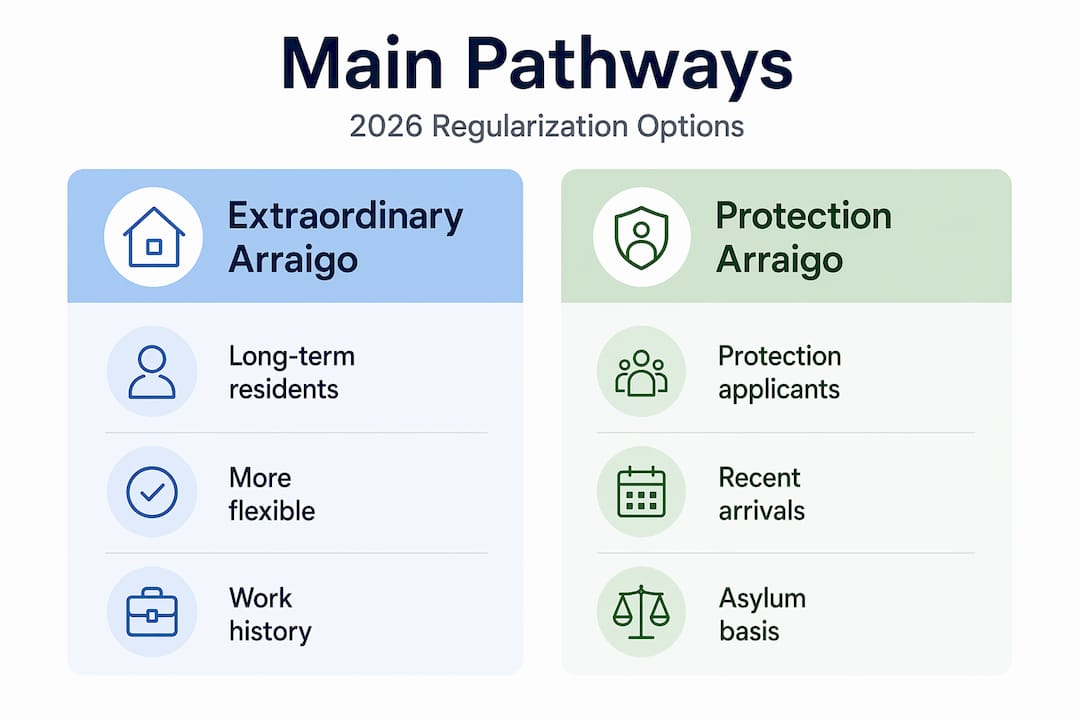
The extraordinary arraigo pathway suits the majority of applicants who have been living and working informally in Spain. The protection route is specifically for people who applied for asylum and have been stuck in procedural limbo, sometimes for years. Choosing the wrong one does not just slow you down. It can get your application dismissed on technical grounds before it is ever reviewed on its merits.
My honest take on what people get wrong
I’ve watched hundreds of people approach extranjería procedures with the belief that 2026’s extraordinary regularization is a kind of amnesty. It is not. The 2026 regularization is a formal administrative procedure, not an automatic right. Every condition must be met, every document must be valid, and every piece of evidence must tell a coherent story.
The mistake I see most often is treating document collection as the last step instead of the first. People spend weeks figuring out which pathway they qualify for, then realize the criminal record they need takes two months to arrive from their home country. Suddenly the June 30 deadline is three weeks away and the file is incomplete.
What actually works is starting with the documents that have the longest turnaround time and building your application backward from there. I’ve also seen applicants submit technically complete files that get rejected because the empadronamiento history had a three-month gap they didn’t address with supporting evidence. The authorities are not trying to catch you out. But they will not fill in the blanks for you.
Legal guidance at the preparation stage, not the appeal stage, is where the real difference is made. If you’re going to invest in professional support, invest it before you submit, not after you receive a denial.
— Martín
How Vive can help you get this right
If the extranjería process steps outlined in this guide feel manageable, great. If they feel like a lot to handle alone, that’s exactly why Vive exists.
Vive is an online legal consultancy built specifically for immigration procedures in Spain. For the 2026 extraordinary regularization and beyond, Vive provides personalized eligibility diagnostics, complete document review, form preparation, and appointment scheduling, all managed through a secure client portal. You track every step in real time. Human immigration specialists review your file before submission to catch errors that would otherwise lead to denial. Whether you need help with the full application or just a document review, you can find the details in Vive’s service agreement. Study centers managing multiple student applications can explore specialized immigration management designed for their needs.
FAQ
What does “extraordinary arraigo” mean in 2026?
Extraordinary arraigo is a temporary legal pathway introduced by Real Decreto 316/2026 that allows qualifying foreign nationals to obtain a one-year residence and work permit in Spain by demonstrating a labor, family, or vulnerability link to the country.
How long does the extranjería resolution process take?
The standard resolution period is 3 months. If no response is received within that period, Spanish administrative law considers it a negative administrative silence, though provisional work authorization applies during the waiting period.
What documents do I need for the 2026 regularization?
You typically need a historical empadronamiento certificate, a criminal record from your country of origin with apostille and sworn Spanish translation, proof of the required link (employment, family, or vulnerability), and identification documents.
Can I work while my extranjería application is being processed?
Yes. Once your application is formally admitted, you receive provisional work authorization immediately and can legally work while waiting for the final resolution.
What happens if my extranjería application is denied?
You have the right to file a recurso de alzada (administrative appeal) within one month of the denial. Seeking legal support at this stage is strongly advisable to assess your grounds and prepare a sound appeal.
Recommended
Living legally in Spain shouldn't be difficult.
View services and pricesNot sure which procedure you need? Find out in 2 min
Questions? Message us on WhatsApp