
Explain Minor Residency Spain: A 2026 Family Guide
TL;DR:
- Securing minor residency in Spain requires a guardian-led application process tailored to the child’s birthplace and the 2026 regularization rules. Proper preparation of documentation, understanding legal distinctions, and sequencing applications correctly are essential for success. The 2026 reforms offer waivers and joint processing options that simplify eligibility but demand careful compliance and professional guidance.
When families relocate to Spain, one of the most misunderstood steps is securing legal residency for their children. To explain minor residency Spain procedures clearly: a minor’s residency permit is a separate legal authorization, tied closely to the parent or guardian’s status, and the process differs significantly depending on where the child was born and whether the 2026 regularization framework applies. Getting this wrong costs weeks of delays. Getting it right means your family is protected, enrolled in school, and fully covered by Spain’s healthcare system.
Living legally in Spain shouldn't be difficult.
View services and pricesNot sure which procedure you need? Find out in 2 min
Questions? Message us on WhatsApp
Table of Contents
- Key Takeaways
- Legal framework for minor residency permits in Spain
- How to apply for minor residency in Spain
- Key requirements and 2026 exceptions to know
- Understanding NIE, TIE, and tax residency for minors
- Practical tips and common pitfalls
- My take on why minor residency trips up so many families
- How Vive can make this process simpler for your family
- FAQ
Key Takeaways
| Point | Details |
|---|---|
| Minor residency is guardian-led | A parent or legal guardian must file on the minor’s behalf; children cannot apply independently. |
| Born in vs. outside Spain matters | Article 159 and Article 160 create different pathways and requirements depending on the child’s birthplace. |
| 2026 reform eases key requirements | Minors not born in Spain may qualify with just 5 months of continuous stay, waiving prior two-year residence proof. |
| Legal residency differs from tax residency | Holding a residence permit does not automatically make your child a tax resident in Spain. |
| Document prep is the biggest bottleneck | Apostilles, sworn translations, and custody documentation often cause the longest delays in minor residency applications. |
Legal framework for minor residency permits in Spain
Spain’s immigration law treats minors as a protected category, and the rules are more nuanced than most families expect. Two articles govern the core of minor residency permits Spain families will encounter: Art. 159 applies to minors born in Spain, while Art. 160 governs children born outside Spain who reside here. These are not interchangeable. Each triggers a different set of requirements, and the 2026 reform has introduced specific waivers and exceptions for each category.
The overarching principle across both articles is family unity. Spanish immigration authorities operate under the premise that separating children from legally residing parents works against the best interests of the child. The 2026 transitional framework reinforces this explicitly, creating a joint processing route for families who were previously stuck in procedural limbo.
A few categories that the current framework specifically addresses:
- Minors born in Spain to foreign parents with irregular status may now qualify for residency without the parents needing two full years of prior continuous legal residence.
- Minors born outside Spain who have lived in Spain continuously for at least 5 months can be processed under Art. 160 with significantly relaxed economic requirements.
- Minors with disabilities and other dependent adults can be regularized alongside their parents, reducing the risk of family separation under the 2026 reform.
- The Disposición Transitoria Primera allows joint applications, meaning parents and children file together rather than as separate cases, which simplifies processing and reduces duplication of documentation.
Pro Tip: If your child was born in Spain but you are currently undocumented, don’t assume you have no path forward. The 2026 reform was specifically designed for cases like yours. Read up on the full child residency guide before you dismiss eligibility.
How to apply for minor residency in Spain
The application process for Spain residency for minors is procedurally specific, and small errors at the filing stage cause outright rejections. Here is how the process works step by step:
-
Identify the correct legal basis. Before filling out any form, determine whether your child falls under Art. 159 (born in Spain) or Art. 160 (born outside Spain). This determines which EX form you complete and what documents you need.
-
Gather required documents. The core package typically includes: the child’s birth certificate, proof of the parent’s guardianship or parental authority, the parent’s own valid residency or identity documentation, proof of financial means (unless waived under the 2026 scheme), and evidence of adequate housing. If applying under the regularization framework, you will also need proof of the child’s continuous stay in Spain.
-
Handle legalization and translation early. Foreign documents such as birth certificates issued outside Spain must carry an apostille stamp and a sworn Spanish translation. This step alone can take two to six weeks depending on your country of origin.
-
Complete the electronic form correctly. Applications go through the Sede Electrónica de Extranjería. The single most common error families make here is filing directly as the minor rather than having the adult representative submit the application. The form has distinct data blocks: one for the minor as the interested party, and one for the adult filing as representative. Swapping these fields causes automatic system rejection.
-
Attach the digital certificate. The parent or guardian must use their own digital certificate to sign and submit the application. Minors do not sign the application themselves.
-
Handle consular applications if applicable. If the minor is currently outside Spain and requires a visa before entry, the parent signs and presents the application at the relevant Spanish consulate. All foreign documents must be apostilled and translated before submission.
-
Track the case and respond to requirements. After submission, the immigration office may issue a requerimiento requesting additional documents. Respond within the given deadline or the application is closed.
Pro Tip: The Sede Electrónica system does not save partial applications. Prepare every document before you start filling in the form. A checklist reviewed by a legal professional before submission can prevent the most common rejection triggers.
Key requirements and 2026 exceptions to know
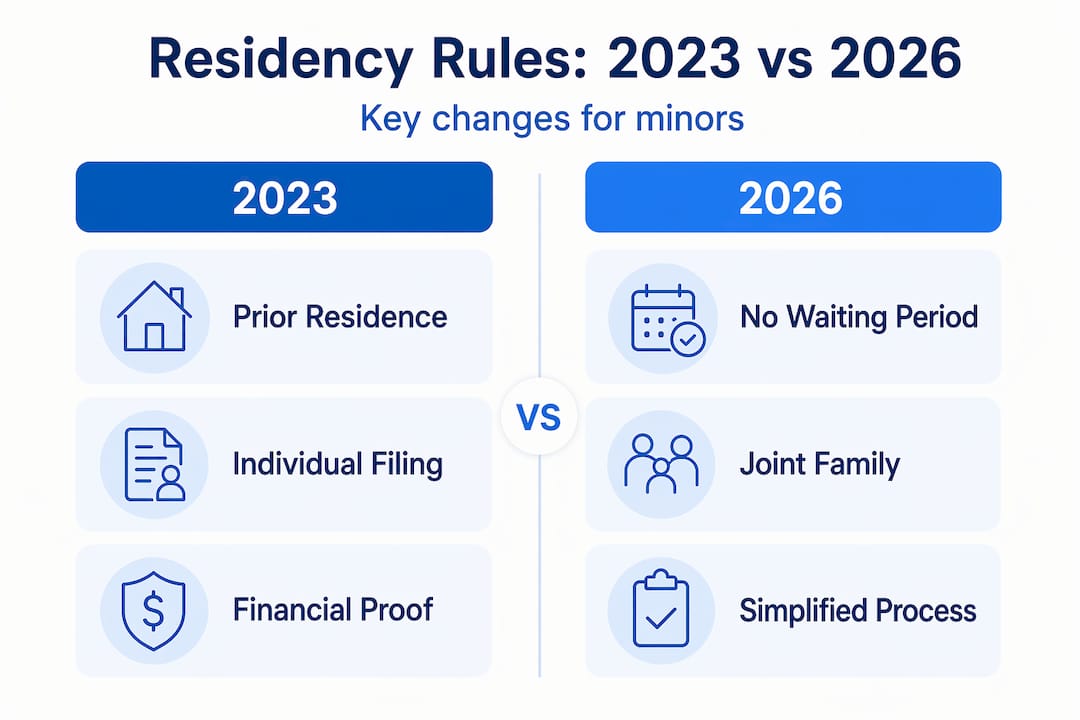
The 2026 regularization scheme changed the rules in ways many families do not yet know about. Here is a side-by-side comparison of what the standard requirements look like versus the waivers available under the new framework:
| Requirement | Standard process | 2026 regularization (Art. 160) |
|---|---|---|
| Prior residence in Spain | Two years continuous legal residence of parent | Waived under joint processing |
| Financial means proof | Required | Waived if processed jointly with parent |
| Adequate housing proof | Required | Waived if processed jointly with parent |
| Child’s minimum stay | Varies | 5 months continuous stay in Spain |
| Criminal record check | Required | Still required, not waived |
Several points deserve extra attention from families reviewing their eligibility:
- The 5-month continuous stay requirement for minors not born in Spain is a hard threshold. Gaps in residence, even short ones, can break continuity. Keep school enrollment records, medical visit records, and utility bills to document physical presence.
- The criminal record check for parents is not waived. Even under the relaxed 2026 provisions, parents must present a clean criminal record from both Spain and their country of origin.
- The 2026 provisions specifically protect family unity, and vulnerable minors including those with disabilities receive coverage under the reform without needing to meet independent economic thresholds.
- Applications under the Disposición Transitoria Primera have retroactive applicability, meaning families whose situations pre-date 2026 may still benefit if they have not yet applied.
Understanding NIE, TIE, and tax residency for minors
This is where many families get tangled up. The difference between NIE and TIE is not just terminology. They serve entirely different legal functions, and confusing them creates real administrative problems.
The NIE (Número de Identificación de Extranjero) is simply an identification number assigned to any foreigner who needs to carry out legal or economic transactions in Spain. Getting a NIE for your child does not mean your child has legal residency. It means they have an ID number. A minor can have a NIE and still be undocumented from a residency standpoint.
The TIE (Tarjeta de Identidad de Extranjero) is the physical residence card. It is issued after a residency permit is granted and serves as proof of legal residency status. Your child needs both: the underlying permit authorization and the TIE card. Check out this guide on legal status in Spain if you need to untangle these categories for the whole family.
Tax residency is a third, separate category. Holding a residence permit does not automatically make your child a tax resident in Spain. Tax residency is triggered by spending more than 183 days per calendar year in Spain or having the primary center of economic interests there. For most minor children, the tax residency analysis follows the parents, but families in cross-border situations should get specific tax advice.
The empadronamiento (municipal registration) is often confused with residency too. Registering your child at your local town hall is required for school enrollment and healthcare access, but it is not a substitute for a formal residency permit. You can be empadronado and still be undocumented for immigration purposes.
Practical tips and common pitfalls
The minor residency application process Spain families encounter has a few failure points that appear repeatedly. Knowing them in advance saves weeks.
- Start with the documents, not the form. Most delays come from missing apostilles and sworn translations, not the form itself. Document legalization timelines vary widely by country of origin. Build in at least four to six weeks for this step alone.
- Sort out parental consent early. In situations with dual custody, both parents must consent to the residency application, or you must present a court ruling granting sole custody to the filing parent. Missing this document is one of the most common causes of application rejection.
- Do not attempt to file in the minor’s name online. The system rejects direct minor applications automatically. The digital form must reflect the parent or guardian as the filing representative, not the child.
- Know the signature rules by age. Minors under 14 do not sign applications. Minors aged 14 to 17 may need to sign in person alongside their parents, depending on the procedure type.
- Book consular appointments early. At Spanish consulates in major cities, appointment wait times can stretch for months. Do not start collecting documents without booking the appointment first.
Pro Tip: Have a legal professional review your full document package before submission, not after rejection. Post-rejection correction is slower and more expensive than getting it right the first time. A document review before filing is one of the highest-return investments you can make in this process.
My take on why minor residency trips up so many families
I’ve seen families go through this process multiple times before getting approval, not because their situation was complicated, but because nobody clearly explained the procedural logic upfront. The most common pattern I’ve observed: a parent files the application in the child’s name online, receives a rejection, assumes the child is ineligible, and then waits months before trying again. The child was eligible all along. The form was just filled out incorrectly.
What I’ve also learned is that the emotional stakes make families more vulnerable to procedural mistakes, not less. When you are worried about your child’s legal status, you rush. You assume the form is self-explanatory. You forget that immigration forms are not designed with empathy. They are administrative instruments with precise logic that punishes any deviation.
The 2026 reforms genuinely improve access to minor residency for families who previously had no realistic path. But the reforms also introduce new complexity. The joint processing route under Disposición Transitoria Primera, for example, offers real benefits. But it also requires correctly sequencing the parent’s and child’s applications so they are evaluated together. Getting that sequencing wrong means losing the benefit of the waived requirements.
My honest advice: approach this as a family unit process from day one, not as separate individual applications. The law now supports that approach. Work with it, not against it.
— Martín
How Vive can make this process simpler for your family
If reading through all of this still leaves you uncertain about your family’s specific situation, that is exactly what Vive is built for. The platform handles minor residency permit applications from document review through electronic submission, and the team knows the 2026 regularization rules in depth.
Vive offers personalized case diagnostics so you know which article and pathway applies to your child before you spend a single hour collecting documents. For families navigating the 2026 extraordinary regularization process, the platform provides end-to-end management including form preparation, appointment coordination, and case tracking through a secure client portal. If your family also needs a TIE application processed, Vive has cases ready to submit within 24 hours.
FAQ
What does minor residency in Spain mean?
Minor residency in Spain is a legal authorization that allows a foreign child to reside in Spain. It is processed by a parent or guardian on the child’s behalf and is distinct from the child’s tax residency status or municipal registration.
Can a minor apply for Spanish residency independently?
No. The electronic application system requires a parent or legal guardian to file on behalf of the child. Attempting to file directly in the minor’s name causes automatic rejection.
What changed for minor residency under the 2026 reforms?
The 2026 framework introduced joint processing for families, waiving the two-year prior residence requirement, financial means proof, and housing proof for minors not born in Spain who have lived in Spain continuously for at least 5 months.
Is a NIE the same as a residency permit for a minor?
No. A NIE is an identification number, not a residency authorization. A minor can hold a NIE without having legal residency. The TIE card is what confirms legal residency status.
Does minor residency make a child a tax resident in Spain?
Not automatically. Tax residency is determined by time spent in Spain (more than 183 days per year) or center of economic interests, not by holding a residency permit.
Recommended
Living legally in Spain shouldn't be difficult.
View services and pricesNot sure which procedure you need? Find out in 2 min
Questions? Message us on WhatsApp