
How to check document validity in Spain

TL;DR:
- Living in Spain as an expat or student requires careful document verification through a complex, multi-system process involving both Spanish and foreign authorities. Verifying Spanish-issued documents typically involves checking a CSV code on official portals, while foreign documents must be apostilled and translated if necessary before acceptance by Spanish authorities. Following proper timing, avoiding errors, and using official channels are crucial to prevent delays and ensure smooth immigration procedures.
Living in Spain as an expat, student, or EU resident means paperwork is never far away, and the moment you need to know how to check document validity in Spain is usually the worst possible moment: right before an immigration appointment. Spanish bureaucracy operates across multiple systems and authorities, with no single portal handling everything. Some documents carry digital verification codes, others need foreign authentication through an international treaty, and a few require both. This guide walks you through each scenario, step by step, so you can confirm your documents are legitimate before a deadline, not after a rejection.
Living legally in Spain shouldn't be difficult.
View services and pricesNot sure which procedure you need? Find out in 2 min
Questions? Message us on WhatsApp
Table of Contents
- Understanding document types and their verification methods
- Step-by-step guide to verifying Spanish-issued documents
- How to authenticate foreign documents for use in Spain
- Common mistakes and troubleshooting tips in document validity checks
- What to expect after document verification: next steps for residency and immigration
- Why conventional document checks can cause unnecessary delays — and how to avoid them
- Get expert help for your document validation and immigration process
- Frequently asked questions
Key Takeaways
| Point | Details |
|---|---|
| Document type matters | Verification methods vary depending on whether documents are issued in Spain or abroad. |
| Use official tools | Spanish authorities provide secure code systems to verify authenticity of official documents. |
| Apostille is essential | Foreign public documents must be apostilled to be valid for use in Spain. |
| Avoid common errors | Carefully enter verification codes and check timing to prevent false invalidity. |
| Professional help benefits | Expert legal assistance can simplify validation and reduce immigration risks. |
Understanding document types and their verification methods
Before you can verify anything, you need to know what kind of document you are dealing with. Spanish immigration and residency documents fall into two broad categories, and each follows a completely different verification path.
Spanish-issued documents include certificates from the Agencia Tributaria (AEAT), the Registro Civil, professional licensing bodies, and regional administrations. Many of these are issued electronically and carry a Código Seguro de Verificación (CSV), a unique alphanumeric code that allows anyone to confirm the document’s origin and authenticity using official government portals. This is one of the most reliable tools available for official document verification Spain.
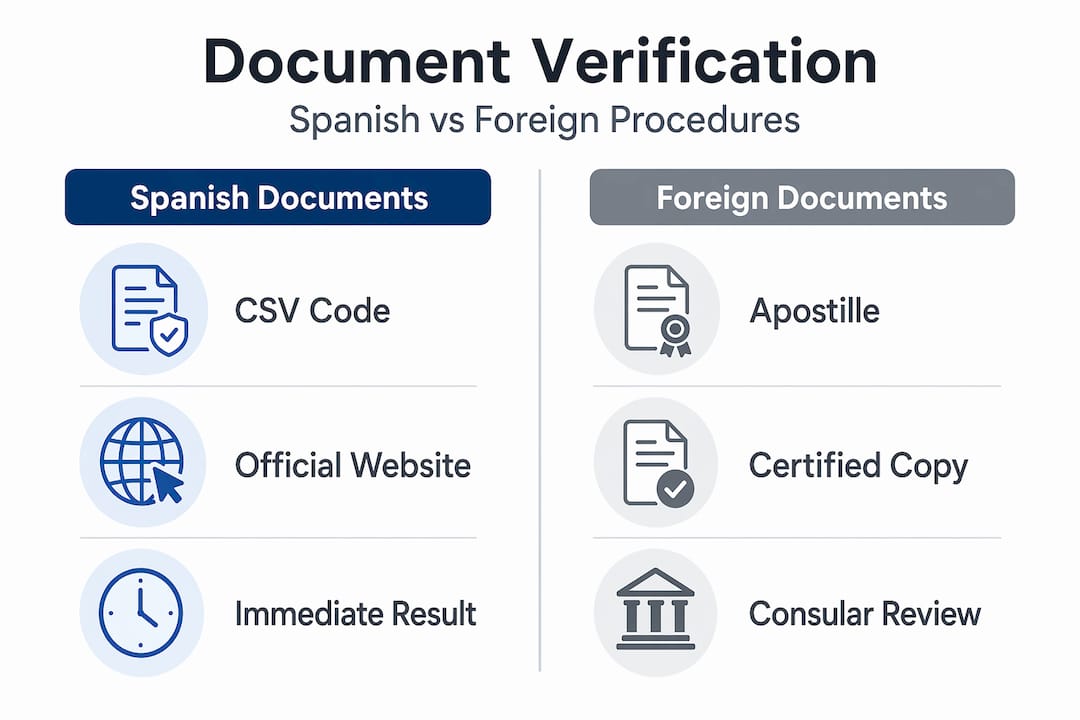
Foreign public documents, on the other hand, cannot simply be submitted as-is. They need to go through a formal authentication process before Spanish authorities will recognize them. Verification depends on the issuing authority and document type, with Spain accepting foreign public documents authenticated through the Hague Apostille Convention system.
Here is a quick breakdown of document categories and their verification methods:
| Document type | Issuing authority | Verification method |
|---|---|---|
| Tax certificates (AEAT) | Spanish Tax Agency | CSV code via AEAT portal |
| TIE / NIE documents | Spanish National Police | In-person or via Extranjería |
| UE registration certificates | Local authorities | Institution-specific portals |
| Birth, marriage certificates (foreign) | Foreign government | Apostille from issuing country |
| Academic diplomas (foreign) | Foreign university | Apostille plus official translation |
| Professional licenses (Spanish) | Licensing body | Body-specific portal or CSV |
Key points to keep in mind:
- Not every Spanish document carries a CSV. Older paper documents may not have one.
- There is no universal Spain document checking service that covers all document types.
- EU-issued documents may have simplified procedures under specific bilateral agreements.
- A missing apostille on a foreign document is one of the most common document issues Spain residents face during residency applications.
Step-by-step guide to verifying Spanish-issued documents
With an understanding of document types, you can now follow a tested process to verify Spanish-issued documents step by step.
Every Spanish Tax Agency certificate includes a CSV that allows recipients to verify authenticity through AEAT’s official service. The process is straightforward, but the details matter.
- Locate the CSV on your document. It typically appears in the top right or bottom section, labeled “Código Seguro de Verificación” or simply “CSV.” The code is usually 16 characters long.
- Go to the official AEAT verification portal. Never use a third-party website for this. The official URL is the one provided on the document itself.
- Enter the exact code. Copy it character by character. Do not type it from memory.
- Submit and review the result. A valid document will return a viewable copy matching your original. If the system returns an error, do not immediately assume fraud.
- Check your issuance timing. Verification cannot be completed before certificate issuance; timing issues often cause failed checks, not actual problems with the document.
- Try again after 24 to 48 hours if the certificate was very recently issued. The system may not have registered it yet.
The AEAT verification process also applies to many regional-level Spanish documents. Some professional bodies, like maritime licensing authorities, use their own portals that require additional fields such as license numbers or issue dates alongside the CSV.
Common character confusion errors:
- The letter O and the number 0 are frequently misread
- The letter S and the number 5 look similar in some document fonts
- The letter I, the letter l (lowercase L), and the number 1 are often confused
Pro Tip: Before manually typing any verification code, photograph the document and zoom in on the CSV field. This dramatically reduces transcription errors, especially on printed documents with small fonts.
The table below summarizes what a valid versus an invalid result typically looks like during the document review steps for Spanish residency:
| Result type | Meaning | Recommended action |
|---|---|---|
| Document displayed | Valid and authentic | Proceed with submission |
| “Code not found” error | Too early, typo, or expired | Check timing and re-enter carefully |
| “Invalid format” error | Code entered incorrectly | Review character confusion points |
| Blank page returned | Portal issue | Retry later or contact AEAT |
How to authenticate foreign documents for use in Spain
Having covered Spanish documents, this section guides you through authenticating foreign documents for valid use in Spain.
Spain is a member of the Hague Apostille Convention, which means foreign documents apostilled by competent authorities are accepted without additional embassy certifications. This simplifies the process considerably compared to countries outside the convention, but there are still several steps you need to follow carefully.
Steps to authenticate a foreign document for Spain:
- Confirm apostille eligibility. Not all documents qualify. Public documents (birth certificates, criminal records, academic diplomas, notarized documents) are eligible. Private contracts generally are not.
- Identify the correct competent authority. In the United States, this varies by document type. Federal documents go through the U.S. Department of State; state-issued documents go through the Secretary of State in that particular state.
- Submit your document for apostille. Processing times vary from a few days to several weeks depending on the country and method (in-person or by mail).
- Arrange an official translation if required. Spain requires that foreign-language documents be translated by a traductor jurado (sworn translator). This is separate from the apostille process.
- Check freshness requirements. Some Spanish immigration offices only accept documents issued within the past three or six months. An apostille on a two-year-old document may not be enough if the underlying record is considered stale.
Pro Tip: If you are gathering supporting documents from abroad, request certified copies at the same time as the apostille to avoid making a second international trip or mailing cycle later.
One often overlooked point: the apostille authenticates the signature and seal on the document, not the content itself. If Spanish authorities question the content of a foreign document, the apostille alone will not resolve it. You may need sworn translation plus additional legal verification depending on the nature of the dispute.

Common mistakes and troubleshooting tips in document validity checks
Equipped with authentication knowledge, it is crucial to recognize pitfalls and best practices to effectively troubleshoot validity checks.
The most frequent failure point in any validity check for Spanish documents is not fraud or genuine invalidity. It is human error combined with poor timing. Slight typos in secure verification codes commonly cause invalidity errors despite the underlying document being perfectly valid.
Top mistakes to avoid:
- Manually retyping a CSV instead of copying it directly from a digital file
- Running a verification check the same day a certificate is issued (allow 24 to 48 hours)
- Using unofficial or aggregator websites that claim to check Spanish documents
- Submitting a document without first confirming that the specific Spanish institution accepts apostilles rather than requiring further legalization
- Assuming one failed verification means the document is permanently invalid
“A failed check is a starting point for investigation, not a verdict. Most problems in document verification come from process errors, not document fraud.”
Pro Tip: Screenshot every successful verification result and save it as a PDF with a timestamp. Immigration offices occasionally ask for evidence that you personally verified the document, and this gives you documented proof.
If a verification check keeps failing despite careful entry and correct timing, contact the issuing authority directly. The importance of document review becomes most obvious at this stage, where a professional can quickly identify whether the issue is technical, procedural, or something that needs formal resolution.
What to expect after document verification: next steps for residency and immigration
After ensuring document validity, it is important to understand the best practices for using these validated documents effectively in your immigration process.
Verified documents form the foundation for smooth residency or immigration applications and reduce rejection risks considerably. But verification alone does not mean you are ready to submit. There are several post-verification steps that matter just as much.
Organizing and preparing verified documents:
- Make certified copies. Some immigration offices require certified copies, not originals. Confirm this before your appointment.
- Check translation requirements. Even an apostilled, verified document needs a sworn translation if it is not in Spanish.
- Confirm any additional certifications. Certain permit types require documents to meet institution-specific standards beyond apostille.
- Take screenshots of digital verification confirmations. Store these alongside the physical or digital documents.
- Submit according to the specific instructions for your permit type. Requirements for an Arraigo application differ from those for a student visa renewal.
After submission:
- Follow up proactively if you have not received acknowledgment within the stated processing window.
- Keep copies of all submitted documents in a secure digital folder.
- Note the exact date of submission and the folio or reference number assigned.
- If discrepancies arise, contact the immigration office with your verification records as supporting evidence.
The tips for avoiding residency rejection consistently point to one common thread: applicants who verify their documents thoroughly and submit organized, complete files face far fewer delays than those who rely on hope and guesswork.
Why conventional document checks can cause unnecessary delays — and how to avoid them
Most people approach document verification the way they approach a password reset: as something that should work instantly and automatically. When it does not, the instinct is to panic. That instinct causes more problems than the original verification failure.
Here is the reality: the systems Spain uses for CSV verification and apostille authentication are generally reliable. What is not reliable is the assumption that everything will be in order on the first try, on the day you need it most. Timing issues often cause false negatives in verification before certificate issuance, a pitfall many applicants miss entirely because nobody told them to wait.
The deeper problem is that people treat document validity checks as a one-day task rather than a rolling process. They request a certificate, receive it, attempt to verify it immediately, get an error, and assume the worst. In reality, the document may be perfectly valid and the system simply has not caught up yet.
There is also a data security dimension that gets almost no attention in guides like this one. When you use unofficial verification portals, browser-based aggregators, or unverified third-party services to validate your immigration documents, you are potentially sharing sensitive personal data with unknown parties. Always use official government portals, and consider protecting your immigration data as seriously as you would your banking credentials.
The smarter approach is to build a verification buffer into your timeline. Run your first check 48 hours after issuance. If it fails, check character by character before assuming a problem. If it still fails, contact the issuing authority with your request number. That three-step process resolves the vast majority of cases without stress.
Get expert help for your document validation and immigration process
Navigating Spain’s document validation landscape is manageable once you understand the rules. But when your residency permit, livelihood, or study authorization is on the line, having a professional review your documents before you submit can make the difference between approval and a frustrating back-and-forth.
Vive Legal handles the full picture. Whether you are applying through an internship residence permit, pursuing a job search visa, or managing student enrollments through an immigration management program for your institution, the platform combines AI-powered document review with expert human oversight. Every step of your case is tracked, every document is verified before submission, and you have full visibility through a secure client portal. Less guessing, fewer rejections, more time to focus on actually building your life in Spain.
Frequently asked questions
Can I verify the validity of any Spanish immigration document online?
Not all Spanish immigration documents have an online verification method. Verification depends on the issuing authority and document type; Spanish electronic documents often carry a CSV for online checks, while foreign documents require apostille authentication from their country of origin.
What should I do if a document fails the online verification check?
Start by checking for typos in the verification code since slight character errors are the most common cause of failed lookups. Confirm the document is fully issued and wait 24 to 48 hours before retrying; if the problem persists, contact the issuing authority directly.
Are apostilled foreign documents always accepted by Spanish authorities?
Spain accepts apostilled foreign documents under the Hague Convention without additional embassy legalization, but you should always confirm whether the specific office also requires a sworn Spanish translation and that the document meets any applicable freshness requirements.
Is it safe to share my secure verification code online for checking?
Treat verification codes as sensitive data and only enter them on official government portals. Using third-party or unverified websites to validate your documents can expose personal information to unknown parties.
Recommended
Living legally in Spain shouldn't be difficult.
View services and pricesNot sure which procedure you need? Find out in 2 min
Questions? Message us on WhatsApp