
Proof of Housing Documents Guide for Spain in 2026

TL;DR:
- Proof of housing documents are essential in Spain for residency and legal status applications, with the Padrón certificate being the foundational proof. Applicants must assemble multiple documents, including rental contracts, property deeds, and housing reports, often requiring careful timing and translation. Common pitfalls involve expired contracts, missing reports, or inconsistent documentation, especially for family reunification applications.
Proof of housing documents are mandatory for nearly every residency and legal status procedure in Spain, confirming that you have a legal, adequate living arrangement before authorities approve your application. Whether you are applying for a TIE card, a family reunification visa, or a non-lucrative residency permit, Spanish immigration authorities require formal evidence of where you live. The core documents in this proof of housing documents guide for Spain include the Empadronamiento (Padrón) certificate, rental contracts, property deeds, and the informe de adecuación de la vivienda (housing adequacy report). Getting these right from the start is the single most reliable way to avoid delays, rejections, and costly resubmissions.
Living legally in Spain shouldn't be difficult.
View services and pricesNot sure which procedure you need? Find out in 2 min
Questions? Message us on WhatsApp
What documents qualify as valid proof of housing in Spain
Spanish authorities recognize several document types as valid proof of address, but not all carry equal weight. The strongest applications combine multiple document types that overlap in time and content.
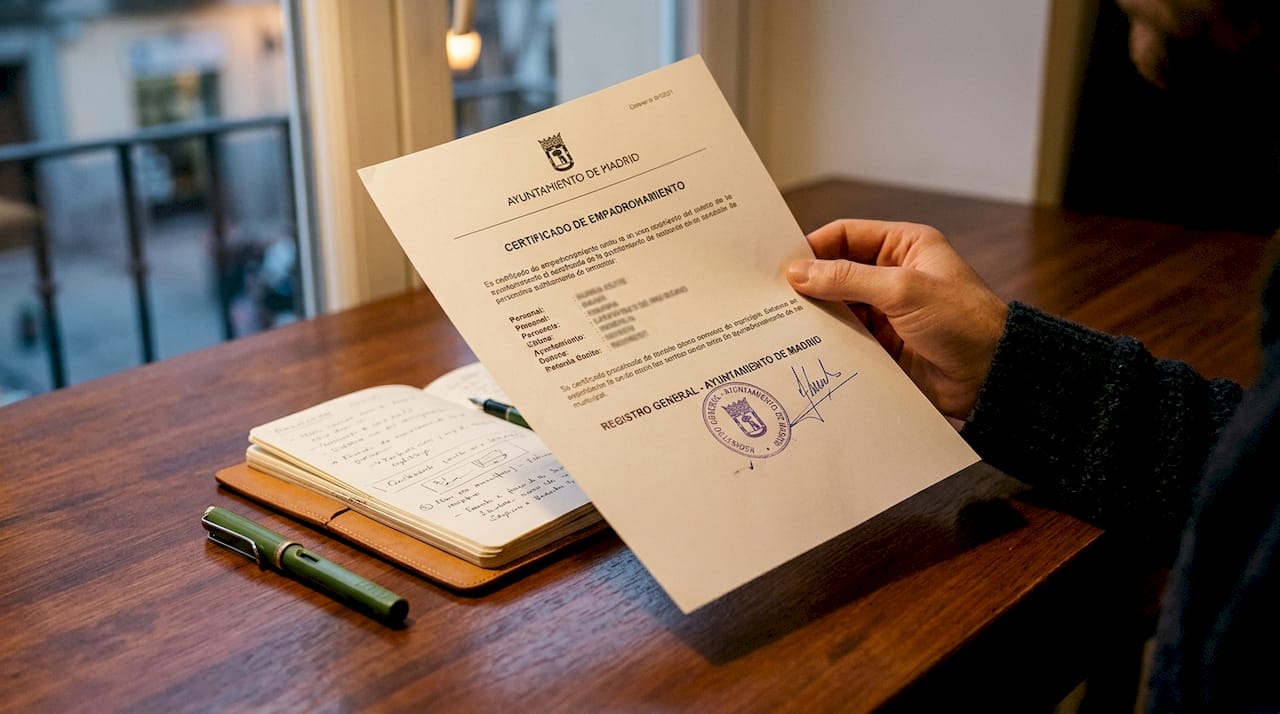
The Padrón certificate
The Empadronamiento certificate is the foundational proof of address for almost all residency-related procedures in Spain. Issued by your local Ayuntamiento (town hall), it confirms your registered address and must be current within 3 months of your application date. Registration requires a valid passport, your rental contract or property deed, and an in-person appointment at the Padrón office. Without it, most TIE and residency applications will not proceed.
Rental contracts and property deeds
A rental contract must meet specific legal standards to count as valid housing proof. The contract must be signed by both landlord and tenant, cover a minimum term of one year, and include the full property address. Property deeds (escritura de compraventa) serve the same function for homeowners and must be notarized. Both documents establish the legal basis of your occupation, which is a requirement the informe de adecuación de la vivienda also verifies.
The housing adequacy report
The informe de adecuación de la vivienda is a specialized document required primarily for family reunification applications. It is not the same as a general habitability certificate. This report confirms the number of rooms, occupant capacity, sanitation, and ventilation standards per Law 12/2023, and it must be requested from social services, not private surveyors. The administration is legally required to issue it within one month of your request.
Supporting documents
Utility bills for electricity, water, and gas strengthen your application as secondary proof. Fixed-line utility bills are preferred by Spanish banks and authorities because they tie you to a permanent address. Mobile phone bills are generally rejected. Bank statements showing your registered address can also supplement your file, but they work best alongside, not instead of, the primary documents listed above.
| Document | Purpose | Issued by | Validity |
|---|---|---|---|
| Padrón certificate | Foundational proof of address | Ayuntamiento | 3 months |
| Rental contract | Legal occupation basis | Landlord / notary | Duration of contract |
| Property deed | Ownership proof | Notary | Permanent |
| Housing adequacy report | Family reunification requirement | Social services | 1 month from issuance |
| Utility bills | Supporting address evidence | Utility providers | Recent statements |
How to compile and submit your housing documents step by step
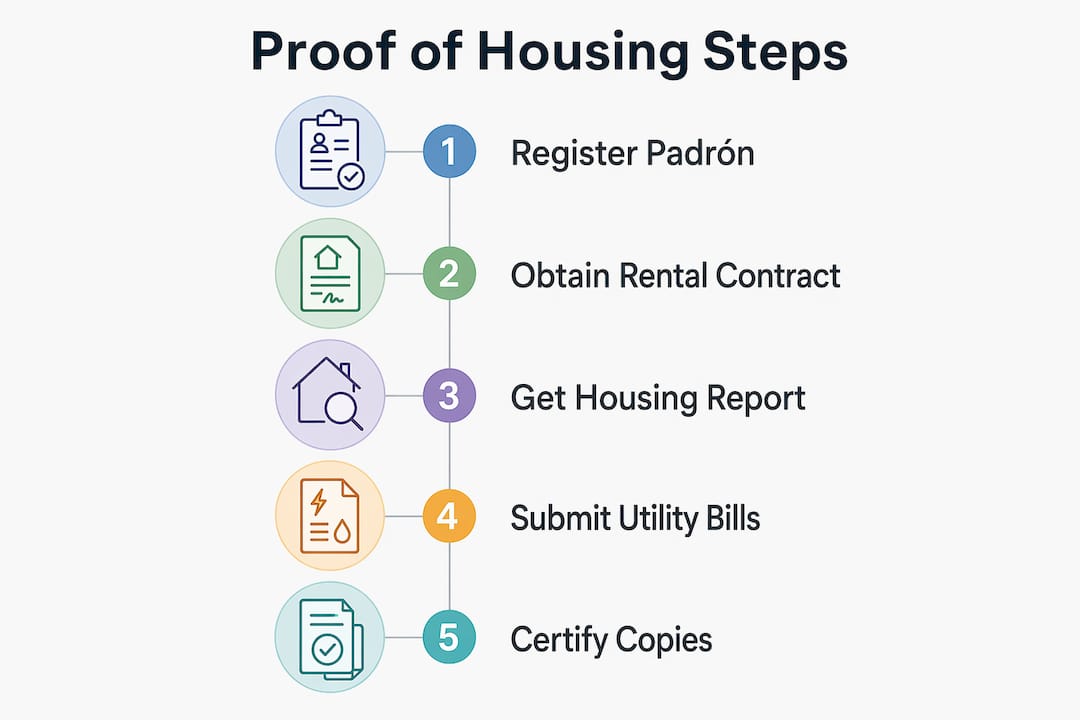
Getting your documents in order requires planning. Start at least three months before your intended application date to absorb any delays at the Ayuntamiento or social services.
-
Obtain your NIE first. The NIE number is not a residency permit, but it is required before you can sign property deeds, open a bank account, or set up utilities. Apply for it at the Dirección General de la Policía or through a Spanish consulate before you arrive.
-
Register for the Padrón. Book your appointment at the local Ayuntamiento as soon as you have a signed rental contract or deed. Bring your passport, the contract, and any supporting address documents. The certificate is usually issued the same day or within a few days.
-
Request the housing adequacy report. If you are applying for family reunification, contact your local social services office to request the informe de adecuación de la vivienda. The one-month issuance deadline is legally binding, but offices can be slow to schedule inspections. Submit your request the moment you have a confirmed address.
-
Gather financial proof. Rental housing requires monthly income at least three times the rent amount. Collect your last three months of payslips and your work contract to satisfy both landlord requirements and immigration authorities simultaneously.
-
Translate and legalize foreign documents. Foreign-language documents must be accompanied by sworn translations and, in many cases, an apostille or consular legalization before Spanish authorities will accept them. Use a certified translator recognized by the Spanish Ministry of Foreign Affairs.
-
Prepare your digital files. Digital uploads must use .pdf or .jpg formats, stay under 5MB per file, and follow the naming conventions specified by the platform you are submitting through. Mercurio, the Spanish government’s electronic submission platform, is the standard channel for many residency applications. Incorrect file formats are one of the most common and easily avoidable causes of administrative delay.
-
Submit a layered file. Submitting 3 to 4 overlapping document types over a five-month window, including your Padrón, rental contract, utility bills, and employment evidence, gives authorities a clear, consistent picture of your residence. This approach produces the strongest applications.
Pro Tip: Request two certified copies of your Padrón certificate at the same time. One goes into your application file, and the other stays as a backup in case the first expires before your appointment date.
Common mistakes that derail housing document applications
Most rejections are preventable. The errors below appear repeatedly in failed applications, and knowing them in advance saves weeks of reprocessing time.
-
Expired or unsigned rental contracts. An informal agreement or a contract missing the landlord’s signature does not meet Spanish legal standards. Authorities will reject it outright, regardless of how long you have actually lived at the address.
-
Confusing NIE with residency status. The NIE is a tax identification number, not proof of legal residency. NIE applications require exact name matching across all documents. Even a small discrepancy between your passport name and your NIE can trigger a rejection that takes weeks to resolve.
-
Missing the housing adequacy report deadline. The one-month issuance window for the informe de adecuación de la vivienda is fixed by law, but applicants often request it too late. If your family reunification application is time-sensitive, submit the report request on the same day you sign your rental contract.
-
Relying on a single document. One document alone, even a valid Padrón certificate, rarely satisfies the full burden of proof. Authorities look for consistency across multiple sources. A single document with no corroborating evidence raises questions about the stability of your housing situation.
-
Landlord reluctance. Tenant documentation demands are rising sharply in Spain’s competitive housing market, and some landlords are reluctant to provide formal contracts or cooperate with housing inspections. Address this before signing by confirming in writing that the landlord will support your Padrón registration and any required inspections.
-
Wrong file formats for digital submission. Uploading a .docx file or an oversized .pdf is a technical rejection that has nothing to do with the quality of your documents. Always convert files before uploading and check size limits on the specific platform you are using.
The most overlooked step in any Spain residency documentation guide is the housing adequacy report. Applicants focus on the Padrón and rental contract, then discover three weeks before their appointment that the report has not been issued yet. Request it first, not last.
How housing proof requirements differ by residency type
Housing document requirements in Spain are not uniform. They scale in complexity depending on the permit or visa you are applying for.
| Residency type | Key housing documents required | Special requirements |
|---|---|---|
| Family reunification visa | Informe de adecuación de la vivienda, rental contract, Padrón | Report must confirm room count and occupant capacity per Law 12/2023 |
| Non-lucrative visa | Rental contract or property deed, Padrón certificate | No housing adequacy report required; financial proof is primary focus |
| Long-term residency (5-year) | Padrón history, utility bills, rental contracts over multiple years | Continuous address proof across the full five-year period |
| EU citizen registration (TIE) | Padrón certificate, rental contract or deed | Simpler process; Padrón is often sufficient as primary proof |
| Arraigo social/laboral | Rental contract, Padrón, utility bills | Overlapping documents over a 3-year window are standard |
Family reunification carries the heaviest housing documentation burden. The informe de adecuación de la vivienda must confirm that your home has enough rooms and sanitation capacity for the number of people joining you. A two-bedroom apartment that comfortably houses two people may not pass inspection for a family of five. For family reunification applications, the size and layout of your home directly determines whether your application succeeds.
Non-lucrative visas place less emphasis on housing adequacy and more on financial self-sufficiency. Your rental contract and Padrón certificate are sufficient housing proof, but your bank statements and health insurance documents carry more weight in the overall assessment.
Long-term residency applications require you to demonstrate continuous presence in Spain. This means your Padrón history, utility bills, and rental contracts must collectively cover the full qualifying period without gaps. A single missing month of utility bills can create doubt about continuity of residence.
Key takeaways
Proof of housing in Spain requires a layered set of official documents, and the Padrón certificate combined with a legally compliant rental contract forms the minimum baseline for every residency application type.
| Point | Details |
|---|---|
| Padrón is non-negotiable | Register at your Ayuntamiento immediately after securing a signed rental contract or deed. |
| Housing adequacy report takes time | Request the informe de adecuación de la vivienda first; the one-month issuance window is legally fixed but delays happen. |
| Layer your documents | Submit 3 to 4 overlapping document types to give authorities a consistent, credible picture of your residence. |
| NIE comes before everything else | Obtain your NIE before signing contracts or setting up utilities, as it is required for nearly every subsequent step. |
| Requirements vary by permit type | Family reunification demands the most documentation; non-lucrative visas require less housing proof but more financial evidence. |
What I’ve learned from watching applicants get this wrong
Most people who struggle with housing documentation in Spain are not making careless mistakes. They are following advice that was accurate two or three years ago but no longer reflects current administrative practice. The housing adequacy report, for example, was rarely scrutinized in family reunification cases before 2023. Today, inspectors check room dimensions and occupant ratios against Law 12/2023 standards with real precision.
The other pattern I see constantly is applicants treating the Padrón as the finish line rather than the starting point. It is the most recognized document in any Spain residency documentation guide, but it is not sufficient on its own for anything beyond the simplest EU registration. The applications that sail through are the ones where every document tells the same story: same address, same dates, same name spelled identically across every page.
On the landlord issue, I would be direct. If a landlord will not support your Padrón registration in writing before you sign the lease, walk away. Landlord cooperation is not optional. It is a structural requirement of the entire process, and discovering that reluctance after you have moved in is a situation that is genuinely difficult to resolve without legal help.
Finally, do not underestimate the translation and legalization step. Sworn translations take time and cost money, and apostilles from foreign governments can take weeks. Build both into your timeline before you book any appointments with Spanish authorities.
— Martín
How Vive makes this process manageable
Gathering proof of housing documents for a Spanish residency application involves multiple offices, tight deadlines, and documents that must align perfectly across every submission. Vive handles the entire process digitally, from reviewing your rental contract and Padrón certificate to preparing your housing adequacy report request and checking every file for format compliance before submission. If you need your residency case ready fast, Vive’s platform combines legal expertise with automated document checks to catch errors before they reach the authorities. International clients work entirely online, with case tracking and notifications at every stage. No office visits, no guesswork, and no surprises at the appointment desk.
FAQ
What is the Padrón certificate and why do I need it?
The Padrón certificate is an official proof of address issued by your local Ayuntamiento after you register your residence in Spain. It is required for nearly all TIE and residency applications and must be issued within the past three months to be valid.
How long does the housing adequacy report take to obtain?
Spanish law requires social services to issue the informe de adecuación de la vivienda within one month of your request. Submit the request as early as possible, since inspection scheduling can add time before the clock formally starts.
Can I use utility bills as my only proof of address?
Utility bills for electricity, water, or gas are accepted as supporting evidence but not as standalone proof. Spanish authorities and banks prefer fixed-line utility bills tied to a permanent address, but these must accompany a Padrón certificate or rental contract to be effective.
Does my rental contract need to meet specific legal requirements?
Yes. A valid rental contract for residency purposes must be signed by both parties, cover a minimum term of one year, and include the full property address. Informal or unsigned agreements are rejected by immigration authorities.
Do I need different housing documents for family reunification?
Family reunification requires the informe de adecuación de la vivienda in addition to the standard Padrón certificate and rental contract. This report confirms that your home has sufficient rooms, sanitation, and space for all occupants under Law 12/2023 standards.
Recommended
Living legally in Spain shouldn't be difficult.
View services and pricesNot sure which procedure you need? Find out in 2 min
Questions? Message us on WhatsApp