
Spain Legal ID Documents Guide for Residents in 2026

TL;DR:
- Spain’s complex ID system requires foreigners to obtain distinct documents like the NIE and TIE, each serving separate legal functions. Proper planning, document authentication, and timely digital registration are essential to avoid delays and compliance issues. Managing both physical and digital IDs through platforms like Mi Carpeta Ciudadana ensures smooth administrative and legal processes in Spain.
Spain’s ID requirements trip up even well-prepared expats. Whether you’re here to work, study, buy property, or simply build a life, understanding this spain legal id documents guide is the difference between smooth administration and costly delays. The system involves several distinct documents, each serving a specific legal purpose. Getting them confused or applying for the wrong one at the wrong time creates problems that echo through every major transaction you attempt in Spain.
Living legally in Spain shouldn't be difficult.
View services and pricesNot sure which procedure you need? Find out in 2 min
Questions? Message us on WhatsApp
Table of Contents
- Key takeaways
- Understanding the main types of legal ID documents in Spain
- How to obtain legal ID documents in Spain
- Managing your Spanish ID documents digitally
- Document needs by situation
- My honest take on navigating Spanish ID documents
- How Vive can simplify your ID document process
- FAQ
Key takeaways
| Point | Details |
|---|---|
| NIE is not residency | The NIE is a tax and administrative identifier. It does not give you the right to live or work in Spain. |
| TIE proves legal residence | Non-EU residents need the TIE card as physical proof of their residency status, separate from the NIE. |
| Documents expire fast | Foreign documents for applications must typically be issued within 90 days and carry an apostille. |
| Digital access matters | Setting up Cl@ve and Mi Carpeta Ciudadana is as critical as holding the physical document itself. |
| Timing determines success | Apply for your NIE before any major transaction. There are no workarounds once a deadline hits. |
Understanding the main types of legal ID documents in Spain
The most common source of confusion in the Spain identification document process is treating these documents as interchangeable. They are not. Each one has a distinct legal function, and knowing which one you need first will save you significant time.
NIE (Número de Identidad de Extranjero)
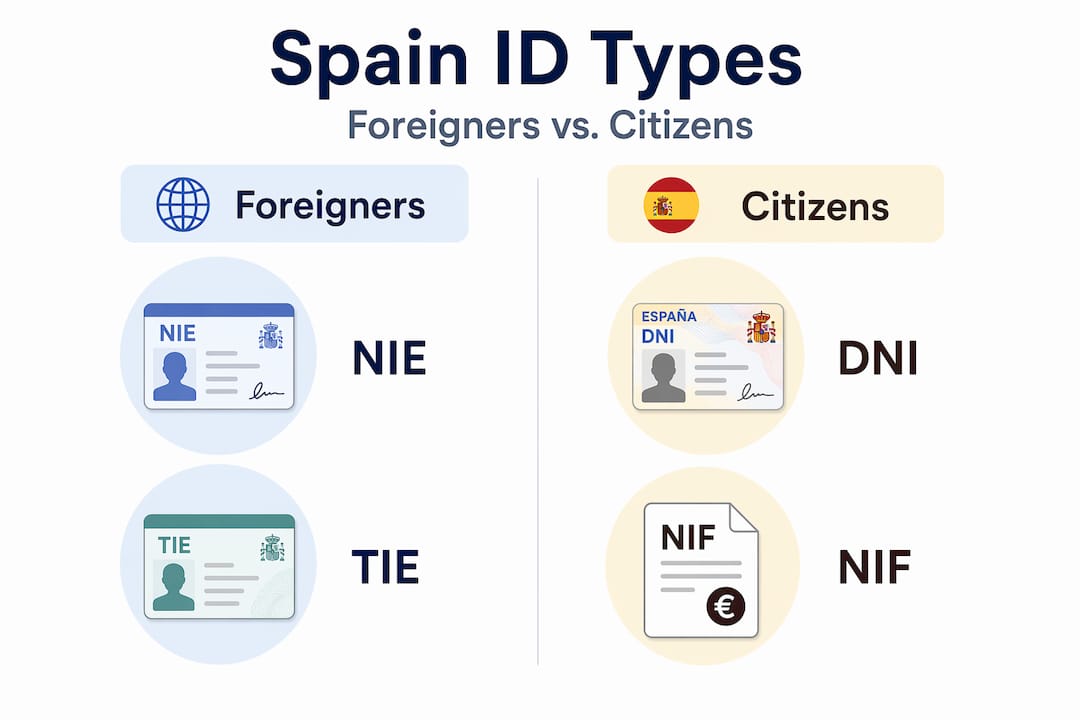
The NIE is a permanent ID number assigned to foreigners by the Dirección General de la Policía. Think of it as your fiscal fingerprint in Spain. You need it to open a bank account, sign a lease, buy a car, or pay taxes. What the NIE does not do is grant you permission to live or work here. Many people arrive assuming their NIE covers their legal stay. It does not.
TIE (Tarjeta de Identidad de Extranjero)
The TIE is a physical residence card issued to non-EU nationals who hold valid residency authorization. Your NIE number appears on the TIE, but the card itself is what legally proves your right to reside in Spain. If you’re a non-EU citizen here on a work permit, student visa, or long-term stay authorization, the TIE is your primary identity document in daily life.
DNI (Documento Nacional de Identidad)
The DNI is exclusively for Spanish citizens. It serves as the national ID card and, in most cases, functions as a travel document within the EU. Foreigners never receive a DNI. If someone tells you that you need a DNI as a foreign resident, they are confusing it with the TIE.
NIF (Número de Identificación Fiscal)
The NIF is a tax identifier. For Spanish citizens, it matches their DNI number. For foreigners, the NIE number acts as the NIF. This means your NIE is also your NIF for tax filings, invoicing, and financial reporting with the Spanish tax authority (Agencia Tributaria).
Here is how these documents compare at a glance:
| Document | Who it’s for | Primary purpose |
|---|---|---|
| NIE | All foreigners | Tax and administrative identification |
| TIE | Non-EU residents | Physical proof of legal residence |
| DNI | Spanish citizens only | National identity and travel |
| NIF | Everyone (tax) | Tax filings and financial transactions |
How to obtain legal ID documents in Spain
The Spain identification document process requires more planning than most people expect. The steps below apply primarily to obtaining an NIE, which is typically the first document you will need regardless of your specific purpose in Spain.
-
Gather your required documents. You will need your valid passport (original and copy), a completed EX-15 form (for NIE applications), proof of the reason for the NIE (property contract, job offer, enrollment letter), and two passport-sized photos. All foreign documents must be officially translated into Spanish by a certified translator.
-
Authenticate foreign documents. Non-Spanish documents must carry an Apostille of The Hague and be issued within 90 days of submission. This rule catches a lot of applicants off guard. A birth certificate issued three years ago will be rejected even if it has a valid apostille.
-
Book your appointment. Applications are submitted in person at a Comisaría de Policía Nacional (for those already in Spain) or at a Spanish consulate abroad. You can apply through an authorized representative using a notarized power of attorney if you cannot attend in person.
-
Pay the administrative fee. The Tasa 790 form (Código 012) covers the NIE application fee. You pay at a bank before your appointment and bring the stamped receipt with you.
-
Attend the appointment. Bring every original document and a copy of each. Officers can and do reject applications for missing photocopies. Build in extra time to make copies nearby if needed.
-
Wait for processing. Processing times in Spain vary by province and season. Major cities like Madrid and Barcelona often have backlogs. Provincial offices tend to move faster. TIE applications follow a similar structure but require an additional biometric enrollment appointment.
Pro Tip: Plan your document preparation backward from your deadline. If you need your NIE before signing a property deed on a specific date, count backward from that date to account for apostille processing time, translation time, and appointment availability. Most people count forward and run out of time.
The requirements for Spanish ID applications do shift based on your visa category and nationality. Always confirm the exact document checklist with the relevant consulate or police station before your appointment, as local variations exist.
Managing your Spanish ID documents digitally
Holding the physical documents is only part of the picture. Spain now expects residents to manage much of their administrative life through official digital platforms. Ignoring this side of things is one of the most common mistakes expats make after successfully obtaining their NIE or TIE.

Mi Carpeta Ciudadana is Spain’s official citizen-administration portal. With over 9.2 million registered users, it centralizes appointment management, administrative deadlines, document status tracking, and renewal alerts. Missing a TIE renewal date, for example, can jeopardize your legal residency status. The platform sends automatic renewal reminders so you are never caught off guard.
To access Mi Carpeta Ciudadana, you need one of the following:
- Cl@ve PIN: A one-time code sent to your registered phone number, useful for occasional access
- Cl@ve Permanente: A reusable username and password system for regular users
- Electronic DNI (eDNI) via NFC: Works via a smartphone app for Spanish citizens
For most foreign residents, Cl@ve PIN or Cl@ve Permanente are the practical access points. Setting up your Cl@ve account requires an in-person verification visit or a video identification process. Do this as soon as you receive your NIE. Waiting until you actually need the platform creates a frustrating delay. To protect your data throughout this process, read more about data security for immigrants managing digital documents in Spain.
Pro Tip: Register for Cl@ve the same week you receive your NIE. Many government services, including tax filings and appointment bookings, require digital identification. Getting locked out because your Cl@ve is not set up is entirely avoidable and surprisingly common.
Document needs by situation
Your exact requirements depend heavily on why you are in Spain. The legal documents in Spain you need for buying property look very different from what a student or a salaried worker needs. Here is a breakdown of the most common scenarios.
Property buyers
NIE must be obtained before signing any purchase deed. Notaries cannot finalize real estate transactions without it. This means arranging your NIE well before your intended purchase date, not after you find the property. Banks also require the NIE to open accounts or process mortgages.
Students
Study visa applications require a specific set of authenticated documents. These include proof of enrollment, notarized guardianship documents for minors, financial solvency proof, and health insurance coverage. Once in Spain on a student visa, the TIE becomes your residency card. Students benefit from guidance on student-specific legal resources to avoid common documentation errors.
Workers
Work authorization and residency status are closely linked but legally separate. A work permit authorizes employment. The TIE proves residency. Both are required, and they must align in terms of validity dates. An expired TIE can technically void your work authorization even if the permit itself is still valid.
Families and minors
Minors require their own NIE and, where applicable, their own TIE. Applications on behalf of minors require notarized proof of legal guardianship. The name on every submitted document must match exactly. A middle name missing on one form and present on another is enough for an application to be flagged or rejected.
Understanding your specific legal status in Spain is the foundation for knowing which documents you need and in what sequence.
My honest take on navigating Spanish ID documents
In my experience helping people manage Spanish legal paperwork, the biggest failure point is not ignorance. Most people do their research. The problem is underestimating time. I’ve seen property purchases collapse because a buyer waited until two weeks before the signing date to start the NIE process. I’ve watched students miss enrollment deadlines because an apostille arrived three days too late.
What I’ve learned is that document preparation should be backward-planned from your deadline, not forward from your current situation. Most people think “I’ll apply when I’m ready.” The bureaucracy doesn’t care when you’re ready. It cares whether your documents are valid and your appointment was booked four weeks ago.
The other thing I’d push back on is the idea that getting the physical card is the finish line. The integration of physical and digital identity is where Spain’s administrative system really lives now. I’ve worked with expats who had a valid TIE but no Cl@ve access, and they couldn’t complete basic tax filings or book government appointments without it. The card is the ticket in. The digital identity is the seat.
If you are going through this process alone, I’d strongly recommend at least having a professional review your document checklist before your appointment. One missing photocopy or a freshness-expired document can cost you weeks of delay. The cost of a second opinion is almost always less than the cost of rebooking and restarting. That is not a sales pitch. That is just what the data from rejected applications consistently shows.
— Martín
How Vive can simplify your ID document process
Getting your Spanish ID documents right requires precision, timing, and knowing exactly which steps come in what order.
Vive handles the complexity behind the scenes so you can focus on settling into your life in Spain. From NIE and TIE applications to residency renewals and document review, the platform combines legal expertise with digital automation to reduce errors and track your case from start to finish. Every document is reviewed before submission. Every deadline is flagged in advance. For study centers managing student immigration at scale, Vive offers dedicated immigration management for study centers built specifically for that administrative load. Whether you are an individual expat or managing a group of international students, Vive’s online client portal means you always know where your application stands.
FAQ
What is the difference between NIE and TIE?
The NIE is an identification number assigned to all foreigners in Spain for tax and administrative purposes. The TIE is a physical residence card issued to non-EU residents that includes the NIE number but also proves legal residency status.
Can I apply for a Spanish NIE from abroad?
Yes. You can apply through a Spanish consulate in your home country or through an authorized representative in Spain using a notarized power of attorney, as confirmed by official application guidance.
How long does it take to get a NIE in Spain?
Processing times vary by location. In major cities, appointments can be booked weeks out and processing may take several additional weeks. Smaller provincial offices typically move faster.
What documents need an apostille for Spanish ID applications?
All foreign public documents submitted for Spanish ID or visa applications, including birth certificates, criminal records, and educational credentials, must carry an Apostille of The Hague and be issued within 90 days of your application date.
Do I need a TIE if I already have an NIE?
Not automatically. EU citizens register on the Registro Central de Extranjeros instead. Non-EU residents with a valid residency authorization are required to obtain a TIE as physical proof of their legal status. The NIE alone does not fulfill this requirement.
Recommended
Living legally in Spain shouldn't be difficult.
View services and pricesNot sure which procedure you need? Find out in 2 min
Questions? Message us on WhatsApp