
Spain residence permit: a clear guide for expats

TL;DR:
- Most newcomers to Spain struggle to understand the difference between visas and residence permits necessary for legal stay and work. Residency permits vary depending on nationality, purpose, and duration, with registration processes differing for EU and non-EU nationals. The 2026 regularization scheme offers a one-time opportunity for eligible residents to gain legal status through a temporary permit.
Moving to Spain and unsure whether you need a visa, a permit, or some kind of registration certificate? You are not alone. Most newcomers arrive with a rough idea that they need something called a “residence permit in Spain” but quickly realize the system has layers, each with its own name, timeline, and paperwork. Understanding what is residence permit Spain in precise legal terms is the first step to living and working here without fear of fines, overstays, or rejected applications. This guide cuts through the confusion and gives you exactly what you need.
Living legally in Spain shouldn't be difficult.
View services and pricesNot sure which procedure you need? Find out in 2 min
Questions? Message us on WhatsApp
Table of Contents
- Understanding residence permits in Spain: basics and categories
- Registering residence in Spain: processes for EU and non-EU nationals
- Pathways to long-term residence in Spain: eligibility and stages
- Spain’s 2026 residence regularization scheme: temporary pathway explained
- Practical guide to applying and maintaining residence permits in Spain
- Why focusing solely on residency permits is shortsighted: the broader journey to legal stability
- Expert legal assistance for your residence permit journey in Spain
- Frequently asked questions
Key Takeaways
| Point | Details |
|---|---|
| Residence permit basics | A residence permit authorizes legal stay and work in Spain beyond tourist visits. |
| EU vs non-EU process | EU citizens register within 3 months; non-EU nationals apply for residence permits with strict document and appointment requirements. |
| Five-year rule | Long-term residence requires five years of continuous legal residence under qualifying permits. |
| 2026 regularization | A temporary one-year residence scheme in 2026 helps eligible irregular residents legalize their status. |
| Plan beyond permits | Residence permits are milestones; long-term integration and legal stability require ongoing compliance and planning. |
Understanding residence permits in Spain: basics and categories
A residence permit is the official legal authorization that allows you to live in Spain beyond the standard 90-day tourist stay. Without one, staying longer makes you legally irregular, which carries serious consequences for future permit applications, employment, and travel within the Schengen Area.
There is no single permit that fits everyone. Spain operates several distinct categories depending on your nationality, relationship to a Spanish citizen, employment situation, or student status. Here are the main types you will encounter:
- EU citizen registration certificate (Certificado de Registro de Ciudadano de la UE): for EU, EEA, and Swiss nationals who register their residence.
- Temporary residence authorization: for non-EU nationals, typically valid for one to two years with renewals.
- Long-term residence permit (Residencia de Larga Duración): for qualifying residents after five continuous years.
- Family reunification permit: for non-EU relatives of legal residents in Spain.
- Residence visa for family members of Spanish nationals: residence visas for family members of Spanish citizens are separate permits that allow qualifying relatives to live in Spain long-term, distinct from ordinary immigration routes.
- Student residence authorization: temporary permission tied to study enrollment.
One point that trips up many expats: a residence permit is not a visa. A visa gets you into Spain. A permit lets you stay. They are separate documents issued at different stages of your journey. You can explore more about family residency in Spain through dedicated guides that walk through each family-based route.
With the basics clear, let’s explore how different resident categories register and secure their legal status in Spain.
Registering residence in Spain: processes for EU and non-EU nationals
The registration process splits sharply depending on whether you hold an EU passport or not. Both paths lead to legal residence, but the timelines, documents, and offices involved are different.
For EU citizens, the process is comparatively straightforward. EU citizens must register within three months of arrival and receive a registration certificate that states their NIE (Número de Identificación de Extranjero) and registration date. This certificate is not a physical ID card; it is a printed document you will reference constantly.
For non-EU nationals, the path involves more steps:
- Enter Spain on the appropriate long-stay visa (unless applying via an in-country route like arraigo).
- Register with your local town hall (padrón) to establish proof of local residence.
- Book an appointment at a foreigners’ office (Oficina de Extranjería) or a national police station.
- Submit your application with originals and copies of all required documents.
- Collect your TIE (Tarjeta de Identidad de Extranjero), the physical card that serves as proof of your residence authorization.
This is where many people mix up NIE and TIE. Your NIE is simply a number, assigned once and kept for life. Your TIE is the physical card that carries that number along with biometric data and proof of your current permit status. You can have a NIE without having a TIE, but you cannot hold a TIE without a NIE. Learn more about the EU registration in Spain process and how it differs from non-EU routes.
Pro Tip: Register with the padrón (municipal census) as early as possible after arriving. That registration date becomes critical evidence for nearly every permit application you make later, including long-term residence and the 2026 regularization scheme.

The first-time residency process has specific quirks depending on your local province, so checking procedures for your specific city before booking appointments saves time.
Now that you understand how to register your residence, let’s examine Spain’s pathways to more stable, long-term residence status.
Pathways to long-term residence in Spain: eligibility and stages
Long-term residence requires five years of continuous legal residence in Spain, typically built through a series of temporary permits and renewals. Missing a renewal window or spending too much time outside Spain can reset your clock, so consistency matters.
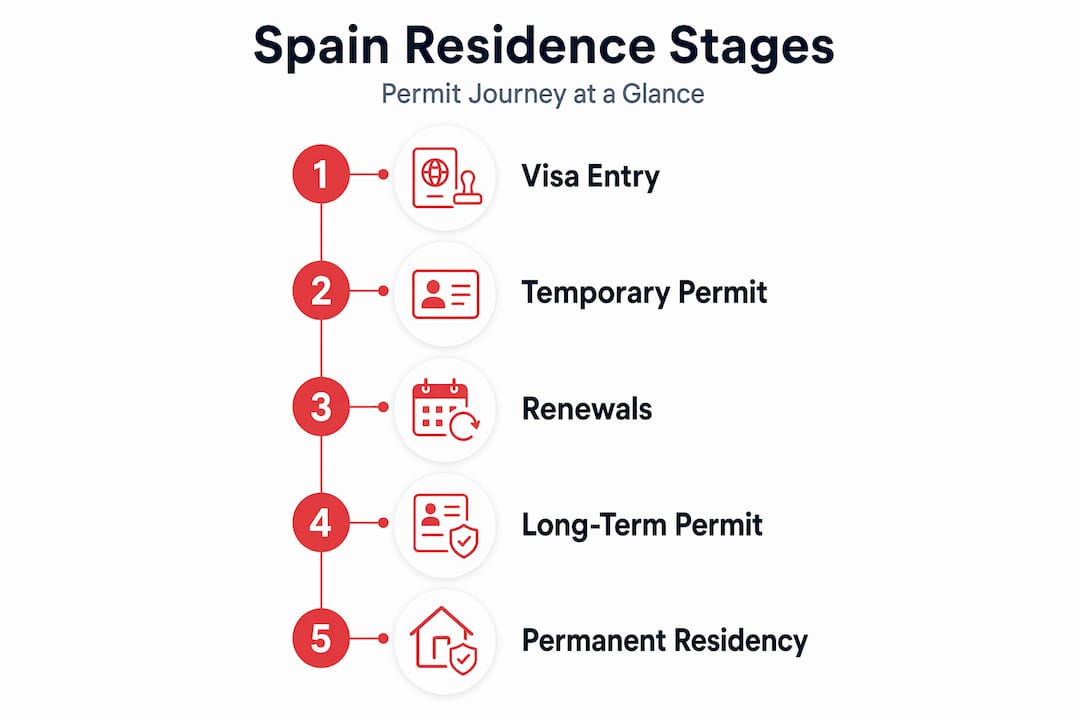
What counts as qualifying residence? Time spent under a valid temporary residence authorization, family permit, or student permit with work rights generally qualifies. Unauthorized stays do not count, and gaps between permits must be minimal.
Here is how the key permit stages compare:
| Permit type | Duration | Who qualifies | Renewal needed |
|---|---|---|---|
| Temporary residence | 1 to 2 years | Non-EU nationals with valid grounds | Yes, before expiry |
| Long-term (national) | 5 years, renewable | Non-EU after 5 continuous years | Yes, every 5 years |
| EU long-term residence | Indefinite | Non-EU after 5 years (EU-standard) | No, unless circumstances change |
| EU citizen certificate | Indefinite | EU/EEA/Swiss nationals | No |
Key documents you will need when applying for long-term status:
- Proof of five years of continuous registered residence (padrón history, permit stamps)
- Proof of sufficient income or assets
- Private or public health insurance coverage
- Clean criminal record certificate from Spain and your country of origin
- Valid passport or national ID
Pro Tip: Changing permit categories within those five years is allowed. A student who switches to a work permit can still count all legally registered time. What matters is that your residence was continuous and legal throughout.
You can review the full list of legal residency options in Spain to identify which route applies to your specific situation. If you are targeting EU-standard long-term status, the dedicated EU long-term residence process page explains the additional requirements compared to national long-term residence.
Having clarified long-term residence pathways, let’s explore Spain’s special 2026 residence regularization scheme facilitating legal status for eligible residents.
Spain’s 2026 residence regularization scheme: temporary pathway explained
In 2026, Spain introduced a significant regularization program that offered undocumented or irregularly staying foreign nationals a path to legal status. This is not an ordinary permit route. It is a one-time window created by royal decree to address a large population of people who had been living in Spain without proper documentation.
Eligibility criteria for the 2026 scheme:
- Physical presence in Spain before January 1, 2026
- At least five months of continuous residence prior to the application date
- No serious criminal record in Spain or abroad
- Not in an active asylum application process (with some exceptions)
- Not subject to a return or expulsion order
How to apply, step by step:
- Gather empadronamiento certificates going back at least five months.
- Collect supporting documents: rental contracts, utility bills, travel entry records, bank statements.
- Prepare your criminal record certificate, apostilled if from abroad.
- Book an in-person appointment or submit online through the official platform within the application window.
- Submit your full file and await the provisional authorization letter.
The 2026 royal decree grants a temporary one-year residence and work permit, with applications open from April 16 to June 30, 2026. After those 12 months, permit holders must transition to a standard residence authorization to maintain legal status.
What happened in practice: thousands of people queued before dawn outside immigration offices in Madrid, Barcelona, and Valencia in the first weeks of the scheme. The sheer volume exposed capacity limits in the system and led to delays in appointment availability. If you are eligible, acting before the June 30 deadline is critical. Check common reasons permits get rejected before submitting your file, as incomplete or incorrectly formatted documents were cited as a primary cause of refusals.
Next, we will discuss practical steps and tips to successfully apply for and maintain residence permits in Spain.
Practical guide to applying and maintaining residence permits in Spain
Knowing which permit you need is half the battle. Getting the application right the first time is the other half. Spanish authorities require originals and copies of all documents, strict appointment scheduling, and in-person appearances at specific offices. A missing photocopy or an unsigned form can mean starting over.
Document checklist for most residence applications:
- Valid passport (original plus copy of all pages)
- Current padrón certificate (issued within the last three months)
- Completed and signed application form (EX-17, EX-01, or relevant form depending on permit type)
- Proof of income, employment contract, or enrollment letter
- Health insurance certificate
- Two recent passport-size photographs
- Application fee receipt (paid at a bank using the official modelo 790 form)
- Criminal record certificate, apostilled if issued abroad
A few things people consistently get wrong. First, appointments at foreigners’ offices fill weeks in advance in major cities. Book as early as possible. Second, documents from outside Spain often need an apostille stamp and certified translation. Third, permit renewal windows open 60 days before expiry, and you can apply up to 90 days after the expiry date without losing your legal status, but do not push that limit.
Pro Tip: Procedures vary noticeably between provinces. What Madrid’s office accepts may differ from Valencia’s. Always check your local Delegación del Gobierno or provincial foreigners’ office website before finalizing your document set.
The Spanish residency document checklist provides a deeper breakdown by permit type. And if you want to avoid the most common mistakes applicants make, the avoid residency rejection in Spain guide covers the top reasons for refusals with concrete fixes.
With practical steps covered, let’s share a unique perspective often overlooked in residence permit discussions.
Why focusing solely on residency permits is shortsighted: the broader journey to legal stability
Here is something most guides do not tell you: a residence permit is not a destination. It is a checkpoint.
Many people obtain their first temporary permit and feel the hard work is done. It is not. The Spanish immigration system is explicitly designed as a staged process. You earn temporary status, renew it, accumulate years, qualify for long-term status, and only then, after additional years and integration criteria, can you even apply for citizenship. Each stage requires active maintenance, not just passive time served.
The most common mistake we see is treating the permit like a parking spot. You cannot just leave it and come back when you feel like it. Spending more than six months outside Spain in a single year risks breaking the continuous residence requirement for long-term status. Failing to update your padrón when you move address weakens your documentation trail for future applications.
There is also a financial dimension that rarely gets discussed early enough. Long-term and citizenship applications require proof of economic integration, not just physical presence. Building that financial record, whether through employment history, tax returns, or self-employment contributions, takes years. Starting that documentation process on day one of your residence, not year four, puts you in a much stronger position.
“Permanent residency is a milestone, not the finish line. It is the gateway to a more settled life.” That framing is useful because it shifts your mindset from reactive to proactive. Every permit renewal is an investment in the next stage.
Explore the full picture of legal residency options overview to understand how your current status connects to where you want to be in five or ten years.
Expert legal assistance for your residence permit journey in Spain
Navigating Spain’s immigration system on your own is possible. Doing it without mistakes, delays, or unnecessary stress is much harder. Vive Legal was built specifically for people at every stage of the residency process, from first-time applicants figuring out their NIE to long-term residents transitioning to EU permanent status.
The platform handles document preparation, appointment scheduling, and case tracking through a secure client portal, combining professional legal oversight with automated workflows that catch errors before they reach the office. Services cover family residency, student permits, TIE renewals, and more. Clients using Vive Legal’s structured workflow have reported up to 30% faster processing compared to self-managed applications in 2026.
Whether you need a TIE application service, support for a study center’s student population through immigration management for study centers, or want to understand the Spain immigration workflow 2026, the platform gives you clarity and support at every step.
Frequently asked questions
What is the difference between NIE and TIE in Spain?
The NIE is your identifying number assigned once and used across all official processes, while the TIE is the physical card that serves as proof of your current residence authorization. Both are necessary but serve different functions.
How long must I live in Spain before applying for long-term residence?
You must complete five years of continuous legal residence under qualifying permits before you are eligible to apply for long-term residence status in Spain.
Can EU citizens apply for the same residence permits as non-EU citizens in Spain?
No. EU citizens must register within three months of arrival and receive a registration certificate, while non-EU nationals must obtain specific residence authorizations through a permit and visa process.
What is the 2026 residence regularization scheme in Spain?
It is a temporary program created by royal decree granting a one-year residence and work permit to eligible foreign nationals already living in Spain, with applications accepted from April 16 to June 30, 2026.
Do permanent residence permits in Spain grant citizenship?
No. Permanent residency does not equal citizenship. Citizenship generally requires at least ten years of legal residence, plus integration and language requirements that go beyond simply holding a long-term permit.
Recommended
Living legally in Spain shouldn't be difficult.
View services and pricesNot sure which procedure you need? Find out in 2 min
Questions? Message us on WhatsApp