
What Is Residencia Permanente in Spain: 2026 Guide

TL;DR:
- Residencia permanente in Spain grants non-EU nationals the right to live and work indefinitely after five years of legal residence, unlike temporary permits that require renewal and specific conditions.
- Maintaining permanent residency demands over 183 days of physical presence annually and accurate documentation, while understanding official terminology like “inicial” prevents unnecessary confusion.
If you’ve been living in Spain for a few years and wondering what comes next, the concept of residencia permanente is probably already on your radar. This is the legal status that allows you to live and work in Spain indefinitely, without the stress of regular renewals tied to employment contracts or income thresholds. Yet many expatriates confuse it with citizenship, mix it up with temporary permits, or simply don’t know when they qualify. This guide breaks down permanent residency explained for the Spanish context, covers the main pathways, and tells you exactly what to watch out for in 2026.
Living legally in Spain shouldn't be difficult.
View services and pricesNot sure which procedure you need? Find out in 2 min
Questions? Message us on WhatsApp
Table of Contents
- Key Takeaways
- What is residencia permanente and how it differs from residencia temporal
- Pathways to obtain residencia permanente
- Renewal and compliance obligations
- Common misunderstandings about residency applications
- My honest take on Spain’s residency system
- How Vive can make your residency process less stressful
- FAQ
Key Takeaways
| Point | Details |
|---|---|
| Residencia permanente defined | Permanent residency gives you the right to live and work in Spain indefinitely after five years of legal residence. |
| Temporary vs. permanent | Residencia temporal is a stepping stone, typically capped at two years per renewal, while permanent status has no expiration on your right to stay. |
| Five main pathways exist | Routes include non-lucrative residence, arraigo, work-based permits, family reunification, and EU long-term residence. |
| Physical presence is non-negotiable | You must spend more than 183 days per year in Spain to qualify for renewal and eventually for permanent status. |
| Recent reforms work in your favor | Spain resolved 1.48 million permit files between May 2025 and April 2026, cutting processing times and simplifying the path from temporary to permanent residency. |
What is residencia permanente and how it differs from residencia temporal
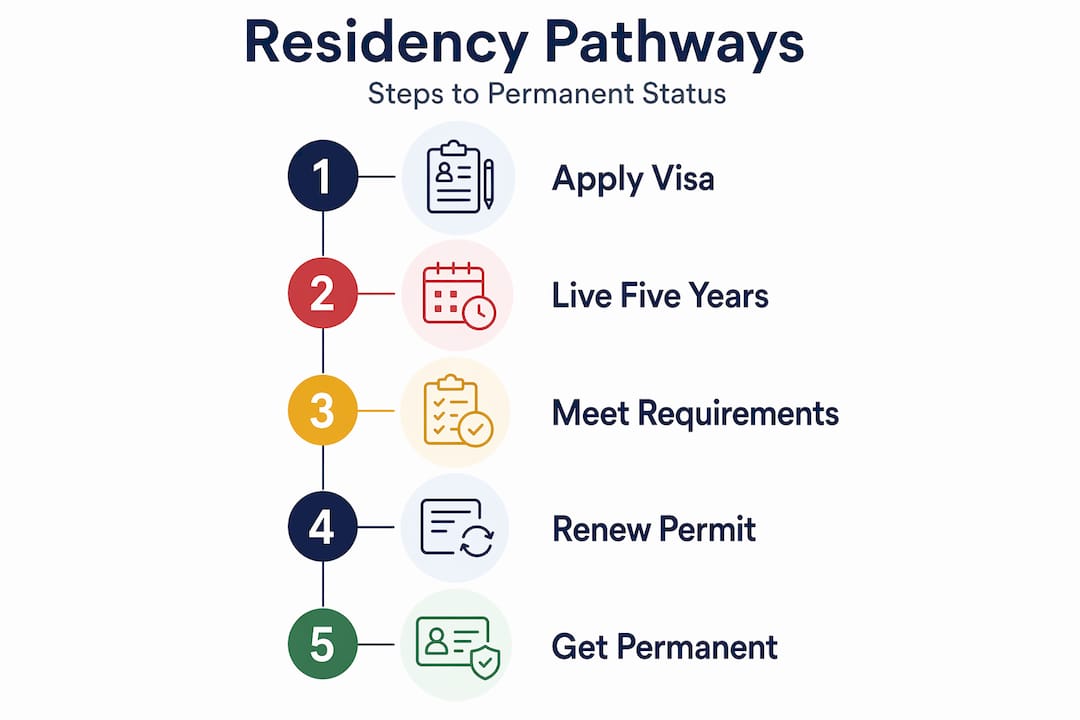
Residencia permanente is a legal authorization granted by the Spanish state that lets you reside in Spain without a fixed expiration on your right to stay. After five continuous years of legal residence, most non-EU nationals can apply. EU citizens follow a slightly different track under free movement rules, but the underlying concept is the same: you have earned the right to call Spain your permanent home.
The contrast with residencia temporal could not be sharper. Residencia temporal is Spain’s way of saying “you can stay for now, under these specific conditions.” The meaning of residencia temporal covers a wide range of permits: work-based, study, family reunification, and non-lucrative, among others. Each one comes with restrictions on what you can and cannot do, and each requires periodic renewal.
Here are the key legal differences between the two statuses:
- Duration: Residencia temporal is capped at specific periods, typically one year initially and two-year renewals after that. Residencia permanente carries no end date on your right to reside.
- Work authorization: Temporary permits often restrict employment to a specific sector or employer. Permanent residents can work in any profession across Spain.
- Renewal burden: Temporary residents must prove ongoing compliance with their permit’s conditions at every renewal. Permanent residents renew their physical card every five years but do not have to re-justify their right to stay.
- Financial thresholds: Many temporary permits require you to demonstrate income above a minimum level. Permanent residency does not carry the same ongoing financial requirement.
- Path to citizenship: Only time spent under legal residency counts toward the ten-year (or two-year, for Latin Americans and others) path to Spanish nationality.
Pro Tip: Do not confuse holding a TIE (Tarjeta de Identidad de Extranjero) with having permanent residency. The TIE is just the physical card. Your actual legal status depends on what category is printed on it.
Pathways to obtain residencia permanente
No single route fits everyone. Spain offers several legally recognized paths, and understanding which one applies to your situation can save you months of unnecessary waiting.
The non-lucrative route
This is the most popular option among retirees and remote workers. You enter Spain on a non-lucrative visa, live here without working locally, and after five years of continuous legal residence, apply for permanent status. The financial requirement for the initial permit is set at 400% of the IPREM for the main applicant, plus 100% of the IPREM for each dependent. It is a high bar, but the status it leads to is worth it.

Work-based and family reunification paths
If you have a Spanish employment contract, your employer’s sponsorship opens the door to a work permit. After five years, the same permanent residency application applies. Family reunification permits follow similar logic: live legally in Spain for five continuous years under any valid permit type and you qualify.
The arraigo routes
These routes are specifically designed for people who are already in Spain, often without full legal documentation, but who have built real roots here. Spain’s immigration regulation now codifies five distinct arraigo pathways, covering social ties, labor history, family connections, and even a second-chance channel for people whose prior residency lapsed. Legal experts widely regard arraigo as a major step forward because it shifts the focus from paperwork compliance to actual integration into Spanish society.
The EU long-term residence permit
This is technically the formal legal name for what most people call residencia permanente for non-EU nationals. It is governed by EU Directive 2003/109/EC and grants holders the right to reside in other EU member states as well. The 2024 Immigration Regulation reform also made it easier to transition from temporary to long-term residence without having to leave Spain first.
Pro Tip: If you previously held a golden visa, note that Spain abolished the investor residency program as of April 3, 2025. Existing permits remain valid, but you will need to transition to a mainstream route for your next renewal. Planning that transition early prevents gaps in your legal status.
Here is a comparison of the main pathways:
| Pathway | Minimum residency required | Key requirement | Typical timeline |
|---|---|---|---|
| Non-lucrative | 5 years | Proof of passive income (400% IPREM) | 6 to 12 months to process |
| Work permit route | 5 years | Active employment contract | Varies by employer and sector |
| Family reunification | 5 years | Sponsor already legally resident | 3 to 9 months |
| Arraigo social | 3 years in Spain | Social integration report | 3 to 6 months |
| EU long-term residence | 5 years | Stable income, no criminal record | 3 to 6 months |
Renewal and compliance obligations
Getting permanent residency is one milestone. Keeping it is another challenge entirely. Spain’s rules are clear, but many people learn about them only after a problem has already started.
The most critical rule is the 183-day presence requirement. Non-lucrative residents must prove physical presence in Spain for more than half of the previous calendar year to maintain and renew their status. Permanent residents face a similar rule: absences longer than 12 consecutive months, or extended absences that suggest you have relocated elsewhere, can put your status at risk.
Applicants commonly lose renewals not because they were absent, but because they failed to document their presence properly. Stamped passports, bank statements showing local transactions, utility bills, and medical records all serve as proof. Keep them organized from day one.
Best practices for staying compliant:
- Track your travel days in a simple spreadsheet, noting entry and exit dates every time you cross a border.
- Keep at least two years of utility bills, lease agreements, and bank statements in a dedicated folder.
- Renew your physical TIE card before it expires, even though your underlying residency right persists. Expired cards cause problems at borders and with employers.
- Read the guide on updating your residency card before your renewal date to avoid surprises.
- If you plan extended travel outside Spain, consult a legal professional beforehand to confirm your absence will not affect your status.
One important note on the 2025 to 2026 regulatory period: renewals for temporary permits are now granted for two-year periods, down from the four-year periods that applied under older rules. This means more frequent renewal cycles for temporary residents, which makes accurate record-keeping even more critical.
Common misunderstandings about residency applications
The Spanish immigration system uses terminology that confuses even experienced applicants. Getting clear on what the labels actually mean saves you from a lot of unnecessary anxiety.
-
“Inicial” does not mean denied. When you see “residencia temporal por circunstancias excepcionales inicial” on an official portal, this is simply the label for a first-time authorized temporary residence granted under special circumstances like social ties or humanitarian reasons. It is not a provisional status or a warning sign. It means your first permit was approved.
-
“Initial” status in portals does not indicate rejection. Many applicants panic when they see the word “inicial” appear on their tracking page. This only marks the first administrative step in the process, not the final outcome. Monitor the full application flow and wait for official written communication before drawing conclusions.
-
Arraigo is not a loophole; it is a recognized legal path. Some applicants treat arraigo as an emergency option or a workaround. In reality, Spain’s legal system deliberately built it as a legitimate integration tool. Expanded arraigo routes now allow people who previously failed renewals to regularize their status if they meet the social or labor criteria.
-
Permanent residency is not citizenship. Holding residencia permanente gives you the right to live and work in Spain indefinitely. It does not give you a Spanish passport, EU citizenship, or the right to vote in national elections. The difference between residency and citizenship is legally significant and practically important.
-
Spain’s processing system has improved, but errors still cause delays. Between May 2025 and April 2026, Spain processed files with 25% greater efficiency than the prior period. Faster processing does not mean a sloppy application goes unnoticed. Incomplete documents and mismatched information remain leading causes of delay and rejection. Read the guide on avoiding residency rejection before you submit anything.
My honest take on Spain’s residency system
I’ve spent years working with people at every stage of Spain’s immigration process, from their first NIE to their long-awaited permanent residency card. And the single biggest issue I see is not complexity. It’s overconfidence.
People assume that because they have lived here for years and feel settled, the paperwork will be straightforward. It rarely is. Spain’s system rewards meticulous documentation, not good intentions. I’ve seen people lose renewals because they couldn’t prove they were in Spain during a period when they obviously were. Feelings don’t count. Records do.
What I’ve also noticed is that the recent regulatory reforms have genuinely helped. The expansion of arraigo pathways is not just a bureaucratic tweak. It’s a real shift in philosophy, moving toward recognizing how people actually build lives rather than just demanding paperwork compliance. That’s worth acknowledging.
My practical advice: start treating your residency file like a financial record. Back it up, organize it by year, and update it every time something changes. The people who sail through renewals and transitions to permanent status are almost never the ones with the cleanest situations. They are the ones with the most organized documentation.
— Martín
How Vive can make your residency process less stressful
Knowing what is residencia permanente is one thing. Actually getting through the application without errors, missed deadlines, or rejected documents is another challenge entirely.
Vive combines legal expertise with a fully digital platform built specifically for Spain’s immigration process. You get document review, form preparation, appointment scheduling, and real-time case tracking through a secure client portal. Whether you are starting with a temporary permit or preparing your permanent residency application after five years in Spain, Vive’s team reviews every detail before submission to reduce the risk of delays. The platform handles the complexity so you can focus on actually living your life in Spain. Start your personalized diagnostic at vive.legal and find out exactly where you stand.
FAQ
What is residencia permanente in Spain?
Residencia permanente is a legal status that grants non-EU nationals the right to live and work in Spain indefinitely after five continuous years of legal residence, without needing to renew under specific employment or income conditions.
What is the difference between residencia temporal and residencia permanente?
Residencia temporal is a time-limited permit tied to specific conditions like work or income, renewed every one to two years. Residencia permanente carries no expiration on your right to reside in Spain.
How many days do you need to spend in Spain to keep your residency?
You must spend more than 183 days per calendar year in Spain to meet the physical presence requirement for maintaining and renewing your residency status.
Does residencia permanente lead to Spanish citizenship?
Not automatically. Permanent residency gives you the right to live in Spain indefinitely, but citizenship requires a separate application after a qualifying residency period, typically ten years for most nationalities.
What does “inicial” mean on a Spanish residency portal?
“Inicial” simply indicates a first-time authorized permit, not a denial or provisional outcome. It marks the opening administrative step in your file and should not be confused with a negative decision.
Recommended
Living legally in Spain shouldn't be difficult.
View services and pricesNot sure which procedure you need? Find out in 2 min
Questions? Message us on WhatsApp