
Guide to updating Spanish residency cards for expatriates

TL;DR:
- Missing your TIE card renewal window can lead to fines, travel re-entry issues, and loss of work rights. To renew on time, gather necessary documents, pay the fee, and understand the two-step process of renewing your residence authorization and then the physical card. Proper preparation and compliance prevent delays, refusals, and legal complications during the renewal journey.
Missing your TIE card renewal window is not just inconvenient. It can trigger fines, compromise your right to work, and create re-entry problems every time you travel. Yet thousands of expatriates across Spain get caught off guard each year because the renewal process is genuinely confusing. This complete guide to updating Spanish residency cards walks you through every stage, from documents and fees to fingerprinting and card collection, so you can stay fully compliant and avoid the pitfalls that trip up even long-term residents. You can renew the Spanish TIE within 30 days before expiry and up to 90 days after to stay compliant.
Living legally in Spain shouldn't be difficult.
View services and pricesNot sure which procedure you need? Find out in 2 min
Questions? Message us on WhatsApp
Table of Contents
- What you need before renewing your Spanish residency card
- Step-by-step process to update your Spanish residency card
- Common mistakes and troubleshooting tips when renewing your residency card
- What to expect after submitting your Spanish residency card renewal
- Why many expatriates misunderstand the Spanish residency card renewal process
- Professional assistance with Spanish residency card renewals
- Frequently asked questions
Key Takeaways
| Point | Details |
|---|---|
| Start early | Begin preparing documents and submitting applications 30 days before your residency card expires to avoid delays. |
| Complete paperwork accurately | Ensure all forms like EX-17 match your passport and NIE details exactly to prevent appointment reschedules. |
| Understand the two-step renewal | Renewing your residence authorization and renewing the physical card are separate steps requiring different appointments. |
| Keep track after submission | Use official online portals to monitor your application status and plan accordingly for card collection. |
| Avoid common errors | Pay the tasa 790 fee properly, bring originals, and comply with appointment timelines to prevent penalties. |
What you need before renewing your Spanish residency card
Preparation is where most renewals go wrong. People book appointments before they have all their documents, show up with photocopies instead of originals, or realize too late that they have not paid the required fee. Getting this stage right sets up everything that follows.
Core documents you must gather
The foundation of any successful renewal is the EX-17 form. This is the official form you use to request your new physical TIE card once your underlying residence authorization has been approved. The EX-17 form must be printed, completed with your personal details, and indicate the renewal option. Do not fill it out in pencil. Do not leave fields blank. Immigration officers will reject incomplete forms on the spot.
Beyond the form, you will need the following:
- Valid passport (original, not a photocopy)
- Recent passport-size photograph meeting Spanish ID photo standards (white background, 32x26mm)
- Proof of fee payment for tasa 790 modelo 012
- Empadronamiento (municipal registration certificate, typically no older than three months)
- Proof of social security or economic activity if applicable to your authorization type
Long-term residence card renewals require a valid passport, fee payment proof, and an official photograph at minimum. Additional documents vary depending on whether you hold a work authorization, a long-term residence permit, or a Withdrawal Agreement card. Check your specific category before booking anything. Our complete TIE card renewal guide covers these categories in more detail.
Fee payment: tasa 790 modelo 012
You cannot walk into your appointment without proof that you have already paid the government fee. The tasa 790 fee for TIE renewals is approximately €19.30 and must be paid before the appointment. You pay it at a bank or online, and you bring the stamped receipt to your fingerprint appointment. Lose that receipt and you will need to reschedule.
Pro Tip: Pay the fee at least a week before your appointment. Bank processing can sometimes take 24 to 48 hours to generate the stamped proof, and some offices accept only the original printed receipt, not a screenshot.
For further guidance on assembling everything you need, see how to gather supporting documents for residency on the Vive Legal blog.
| Document | Required for all? | Notes |
|---|---|---|
| Valid passport (original) | Yes | Photocopies not accepted |
| EX-17 form | Yes | Printed, signed, correct renewal box ticked |
| Tasa 790 receipt | Yes | Must be paid before appointment |
| Passport photo | Yes | White background, ID dimensions |
| Empadronamiento | Usually yes | Issued within last 3 months |
| Social security proof | Depends | Required for work authorization types |
Step-by-step process to update your Spanish residency card
With your documents in order, here is how the full renewal actually works. Updating Spanish residency is a two-stage process, and most people who struggle have not realized this.
The two stages
Stage one is renewing your residence authorization. This is the legal permission itself, separate from the physical card. Stage two is requesting the new physical TIE card. You cannot do stage two without completing stage one first.
Renewal involves first submitting the authorization renewal within 60 days before expiry, or 90 days after with sanction risk, followed by a police appointment for fingerprints with your completed EX-17 form and fee paid.
Step-by-step breakdown
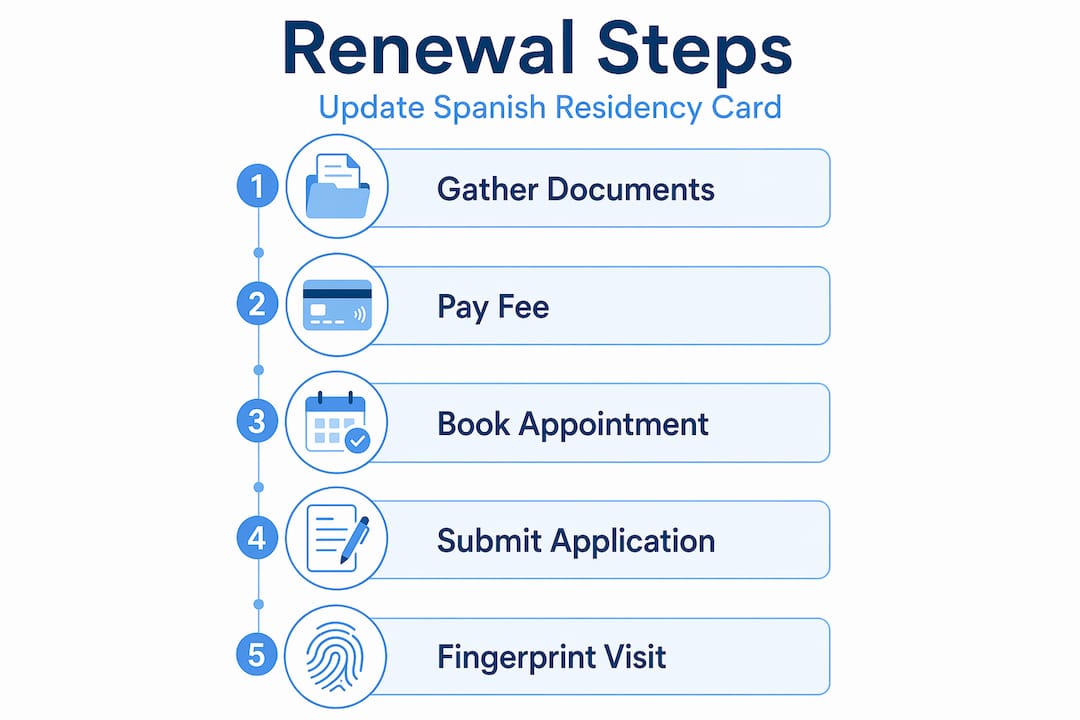
- Submit your residence authorization renewal at the Oficina de Extranjería within the correct window.
- Wait for a favorable resolution. Processing times vary by province, typically several weeks to a few months.
- Pay tasa 790 modelo 012 once you have your favorable resolution, if you have not already.
- Complete the EX-17 form accurately, matching all details to your passport and NIE exactly.
- Book your fingerprint appointment (cita previa) at the Comisaría de Policía Nacional. After a favorable decision on the residence authorization, you have one month to book and attend this appointment.
- Attend in person with all originals: passport, EX-17, fee receipt, and photograph.
- Wait for card issuance, typically 3 to 6 weeks after fingerprinting.
- Collect your new TIE card in person at the police station with your appointment receipt and valid ID.
One thing worth knowing: submitting the renewal within the legal window extends your current card validity until the application is resolved. This means you remain legal during the waiting period, as long as you applied on time.
Pro Tip: Screenshot your online appointment confirmation and keep a printed copy. Some police stations require you to present it at the door to even enter the building.
For a visual breakdown of where TIE applications fit in the broader process, the steps to obtain TIE card article explains the full timeline. You should also review the TIE card application timing rules to understand the one-month window in detail.
Processing times by stage
| Stage | Typical timeline |
|---|---|
| Authorization renewal decision | 1 to 4 months (varies by province) |
| Fingerprint appointment availability | 1 to 6 weeks after resolution |
| Physical card issuance after fingerprints | 3 to 6 weeks |
| Total end-to-end | 2 to 5 months |
Common mistakes and troubleshooting tips when renewing your residency card
Most renewal problems are preventable. Here are the ones we see most often when people try to navigate this process without proper guidance.
Mistakes that cause delays or refusals
-
Mismatched data on forms. Every field on your EX-17 must match your passport and NIE exactly. A transposed digit in your NIE number can result in immediate rejection. Common errors such as mismatched information on EX-17 or the absence of your original passport lead to delays or rescheduling.
-
Attempting to renew too early under the Withdrawal Agreement. This one catches British nationals in particular. Certain Withdrawal Agreement TIE cards have led to refusals when renewal was attempted before expiry. In some cases, waiting until expiry is actually mandatory. If you hold a Brexit TIE, confirm your specific rules before you do anything.
-
Missing original documents. Bring every original. Not a notarized copy, not a high-quality scan on your phone. The original.
-
Booking fingerprints before authorization approval. You will waste your appointment slot. The fingerprint appointment is only valid after a favorable resolution on your authorization.
-
Waiting too long. There is a sanction risk if you submit your authorization renewal more than 90 days after expiry. This does not automatically cancel your residence, but it does open you up to fines and complications.
Pro Tip: Set a calendar alert six months before your TIE expiry. That gives you time to prepare documents, navigate appointment scarcity, and resolve any issues without rushing. See how to avoid fines for residency renewal delays for a breakdown of the financial risks.
“Applying within the legal renewal window is the single most important thing you can do. Everything else is secondary.”
What to expect after submitting your Spanish residency card renewal
You have submitted your authorization renewal and attended your fingerprint appointment. Now what? This stage feels the most opaque, but there are clear things you can do to stay informed and protect yourself.
Your card validity during the wait
Your previous card’s validity is extended until the resolution if you apply within the legal renewal period. This means you are not in an undocumented limbo during the wait. You are legally covered, even if your physical card shows an expired date.

How to track your application
Most provinces allow you to check your application status through the official government portal (Sede Electrónica). You will need your NIE and application reference number. Some people find it worth checking every two weeks. For a detailed walkthrough, see how to track residency application status.
If you need to travel while waiting
This is a situation many people do not think about until it is urgent. If you need to travel abroad before receiving the renewed card, you must obtain a separate Autorización de regreso (Return Authorization). Without it, you risk being denied re-entry into Spain, even if your renewal application is fully valid.
Apply for the Return Authorization at your local police station before leaving. It is typically valid for 90 days.
Key things to keep in mind post-submission
- Card issuance typically takes 3 to 6 weeks after your fingerprint appointment, but this varies significantly by province.
- You will receive a text or notification when your card is ready for collection.
- To collect, bring your receipt from the fingerprint appointment and a valid photo ID.
- Do not send someone else. Collection must be done in person by the applicant.
Why many expatriates misunderstand the Spanish residency card renewal process
After working with hundreds of renewal cases, we have noticed a pattern. It is not that expatriates are careless. It is that the process is genuinely counterintuitive in ways that official guidance rarely explains clearly.
The biggest misunderstanding is structural. People think of residency card renewal as a single action, like renewing a driver’s license. You show up, pay a fee, get a new card. But renewing residency in Spain is two separate legal events: renewing the authorization (the right to reside) and then requesting the physical card that documents that right. Miss the distinction and you may book a fingerprint appointment before your authorization is approved, or worse, miss the one-month window to book fingerprints after approval.
The key point is that renewing the residence authorization and renewing the physical TIE are distinct steps. Many people neglect to budget time for the fingerprint appointment after authorization renewal, which creates avoidable delays.
The second misunderstanding is about where the bottleneck actually is. Most people assume the slow part is getting the authorization approved. It often is not. The real wait is securing a fingerprint appointment. In cities like Madrid and Barcelona, appointment slots can be booked solid for weeks. By the time you get an available slot, you may be brushing up against your one-month window.
The third issue is timing precision. This process has hard edges. Applying too early under certain permit types can trigger a refusal. Applying too late triggers sanctions. The window feels narrower than it looks on paper.
Understanding digital residency management tools and automated reminders can help you stay ahead of these deadlines, rather than scrambling when things change.
Our honest advice: treat the fingerprint appointment as the most time-sensitive step in the whole process, not the paperwork. Book it the moment your favorable resolution arrives.
Professional assistance with Spanish residency card renewals
Navigating Spanish immigration bureaucracy on your own is possible. But when small errors cost you months and missing a window costs you fines, professional support pays for itself quickly.

Vive Legal specializes in TIE renewals and the full range of Spanish residency procedures. Whether you need help preparing documents, ensuring your EX-17 is error-free, or managing your appointment schedule, our team handles it with professional oversight and automated tracking at every stage. We combine legal expertise with technology so you never miss a deadline or show up to an appointment unprepared. Explore our immigration management services or review our service agreement with Vive Legal to understand exactly what you get. Your legal status in Spain matters too much to leave to chance.
Frequently asked questions
How early can I apply to renew my Spanish residency card?
For a non-EU national renewing a Spanish TIE, the application can be submitted up to 30 days before expiry and 90 days after expiry. Applying as early as the window allows gives you the most time to resolve any complications.
What happens if I miss the renewal deadline?
Submitting renewal after expiry can trigger sanctions but does not automatically terminate your national long-term residence permit. That said, administrative fines are a real consequence, so late submission should be avoided.
Do I need to appear in person to renew my residency card?
Yes. Renewing a TIE involves an in-person appointment for fingerprints regardless of any online steps you complete beforehand. There is no workaround for this requirement.
Can I travel outside Spain while waiting for my renewed residency card?
You should apply for a Return Authorization before traveling if your card has expired and the renewal is pending. Without this separate authorization, you risk being denied re-entry into Spain even with a valid pending application.
What if my renewal application is refused?
Seek legal advice immediately to understand the specific grounds for refusal. You typically have the option to appeal the decision (recurso de alzada or recurso contencioso-administrativo) or reapply with corrected and complete documentation, depending on the reason cited.
Recommended
Living legally in Spain shouldn't be difficult.
View services and pricesNot sure which procedure you need? Find out in 2 min
Questions? Message us on WhatsApp