
Legal Guardianship in Spain: A Parent's 2026 Guide

TL;DR:
- Legal guardianship in Spain involves court-appointed arrangements where capable adults care for minors or dependents unable to manage their affairs. The system includes full tutela, partial curatela, and informal guarda de hecho, each with distinct legal powers and documentation requirements. Properly formalizing guardianship ensures legal authority to act on behalf of dependents in health, financial, and legal matters.
Legal guardianship in Spain is the formal legal responsibility assigned to a capable adult to care for, protect, and legally represent a minor or dependent who cannot fully manage their own affairs. Known in Spanish law as tutela or curatela depending on the arrangement, guardianship is distinct from parental custody and from informal care. Spanish courts, governed by the Civil Code and reformed significantly by Law 8/2021, oversee the appointment of guardians and define the scope of their authority. If you are a parent, relative, or caregiver trying to understand this system, the distinctions between tutor, curador, and guardador de hecho are not just legal vocabulary. They determine what you can and cannot do on behalf of the person in your care.
Living legally in Spain shouldn't be difficult.
View services and pricesNot sure which procedure you need? Find out in 2 min
Questions? Message us on WhatsApp
What does legal guardianship in Spain actually mean?
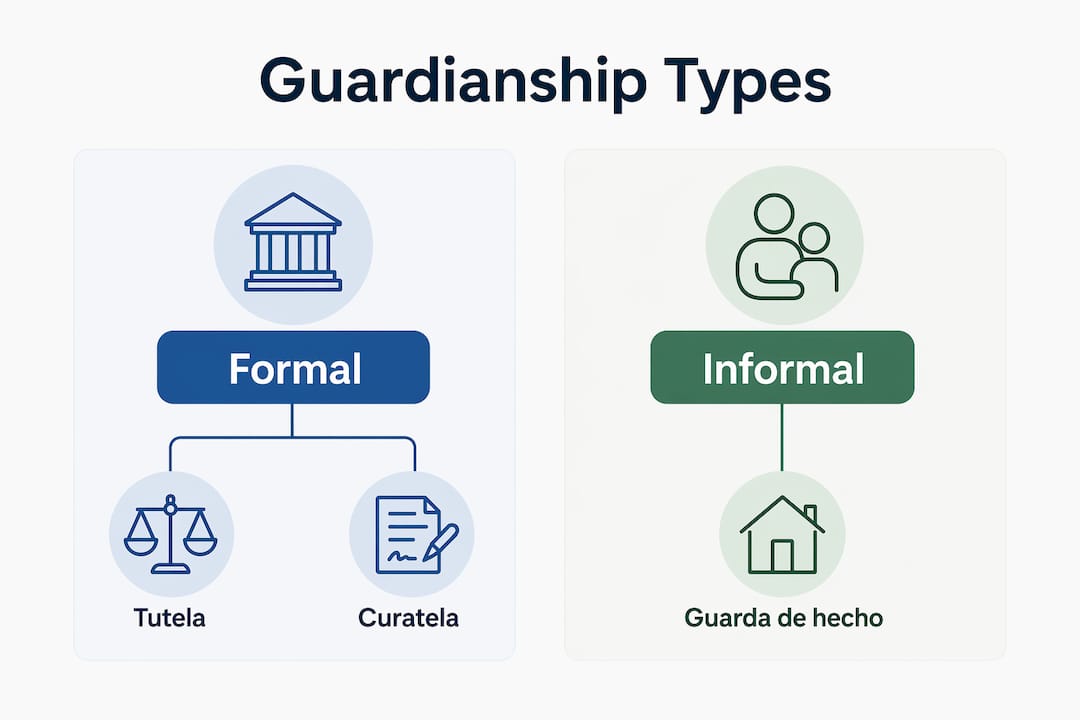
Legal guardianship in Spain covers three distinct legal figures: judicial guardianship (tutela), curatorship (curatela), and informal care (guarda de hecho). Each applies in different circumstances and carries different legal weight. Getting the right one matters because filing the wrong procedure can delay protection for the person who needs it most.

Tutela is the most formal arrangement. A judge appoints a tutor to fully represent a minor or a person with a disability when no parent or legal representative is available. The tutor acts in all legal, medical, and financial matters on behalf of the dependent. This is the arrangement most people picture when they hear “legal guardian.”
Curatela, or curatorship, is a lighter form of support. Rather than replacing the dependent’s decision-making, a curador assists with specific acts where the person needs help. After Law 8/2021, Spanish courts now prefer curatorship over full guardianship for adults with disabilities, emphasizing autonomy and proportionality. The court specifies exactly which decisions require the curator’s involvement, rather than granting blanket authority.
Guarda de hecho is informal care. A guardador de hecho is a person who assumes custody and protection of a dependent through real-life coexistence, without any judicial appointment. This is common in family situations where a grandparent or aunt raises a child without going through court. Spanish law recognizes this arrangement for daily care, but it has clear limits.
| Type | Legal basis | Best for |
|---|---|---|
| Tutela (judicial guardianship) | Court appointment, Civil Code | Minors without parents; adults fully lacking capacity |
| Curatela (curatorship) | Court appointment, Law 8/2021 | Adults needing partial support with specific acts |
| Guarda de hecho (informal care) | Family coexistence, recognized by law | Day-to-day care without formal proceedings |
The key practical difference: guarda de hecho works for daily life, but the moment you need to make a significant legal or financial decision on behalf of the dependent, you need judicial authorization regardless.
How is legal guardianship appointed in Spain?
The judicial appointment process begins with a petition to the civil court (juzgado de primera instancia) in the jurisdiction where the dependent lives. The court evaluates the case, considers the best interests of the minor or dependent, and assesses whether the proposed guardian is suitable. This is not a rubber-stamp process. Judges apply proportionality, meaning they grant only the level of authority the situation genuinely requires.
The documentation you will need to gather includes:
- Empadronamiento certificate proving your residence and cohabitation with the dependent. This padrón registration is one of the most frequently requested documents in guardianship proceedings.
- Acta de notoriedad from a notary, which certifies well-known facts about your relationship with the dependent when no official record exists. This notarial document is particularly useful for informal caregivers seeking to formalize their status.
- Social services report assessing the living situation and the dependent’s needs.
- Medical or psychological reports if the guardianship involves an adult with a disability.
- Birth certificates, family book (libro de familia), and any prior court orders related to the dependent.
The notary’s role in the acta de notoriedad process deserves attention. The notary conducts an investigation, gathers witness testimony, and issues a certified document that third parties, including banks, schools, and hospitals, can rely on. This process can save families months of court proceedings when the facts of the care relationship are clear and uncontested.
Timelines vary. Straightforward cases involving a minor with no competing claims can resolve in two to four months. Contested cases or those involving adults with complex disabilities can take considerably longer. Courts may appoint a defensor judicial (a temporary judicial defender) to represent the dependent’s interests during proceedings.
Pro Tip: Gather your empadronamiento certificate and any notarial documents before filing your petition. Courts move faster when the documentary record is complete from day one. Missing a single document can add weeks to the process.
Judicial authorization is also required for significant economic or legal acts even when a guarda de hecho already exists. Selling property, opening bank accounts, or signing contracts on behalf of the dependent all require court approval. This is not bureaucratic obstruction. It is the system’s way of protecting the dependent from potential misuse.
How does guardianship differ from parental custody?
Parental custody (guarda y custodia) is the legal duty of parents to care for their children on a daily basis. It is a component of patria potestad (parental authority), which is the broader bundle of rights and responsibilities parents hold over their minor children. Custody becomes a formal legal issue primarily in separation and divorce proceedings, where courts decide whether children live primarily with one parent or alternate between both.
Guardianship, by contrast, arises when parental authority is absent, suspended, or insufficient. A guardian steps in precisely because a parent cannot. The two arrangements are not interchangeable, and confusing them leads to filing the wrong legal procedures.
Here is how the practical differences play out:
- Decision-making authority: A parent with patria potestad makes all major decisions for a child automatically. A guardian requires judicial authorization for significant acts.
- Origin of the arrangement: Custody derives from family law proceedings between parents. Guardianship is appointed by a court in protective proceedings.
- Duration: Custody arrangements last until the child turns 18 or a court modifies them. Guardianship ends when the minor reaches adulthood, when the dependent recovers capacity, or when a court terminates it.
- Legal representation: Both a parent and a guardian can represent a minor in legal proceedings, but a guardian’s scope is defined by the court order, not by default parental rights.
- Residency implications: A guardian can determine where a minor lives within Spain, but relocating a minor abroad typically requires judicial authorization regardless of whether the arrangement is custody or guardianship.
The scenario where this distinction matters most: a grandparent raising a grandchild after both parents have died. The grandparent is not a custodial parent. They need to petition for tutela to legally represent the child in school enrollment, medical decisions, and financial matters. Acting as a guardador de hecho covers daily care, but it does not give them legal standing in formal institutions without additional documentation.
What rights and responsibilities does a legal guardian hold?
A legal guardian in Spain holds the authority and the obligation to act in the dependent’s best interests across health, education, housing, and legal representation. This is not optional. Guardianship is a legal duty, and courts can remove a guardian who fails to fulfill it.
Guardians have the right to access all information relevant to the dependent’s care, including medical records, school reports, and financial accounts. They can sign contracts, enroll children in school, consent to medical treatment, and represent the dependent in legal proceedings. Guardians also receive support from public services and can request assistance from social services when needed.
The limitations are equally important to understand. Judges maintain control over significant acts by guardianship holders to prevent misuse and keep decisions aligned with the dependent’s best interests. Selling real estate, accepting or rejecting inheritances, taking out loans, or making major financial commitments all require prior judicial authorization. This oversight is not a sign of distrust toward the guardian. It is a structural protection for the dependent.
Guardianship under Spanish law is not a transfer of the dependent’s rights to the guardian. It is a mandate to protect and support those rights on the dependent’s behalf.
Pro Tip: Keep a written record of every significant decision you make as a guardian, including medical consents, school enrollments, and financial transactions. Courts may request an accounting of your guardianship activities, and organized records demonstrate responsible stewardship.
For informal caregivers acting as guardadores de hecho, the acta de notoriedad is the most practical tool available. It provides third parties with certified proof of your care relationship without requiring a full court proceeding. Banks, schools, and healthcare providers regularly accept it as evidence of your authority to act on the dependent’s behalf.
Key takeaways
Legal guardianship in Spain is a court-regulated responsibility that differs fundamentally from parental custody and informal care, with each arrangement carrying distinct legal powers and limitations.
| Point | Details |
|---|---|
| Three distinct arrangements | Tutela, curatela, and guarda de hecho each apply in different circumstances with different legal authority. |
| Documentation is decisive | Empadronamiento certificates, actas de notoriedad, and social services reports determine how fast courts act. |
| Custody and guardianship are not the same | Custody derives from parental authority; guardianship is judicially appointed when parental authority is absent. |
| Judicial oversight protects everyone | Courts must authorize significant financial or legal acts even when informal care is recognized. |
| Law 8/2021 shifted the approach | Spanish courts now prioritize the dependent’s autonomy and tailor curatorship to specific needs rather than granting blanket authority. |
Why the confusion around guardianship costs families more than they expect
I have seen families spend months in legal limbo because they assumed that raising a child in their home gave them automatic legal authority over that child. It does not. A grandparent who has cared for a grandchild for three years, paid for school, taken them to every doctor’s appointment, and provided a stable home can still be turned away by a hospital administrator who needs a legal guardian’s signature. That gap between real-life care and legal recognition is where families get hurt.
The reform brought by Law 8/2021 was a genuine improvement, but it also added complexity. Curatorship now requires courts to specify exactly which acts need the curator’s involvement, which means the judicial resolution itself becomes a document you need to carry and understand. Families who do not read that document carefully often discover its limits at the worst possible moment.
My consistent advice: do not wait for a crisis to formalize your guardianship arrangement. The empadronamiento guide from Vive covers the residency documentation side well, and understanding your legal status in Spain before you need to act is always better than scrambling after the fact. Proactive families who gather documentation early and consult a professional before filing consistently have faster, smoother proceedings than those who wait.
The other thing practitioners rarely say out loud: the acta de notoriedad is underused. Families default to assuming they need a full court proceeding when a notary can often certify the facts of their care relationship in a fraction of the time. It will not replace judicial guardianship for major decisions, but it buys you legal standing with schools, doctors, and banks while you work through the formal process.
— Martín
How Vive can support your guardianship process in Spain
Guardianship procedures in Spain involve multiple documents, court filings, and legal distinctions that are easy to get wrong without professional guidance. Vive Legal offers online legal support for families working through residency documentation, guardianship-related paperwork, and formal legal processes in Spain. Whether you need help organizing your empadronamiento certificate, understanding your service agreement with a legal professional, or managing immigration documentation for a minor in your care, Vive provides professional oversight without requiring you to visit an office. For families managing educational guardianship for minors studying in Spain, Vive’s study center immigration management service covers the specific documentation needs that arise in those situations. Get clear, professional guidance from the start.
FAQ
What is legal guardianship in Spain?
Legal guardianship in Spain is a court-appointed arrangement where a capable adult is given legal authority to care for and represent a minor or dependent who cannot manage their own affairs. The main forms are tutela (full guardianship) and curatela (partial support), governed by the Spanish Civil Code and Law 8/2021.
How does guarda de hecho differ from judicial guardianship?
A guardador de hecho is an informal caregiver recognized by law through real-life coexistence with the dependent, but without a court appointment. Judicial guardianship grants formal legal authority, while guarda de hecho covers daily care but requires judicial authorization for significant legal or financial acts.
What documents do I need to apply for guardianship in Spain?
The core documents include an empadronamiento certificate proving cohabitation, an acta de notoriedad from a notary, social services reports, and medical or psychological assessments if relevant. Birth certificates and any existing court orders related to the dependent are also required.
Can a grandparent be a legal guardian in Spain?
Yes. A grandparent or other relative can petition a civil court for tutela when parents are deceased, absent, or have had parental authority suspended. Acting as a guardador de hecho covers daily care, but formal guardianship is needed for legal representation in schools, hospitals, and financial institutions.
How long does the guardianship appointment process take in Spain?
Straightforward cases typically resolve in two to four months from the date of filing. Contested cases or those involving adults with complex disabilities can take significantly longer, depending on the court’s caseload and the completeness of the documentation submitted.
Recommended
Living legally in Spain shouldn't be difficult.
View services and pricesNot sure which procedure you need? Find out in 2 min
Questions? Message us on WhatsApp