
Residencia por estudios in Spain: requirements and how to apply

TL;DR:
- Many international students in Spain mistakenly believe their student visa grants them residency, but it only provides a temporary stay authorization. Residency in Spain is a separate legal category called “estancia por estudios,” which does not count toward permanent residence and limits work rights. Proper planning, documentation, and timely application are essential to leverage this permit effectively for long-term stays and post-graduate opportunities.
Many international students arrive in Spain believing their student visa automatically gives them “residency,” only to discover that Spanish immigration law draws a sharp line between temporary stay and actual residence. This distinction is not just semantic. Missing it can mean wrong paperwork, rejected applications, or losing access to rights you actually have. According to Spain’s Ministry of Inclusion, residencia por estudios is formally an “estancia por estudios de larga duración,” a temporary stay authorization for non-EU students to live in Spain beyond 90 days for full-time studies, training, internships, or volunteering at authorized centers. Here is what that means in practice and how to navigate it correctly.
Living legally in Spain shouldn't be difficult.
View services and pricesNot sure which procedure you need? Find out in 2 min
Questions? Message us on WhatsApp
Table of Contents
- What is residencia por estudios?
- Eligibility, requirements, and documentation
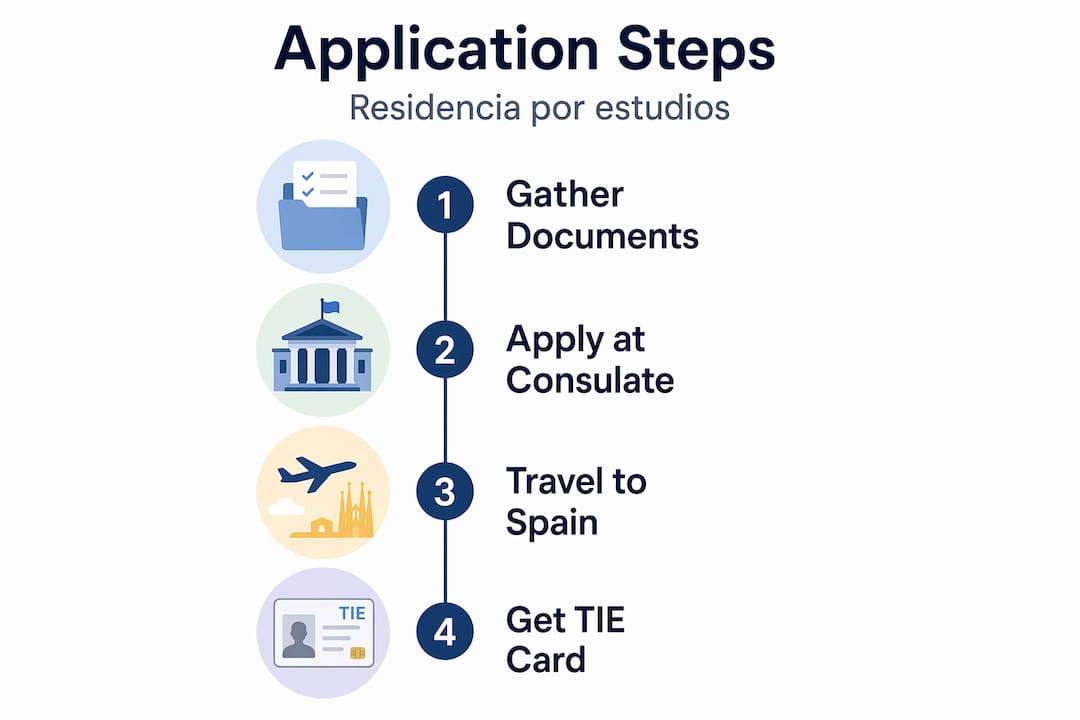
- The application process: step-by-step
- Benefits and limits: what residencia por estudios allows
- The real path: what most guides won’t tell you about residencia por estudios
- How Vive Legal can help you achieve residencia por estudios
- Frequently asked questions
Key Takeaways
| Point | Details |
|---|---|
| Not permanent residence | Residencia por estudios is a temporary stay permit for non-EU students, not full legal residency. |
| Clear eligibility checklist | Applicants must meet specific requirements like enrollment, funds, and health insurance. |
| Timely application vital | Applying at the right time and with complete documents is crucial for approval. |
| Limited, but valuable rights | This permit allows some work, family, and post-study job search but has clear restrictions. |
| Expert help reduces risk | Legal support can help prevent mistakes and make the process smoother. |
What is residencia por estudios?
The term “residencia por estudios” is used colloquially, but its legal name matters a great deal. It is not a full residency permit. It is a long-term stay authorization that sits between a short-term tourist visit and full legal residence. That difference shapes everything from your work rights to your path toward permanent residency.
Full residency in Spain, such as a “residencia temporal por trabajo” or an Arraigo, counts toward the five years you need for permanent residence. Time spent under “estancia por estudios” does not count toward that five-year clock. This is one of the most important facts that students overlook when planning their long-term future in Spain.
Who qualifies for this permit?
This authorization is designed for non-EU nationals. EU citizens and their family members have their own registration pathway. Under the estancia por estudios, the people who qualify include:
- Non-EU students enrolled in officially recognized full-time study programs
- Trainees and interns at authorized companies or institutions
- Volunteers participating in recognized programs such as the European Voluntary Service
- Language assistants and researchers in affiliated institutions
If you fall into one of these categories, you likely need this permit to stay legally in Spain beyond 90 days.
“The estancia por estudios is not a residency permit. It is a specific legal category that grants the right to stay in Spain for study-related purposes, with its own rights, obligations, and timeline.”
Comparing it to other permit types helps clarify things. Here is how it stacks up against the most common options:
| Permit type | Counts toward permanent residence | Work allowed | Duration |
|---|---|---|---|
| Estancia por estudios | No | Limited | 1 academic year, renewable |
| Residencia temporal (work) | Yes | Yes (full) | 1 year, renewable |
| Residencia no lucrativa | Yes | No | 1 year, renewable |
| TIE for EU family members | Yes | Yes | 5 years |
If you are exploring your full range of options, check out the student residency options available to international students in Spain, along with the required residency documents you will need regardless of which route you take.
Eligibility, requirements, and documentation
Understanding what the permit is brings you to the practical question: do you qualify, and what do you need to prove it?
General eligibility criteria
To be eligible, you must be a non-EU national planning to study, train, intern, or volunteer in Spain for more than 90 days. Your institution, company, or volunteer organization must be officially authorized or recognized by Spanish authorities. You also need to demonstrate that your stay is temporary in nature and that your primary purpose is study-related, not employment.
Documents you need to prepare
The documentation list may look long, but each item serves a specific purpose. Here is what is typically required:
- Valid passport with at least one year of validity remaining
- Official admission or acceptance letter from the authorized Spanish institution
- Proof of sufficient financial resources (bank statements, scholarship letters, or a financial sponsor declaration)
- Private health insurance valid in Spain for the full duration of your stay
- Proof of paid tuition or enrollment confirmation
- Recent passport-size photos meeting Spanish official specifications
- Completed application form (EX-01 for visa applications, or the relevant form at the Oficina de Extranjería if applying from within Spain)
- Criminal background check from your country of origin, apostilled and officially translated if not in Spanish
One document that often trips people up is the financial proof requirement. Spain expects you to show you can cover roughly 100% of the monthly IPREM (the Spanish public income index) for yourself, plus additional amounts for any dependents. As of 2026, the monthly IPREM is set at approximately 600 euros, so the actual required amount scales with your situation.
Pro Tip: Get your criminal background check as early as possible. In many countries, processing takes 3 to 8 weeks, and this document has a shelf life of just 3 months. Timing it wrong can delay your entire application.
Where and when to apply
Application is almost always done at a Spanish consulate in your home country before you travel. If you are already legally in Spain, for instance on a tourist visa that has not expired, you can apply at the Oficina de Extranjería within 60 days for certain study types. For stays longer than six months, you are also required to apply for your TIE (Tarjeta de Identidad de Extranjero, the physical identity card for foreigners) within one month of arriving in Spain.
To avoid rejection, pay close attention to expiration dates on every document you submit. A common oversight is submitting insurance that starts after your intended arrival date, or a background check that expires before your appointment. Take care to gather supporting documents systematically rather than last-minute. If you are just getting started, a first steps guide can help you prioritize.
The application process: step-by-step
Once your eligibility is confirmed and your documents are in order, the process itself is more straightforward. The key is knowing where you apply from and what happens after each stage.
Applying from your home country
- Contact the Spanish consulate in your country and schedule an appointment for a student visa application
- Submit all required documents in person at the consulate appointment
- Pay the visa fee (typically 60 to 80 euros, though it varies by country and reciprocity agreements)
- Wait for processing, which typically takes 1 to 3 months depending on the consulate
- Receive your visa, usually valid for the duration of your studies plus a short buffer period
- Travel to Spain before the visa’s start date
Applying from within Spain
- Confirm you are still in legal status (e.g., tourist visa has not expired)
- Book an appointment at your local Oficina de Extranjería using the online system
- Submit your completed EX-01 form and supporting documents in person
- Receive a resguardo (receipt) confirming your application is under review
- Wait for resolution, typically 1 to 3 months
- If approved, receive your authorization and proceed to request your TIE card
Here is a practical timeline overview to help you plan:
| Stage | Estimated timeframe |
|---|---|
| Document collection | 4 to 8 weeks |
| Consulate or Oficina appointment | 1 to 6 weeks wait |
| Application processing | 1 to 3 months |
| TIE card appointment (if needed) | 1 to 4 weeks after approval |
| TIE card issuance | 3 to 6 weeks after appointment |
For students staying over six months, the TIE card is mandatory. It is your physical proof of legal stay and will be requested regularly, including when opening a bank account, signing a rental contract, or enrolling at a health center. Learn the exact steps to obtain a TIE card, be aware of the TIE card 30-day application rule, and know how renewing your TIE card works when your first permit expires.

Pro Tip: Always bring both originals and photocopies to every appointment. Many offices will not make copies for you, and missing a photocopy can result in a rejected submission on the spot.
Benefits and limits: what residencia por estudios allows
This permit gives you a set of real, useful rights. But it also comes with hard limits that are important to understand before you commit to this path.
What you can do
Under the estancia por estudios, you are allowed to:
- Reside in Spain legally for the duration of your authorized stay
- Enroll in and attend your designated program or institution
- Work part-time in some cases, typically up to 30 hours per week, as long as it does not interfere with your studies and is explicitly authorized on your permit
- Participate in paid or unpaid internships if they are part of your academic curriculum
- Travel freely within the Schengen Area for short periods
- Bring certain family members under specific reunification rules
Post-study options: the job search period
One of the most valuable features for students planning to stay in Spain after graduation is the post-study job search period. Under EU Directive 2016/801, Spain aligns with a minimum of 9 months during which you can legally remain in Spain after completing your studies to look for work. This is a significant window, and it is a direct product of Spain’s integration of EU law into its immigration framework.
“EU Directive 2016/801 facilitates student mobility, family reunification, and post-study stays. Spain offers a minimum 9-month job search period for eligible graduates.”
Family reunification
In many cases, your immediate family members (spouse or registered partner, minor children) can join you in Spain. This right exists thanks to the incorporation of EU Directive 2016/801, which standardizes protections for students from non-EU countries studying across EU member states.
What you cannot do
There are real limits. Time under estancia por estudios does not count toward permanent residency. You cannot work full-time without a separate work authorization. You cannot change to a full work residency permit while staying on a student authorization in all cases, though strategic transitions are possible if planned correctly. For study-linked training, the internship and training residence route may be a better fit depending on your program.
The real path: what most guides won’t tell you about residencia por estudios
After working with hundreds of students and expats navigating Spain’s immigration system, we have seen the same patterns play out repeatedly. The people who struggle are not the ones who lack documents. They are the ones who misunderstand what the permit is actually for and what it can lead to.
Here is the uncomfortable truth: too many students treat the estancia por estudios as a bureaucratic checkbox rather than a strategic tool. They get the permit, show up for classes, and never think about what comes next until their permit expires. That reactive approach costs them real opportunities.
The students who succeed long-term approach this permit differently. They use the study period to establish roots: a Spanish bank account, a rental contract in their name, a work authorization if eligible, and a clear plan for the transition period after graduation. They track their student options checklist from day one rather than scrambling at renewal time.
Documentation habits matter more than most guides acknowledge. One missing apostille, one wrong translation format, or one document dated outside the accepted window can trigger a rejection. And a rejection is not just an inconvenience. It can leave you in legal limbo if your current stay authorization is about to expire.
The smarter move is to build redundancy into your file. Submit more evidence than the minimum. Include a statement from your institution. Add proof of your housing situation. Include your enrollment confirmation and your tuition payment receipt separately. Immigration officers are looking for coherence. The more your documents tell a consistent, clear story about why you are in Spain and what your plan is, the stronger your application becomes.
Another missed opportunity: many students do not realize that the 9-month post-study job search period is not automatic. You need to apply for it separately, and you need to do so before your student authorization expires. Missing that window forces you into a gap that is very difficult to bridge without leaving Spain and restarting from scratch.
The students who truly leverage residencia por estudios treat it as the first chapter of a longer immigration story in Spain, not a one-off event.
How Vive Legal can help you achieve residencia por estudios
Navigating student immigration in Spain is manageable when you have the right support from the start. At Vive Legal, we specialize in exactly this kind of process.
Our platform combines legal expertise with digital tools so you spend less time chasing paperwork and more time focused on your studies. We offer document review to catch errors before submission, form preparation tailored to your specific situation, and appointment scheduling that fits your timeline. Whether you are applying from abroad or already in Spain, our team can manage the process through your secure client portal with updates at every stage. Explore how our immigration services for study centers support both students and institutions. For full details on how we work, review our service terms, and access the essential immigration forms you will need for your application. Less guesswork, more confidence.
Frequently asked questions
Is residencia por estudios the same as a student visa?
No. A student visa is what you obtain at the consulate to enter Spain, while residencia por estudios refers to the authorized stay status you hold once inside Spain. They are two separate legal steps in the same process.
When must I apply for my TIE card as a student?
If your authorized stay exceeds six months, you must apply for the TIE card within one month of arriving in Spain. Missing this window can complicate your legal status even if your visa is valid.
Can I work in Spain with residencia por estudios?
Yes, in limited cases. The stay permit allows part-time work under certain conditions, but your permit must explicitly authorize it, and the work generally cannot interfere with your studies.
What happens after my studies end?
Spain provides a minimum 9-month post-study job search period under EU Directive 2016/801, but you must apply before your student authorization expires to access it.
Can my family join me with residencia por estudios?
Yes, in many situations. EU Directive 2016/801 facilitates family reunification for eligible students, meaning your immediate family may be able to join you if you meet the relevant income and housing requirements.
Recommended
Living legally in Spain shouldn't be difficult.
View services and pricesNot sure which procedure you need? Find out in 2 min
Questions? Message us on WhatsApp